
Bangkok water authority affirms tap water safety amid river pollution
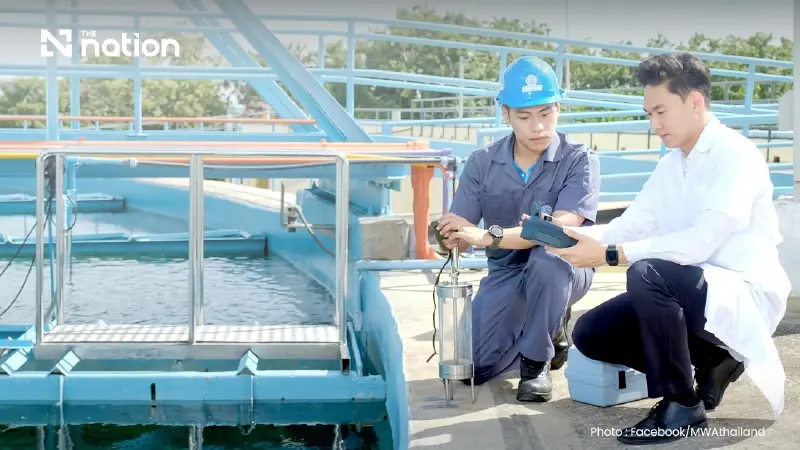


The utility cites separate river basins and 24-hour quality monitoring to reassure residents in Bangkok, Nonthaburi and Samut Prakan.
- The Metropolitan Waterworks Authority (MWA) has assured residents that tap water in Bangkok, Nonthaburi, and Samut Prakan is 100% safe from recent river pollution.
- The water supply is unaffected because its raw water sources, the Chao Phraya River and Mae Klong Dam, are in separate river basins with no connection to the contaminated rivers.
- The MWA is reinforcing safety by strengthening its round-the-clock, real-time water quality monitoring and conducting laboratory tests that meet international standards.
The Metropolitan Waterworks Authority (MWA) has assured residents of Bangkok, Nonthaburi and Samut Prakan that its tap water is 100% safe and unaffected by arsenic contamination in the Sai, Kok and Mekong rivers or pollution in the Bang Pakong River.
It attributes this to its raw water sources being in separate river basins, with no waterway connections to the affected rivers, and is strengthening round-the-clock, real-time water quality monitoring.
News reports and concerns shared online about arsenic contamination in the Sai, Kok and Mekong rivers in the North, alongside reports of water pollution in the Bang Pakong River in the East, have alarmed many people.
They have raised questions about the safety of raw water sources and the quality of tap water used for drinking and everyday household needs.
In its latest clarification, intended to give the public an accurate understanding of the situation and ease alarm, the MWA stressed that it was taking the environmental situation and water quality issues seriously.
It assured residents in its service areas of Bangkok, Nonthaburi and Samut Prakan that water delivered to their homes was not directly affected by these incidents.

MWA affirms no waterway links to affected rivers
The MWA attributes this protection to geography and the clear separation between river basins.
None of the raw water used in its treatment process comes from the Sai, Kok, Mekong or Bang Pakong rivers, meaning the reported contamination cannot affect its water production system.
There are also no natural waterways or irrigation systems connecting the affected areas to the MWA’s main raw water sources.
The authority maintains that contaminants and water pollution therefore cannot cross from those basins into the production system serving the capital and surrounding areas.
Two main raw water sources serve Bangkok and neighbouring provinces
To clarify how its water production system operates and why it remains safe, the MWA outlined the two main raw water sources serving Bangkok, Nonthaburi and Samut Prakan:
- Chao Phraya River (eastern supply): The MWA takes raw water from the Chao Phraya River through Sam Lae Raw Water Pumping Station in Pathum Thani. It then travels along the Eastern Waterwork Canal to Bang Khen Water Treatment Plant for treatment to the required standards. The plant mainly supplies eastern Bangkok and parts of Nonthaburi and Samut Prakan.
- Mae Klong Dam (western supply): The MWA identifies Mae Klong Dam in Kanchanaburi as being at the headwaters of the Mae Klong basin. It draws raw water from the dam and sends it through the Western Waterwork Canal to Maha Sawat Water Treatment Plant for treatment and distribution to the Thon Buri side of Bangkok, Nonthaburi and nearby areas.
The Chao Phraya and Mae Klong basins are geographically and hydrologically separate from the Sai, Kok and Mekong rivers within the Mekong basin in the North and Northeast.
They are also entirely separate from the Bang Pakong basin in the East.
The MWA therefore maintains that the reported arsenic contamination and other river pollution have no physical connection to its raw water sources.
Stricter controls and 24-hour real-time monitoring
Alongside the geographical separation of its raw water sources, the MWA continues to give water quality and safety the highest priority.
It uses modern technology to maintain strict monitoring and inspection at every stage.
Real-time online monitoring.
The MWA has installed automated water quality monitoring systems that operate continuously, 24 hours a day, to track key physical, chemical and biological parameters.
Checks at every key point.
Monitoring extends beyond water treatment plants to cover raw water intake points, treatment processes within the plants, distribution pipelines and distribution pumping stations throughout the service area.
Internationally accredited laboratory testing.
Water samples are collected and analysed in scientific laboratories accredited to international standards to screen for contaminants, heavy metals and hazardous chemicals.
The MWA states that these checks ensure all tap water supplied meets World Health Organization (WHO) guidelines.
MWA reiterates commitment to water supply security
With information spreading rapidly, the MWA stressed the importance of obtaining updates from official sources.
It urged the public to assess information carefully and avoid becoming alarmed by reports that could lead to misunderstandings.
The authority reiterated that all stages of tap water production operate under strict quality controls and monitoring measures to provide residents of Bangkok, Nonthaburi and Samut Prakan with a continuous supply of clean, safe, good-quality water for consumption and domestic use.
It will also keep environmental conditions and potential risks to raw water sources under constant scrutiny to maintain a stable and secure water supply.
Residents with questions about tap water quality or seeking further information can contact the MWA’s call centre on 1125, available 24 hours a day, or follow announcements on the authority’s official social media channels.
