
Bangkok Must Treat Water as a Urban Design Partner, Say Developer, Architect and BKK Governor
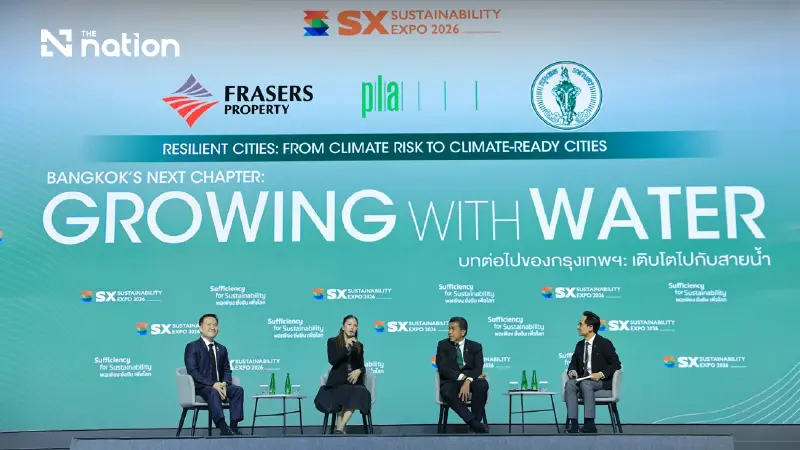


Governor Chadchart, One Bangkok’s Panote Sirivadhanabhakdi and landscape architect Wannaporn Phornprapha call for a shared ‘water charter’ at SX2026
- Bangkok's Governor, a prominent developer, and a landscape architect advocate for a new urban planning strategy that treats water as a design partner rather than an adversary to combat climate challenges.
- Governor Chadchart called for a "shared constitution for living with water," emphasising the need for public-private collaboration to create retention areas and permeable surfaces, as public infrastructure alone is insufficient.
- The One Bangkok mega-project is presented as a private-sector blueprint, integrating large-scale water retention basins, water recycling systems, and significant green space into its master plan.
- The speakers propose designing multi-functional public spaces, such as parks and plazas, to also serve as "living infrastructure" that can temporarily store water during heavy rainfall.
Governor Chadchart, One Bangkok’s Panote Sirivadhanabhakdi and landscape architect Wannaporn Phornprapha call for a shared ‘water charter’ at SX2026.
As Bangkok faces mounting climate challenges, city leaders, developers, and landscape architects gathered on Thursday (November 12) to chart a sustainable path forward by embracing, rather than resisting, the capital's historic relationship with water.
Speaking during a panel discussion titled "Bangkok’s Next Chapter: Growing with Water" at Sustainability Expo 2026 (SX2026)—ASEAN's largest sustainability exposition held from 6 to 15 November—Bangkok Governor Chadchart Sittipunt, Frasers Property Limited Group CEO Panote Sirivadhanabhakdi, and P Landscape founder and managing director Wannaporn Phornprapha examined how urban planning, mega-projects, and public spaces must evolve for future generations.
Moderated by Amarin Group CEO and National Geographic Thailand executive Jeremiah Pitakwong, the session highlighted that water should be treated as a living condition and design partner rather than an adversary.

A Shared Constitution for Urban Water Management
Governor Chadchart stressed that managing water in Bangkok requires a collective understanding of nature and urban form. Unlike regions with extensive natural topography, Bangkok relies heavily on its road and canal networks, with private land comprising roughly 90% of the city.
Highlighting the city's vulnerability during extreme weather events, Chadchart recalled a severe storm last month that dumped 350 millimetres of rain over three days—surpassing September's typical monthly average.
While about 20% of the city experienced temporary flooding, rapid recovery efforts restored normalcy within a week. However, Chadchart noted that master zoning regulations alone cannot solve complex water crises.

Effective management relies on a combination of strict public baselines, underground infrastructure—such as drainage tunnels running near major business districts—and active cooperation from private developers.
"We need a shared constitution for living with water," Chadchart said, noting that private sector collaboration is essential for creating retention areas and permeable surfaces that reduce runoff pressure on public drainage systems.

The Private Sector Blueprint: One Bangkok
As a prime example of large-scale private sector integration, Panote Sirivadhanabhakdi outlined how the 120-billion-baht One Bangkok district incorporates comprehensive water management into its foundational master plan.
Developed by Frasers Property Thailand, the 108-rai mixed-use project integrates climate risk assessment and flood-proofing directly into its design.
Panote explained that the project incorporates stormwater retention basins holding 2.3 times the volume required by Environmental Impact Assessment (EIA) standards.

Featuring five major underground water retention and distribution points across the district, the development controls discharge rates before releasing water into municipal systems.
Furthermore, centralised wastewater treatment systems recycle treated water for toilet flushing, landscape irrigation, and cooling tower operations.
In line with the project's "Make Way for Life" philosophy, One Bangkok dedicates over 50% of its total footprint to open public spaces and greenery.
By centralising heat-releasing cooling towers and setting back buildings 35 to 40 metres along Rama IV and Witthayu roads, the project has created expansive linear parks featuring 178 carefully selected plant species that bolster urban biodiversity and mitigate the urban heat island effect.

Landscape Architecture as Living Infrastructure
Wannaporn Phornprapha emphasised that landscape architecture must be viewed as vital, living infrastructure rather than mere aesthetic decoration.
Drawing inspiration from the sustainable water management theories of the late King Rama IX, Wannaporn explained that open spaces must be designed with multi-functional capabilities.
"Water has no boundaries and does not respect land titles or administrative zones," Wannaporn noted.

By designing lawns and public plazas to double as temporary water detention basins during heavy rainfall, urban spaces can effectively slow and store runoff.
Both Panote and Wannaporn credited Bangkok's current administration with fostering an environment where private developers are encouraged to open their boundaries, integrate green networks, and collaborate on improving urban quality of life.
Concluding the session, the speakers underscored that building a climate-ready Bangkok requires a unified front combining governmental frameworks, academic knowledge, private sector innovation, and active community participation.
