
Toxic river contamination threatens local economies beyond fisheries
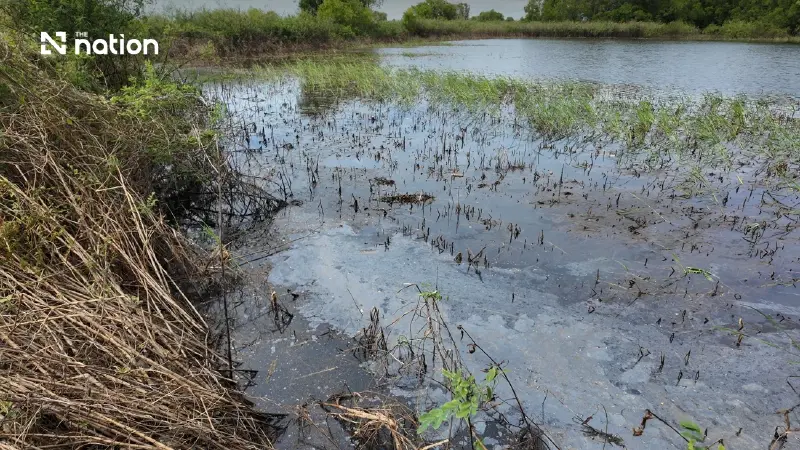


Kasikorn Research Center says river contamination threatens fishing, farming, tourism and water supplies in four provinces as a dry period could complicate recovery.
Toxic contamination in Thailand’s freshwater rivers is threatening the livelihoods of 44,731 fishing households across four provinces, with potential economic consequences extending to agriculture, tourism, public health and food security.
Kasikorn Research Center has called for urgent action to stop pollution at its source and restore affected ecosystems, cautioning that prolonged contamination could cause economic and social damage that would be increasingly difficult to quantify.
The research identifies Chiang Rai, Chiang Mai, Prachin Buri and Chachoengsao as the four main provinces affected by pollution in northern and eastern river basins.
It also highlights the possibility of contamination spreading to other waterways, including the Mekong and Bang Pakong rivers, potentially exposing additional communities and economic activities to risk.

Freshwater fisheries face losses worth hundreds of millions
According to Department of Fisheries data for 2025, compiled by Kasikorn Research Center, natural freshwater fisheries in the four provinces recorded catches totalling 4,256 tonnes, with a combined value of THB252.4 million.
The sector supports 44,731 households whose livelihoods could be affected by deteriorating water quality and restrictions on the use of natural waterways.
The research centre estimates that the potential direct economic impact on freshwater fisheries could run into hundreds of millions of baht annually.
Although this amount would be relatively small compared with Thailand’s overall economy, the consequences for individual communities could be substantial.
Many households depend on rivers and other natural water sources for their income, while opportunities to change occupations or relocate may be limited.
Prolonged exposure to contaminated water also raises concerns about illness and other health complications, creating social costs that cannot easily be expressed in monetary terms.
The centre noted that these potential health and livelihood consequences could become particularly serious if contamination persisted long enough to cause lasting damage.
Agriculture and tourism face wider economic risks
The effects of river pollution could extend well beyond freshwater fishing communities.
Farmers who rely on natural waterways for irrigation may face risks from harmful substances accumulating in soil and water, potentially affecting agricultural production.
Businesses throughout agricultural supply chains and the service sector, particularly tourism, could also experience disruption as concerns over water quality increase.
If contamination continues, risks could spread to water used for household consumption, including tap water and groundwater, as well as supplies for agriculture, manufacturing and other services.
Businesses and water suppliers could face higher operating costs as additional treatment and decontamination measures become necessary.
Concerns about the safety of food produced in affected areas could also weaken consumer confidence.
Over time, the consequences could extend to Thailand’s reputation as a tourism and business destination, potentially affecting commercial competitiveness.
Kasikorn Research Center cautioned that continued contamination could therefore undermine food security and economic activity over the medium to long term, in addition to creating public health risks.

Drier conditions could complicate river restoration
The research centre identified stopping contamination at its source as the immediate priority, alongside accelerating ecosystem restoration with support from relevant specialists.
It stressed that restoring waterways to safe conditions would be essential for communities and businesses to resume their normal activities.
However, efforts to address the problem could become more difficult if Thailand experiences increasingly hot and dry conditions towards the end of 2026 and into the first half of 2027.
Kasikorn Research Center linked this risk to its assessment of a potential Super El Niño event, which could reduce rainfall and river levels.
Lower water availability would limit opportunities to divert additional water into affected waterways to dilute pollutant concentrations.
As a result, removing contamination and restoring damaged ecosystems could require more resources and become increasingly challenging.
The centre emphasised that river pollution should not be viewed solely as a local environmental problem.
Its potential consequences for community incomes, public health, agriculture, tourism, food security and business competitiveness make it a broader economic concern.
Without decisive action to eliminate pollution sources and restore affected ecosystems, the damage could spread to more communities and become substantially harder to reverse.
