
IMF Warns Global Resilience 'Reaching its Limits' as Risks Tilt Downward


Fund says buffers are wearing thin as war, AI and debt risks mount, urging governments to rebuild fiscal space and supply-side resilience now
- The International Monetary Fund (IMF) warns that while the global economy has been resilient, its protective buffers are wearing thin and its ability to withstand shocks is reaching its limits.
- Key downward risks straining the economy include war, potential corrections in artificial intelligence (AI) valuations, and the pressure of high public debt combined with rising borrowing costs.
- The IMF identifies three specific areas where resilience is strained: energy market adjustments are nearly exhausted, growth is heavily dependent on a concentrated AI boom, and fiscal space is shrinking.
- As a result, the Fund is urging governments to rebuild their financial capacity and supply-side resilience, recommending fiscal restraint and debt consolidation to prepare for potential new shocks.
Fund says buffers are wearing thin as war, AI and debt risks mount, urging governments to rebuild fiscal space and supply-side resilience now.
The global economy has again proved more resilient than expected, but the International Monetary Fund (IMF) warned on Tuesday (October 13) that the buffers behind that resilience are wearing thin, with risks from war, artificial intelligence (AI) valuations and public debt all tilted to the downside.
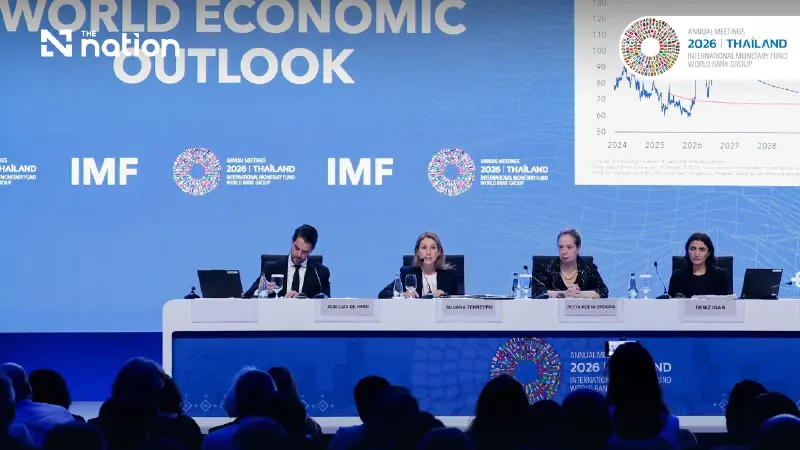
Launching the October 2026 World Economic Outlook, Resilience Under Strain, Urgent Choices, on the second day of the IMF-World Bank Annual Meetings, the Fund's new chief economist offered a stark summary.
"The global economy has been resilient, but that resilience is under strain with risks tilted to the downside," said Silvana Tenreyro, IMF Economic Counsellor and Director of the Research Department, in her first briefing in the role.

Asia powers ahead on AI
Asia-Pacific remains the world's fastest-growing region, and the AI boom is the main reason.
"This region has been incredibly resilient even though they are net importers of energy and other commodities," Tenreyro said. "The AI boom has more than offset the weaknesses coming from the commodity markets."
India is forecast to grow by 7 per cent this year and next. China is projected to expand by 4.5 per cent in 2026 and 4 per cent in 2027.
Economies tightly woven into the AI supply chain, including South Korea, Singapore, Vietnam and Malaysia, have seen significant upward revisions, and Thailand has benefited to a lesser extent.

For host nation Thailand, growth is projected at 2.1 per cent in both 2026 and 2027. Inflation is also forecast at 2.1 per cent this year, ending last year's deflation, before easing to 1.7 per cent in 2027.
Tenreyro said the economy had coped well despite being an energy importer. Not every Asian economy has shared in the technology windfall, she noted.
A split global economy
Global growth is projected at 3.1 per cent in 2026, 0.4 percentage points below last year, before rising to 3.4 per cent in 2027. The 2026 figure is unchanged from April, while the 2027 forecast has been revised moderately upward.
Tenreyro described two forces pulling in opposite directions. The war in the Middle East has pushed up energy and commodity prices, acting like a global supply shock that raises prices and hampers activity.
The AI-driven tech boom is a demand shock that lifts both activity and prices, particularly trade and investment.
"While these demand and supply forces pull activity in opposite directions, both forces put upward pressures on inflation," she said.
Headline inflation is forecast to rise to 4.7 per cent this year before easing to 4.1 per cent in 2027. Core inflation is projected at 3.9 per cent and 3.7 per cent respectively.
The Fund attributes the rise mainly to energy and food prices. AI's weight in the world economy is substantial. Global trade grew 8.3 per cent cumulatively between 2023 and 2025, but trade in AI-related goods rose 29 per cent.
Without it, overall trade growth would have been only 4.6 per cent. The benefits are uneven.

Energy exporters outside the conflict zone and countries integrated into the AI cycle are faring better. Energy importers with limited AI links, many of them low-income and fragile states, face the toughest outlook, raising the risk of wider income gaps.
Tenreyro identified three limits to resilience. First, adjustments in energy markets, including rerouted supplies, higher output elsewhere, inventory drawdowns, renewables and efficiency gains, have contained the shock.
Without them, she said, global growth this year could have been 2.5 per cent rather than 3.1 per cent.
"But some of these margins, in particular inventories and energy efficiency gains, are reaching their limits," she warned, adding that El Niño-related extreme weather could further disrupt commodity markets.

Second, growth is leaning heavily on AI, whose supply chains are concentrated in a few countries, sectors and firms. A market correction or AI-related cyber threats could weigh on growth and financial stability.
Third, the limit is fiscal. "The interaction of high public debt and higher financing costs in turn has heightened fiscal concerns and risks," she said. Borrowing costs have risen in several advanced economies, which could crowd out critical spending and erode buffers.
Tenreyro pointed to three drivers of rising bond yields: stronger demand from the AI investment boom and higher government spending, energy and commodity prices, and a premium investors now demand for holding debt in a supply-shock environment.
In a risk scenario where commodity prices and fiscal worries push up that premium and inflation expectations, growth in advanced and emerging economies would be 50 to 60 basis points lower by 2027.
A separate scenario in which commodity prices stay high for roughly six more months, 17 per cent and 40 per cent higher in 2026 and 2027, would also lower growth and raise inflation in both country groups. The prescription was blunt.
"Fiscal policy must be restrained to contain demand pressures at a time of highly inflationary risks," Tenreyro said. "Countries with high debts and deficits need to initiate a fiscal consolidation."
Any support should be temporary and targeted at the most vulnerable while preserving price signals. Central banks should keep a "sufficiently restrictive" stance to prevent second-round effects, she added, stressing that central bank independence is vital.
The right setting varies by country, and a more cautious approach suits energy importers outside the technology chain with subdued inflation.

Middle East and Africa
Petya Koeva Brooks, deputy director of the Research Department, said the picture in the Middle East is "quite heterogeneous". The Fund revised its forecasts at the last minute to reflect higher oil prices.
Gulf oil exporters face a sharp contraction in output and exports this year, followed by a strong rebound in 2027, while some non-oil sectors are also slowing.
Oil importers received a small upgrade, helped by robust domestic demand, remittances and tourism. Egypt's forecast was raised for both years, driven by a recovery in Suez Canal activity and petroleum-related output, though growth is expected to moderate.
"Risks are very much on the downside, as in the rest of the region," Brooks said.
On Africa, Deniz Igan, assistant director of the Research Department, said governments must balance near-term food and energy security with medium-term stability.
Citing Nigeria, where growth has held up but living costs are punishing, she urged temporary cash transfers for the most vulnerable, alongside better spending quality and revenue collection.

Europe: UK urged to hold course
Asked whether Britain needs decisive action in the new chancellor's first budget, Tenreyro noted that the UK has already begun fiscal consolidation and that it and India stand out in the Fund's fiscal tables.
"The message for the UK is just simply stay the course and continue on that trajectory," she said.
The Americas
Latin America is forecast to grow 2.3 per cent in 2026 and 2.5 per cent in 2027, both small downgrades, with inflation at 4.2 per cent and 4.1 per cent. AI has not been a strong driver there, so commodity exporters are doing better than importers.
Argentina's growth is projected to slow from 4.5 per cent last year to 2.1 per cent this year, a 1.4-point downgrade reflecting weaker activity and softer domestic demand under tight financial conditions.
The Fund expects growth to recover to 3.5 per cent in 2027, supported by stronger terms of trade, easing financial conditions and rising investment.

'Homework for everyone'
On the upside, longer-lasting AI investment with real productivity gains, or a lasting easing of geopolitical and trade tensions, could lift growth.
Asked for her key message, however, Tenreyro returned to caution.
"The global economy has been resilient, but that resilience is reaching its limits. So we need to move from just coping to rebuilding. We need to restore fiscal space. We need to rebuild supply-side resilience," she said. "That's the homework for everyone, to make sure that we're resilient and we replenish that resilience in the face of potentially new shocks."
