
BOT to present Bangkok Blueprint on fraud at 2026 IMF–World Bank meetings
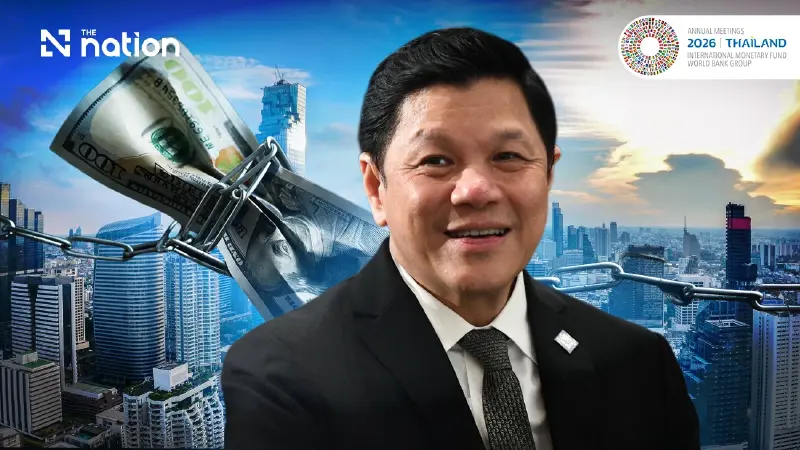


Thailand’s Bangkok Blueprint would guide countries on laws, financial product design, fraud detection and the recovery of money lost to scams.
- The Bank of Thailand (BOT) will present the "Bangkok Blueprint" at the 2026 IMF–World Bank meetings, a framework developed with both organizations to help countries combat fraud, scams, and cyber risks.
- The Blueprint will outline principles for a comprehensive response, covering prevention measures, legislation, inter-agency cooperation, and processes for tracing and recovering lost funds.
- It is designed as an adaptable, long-term reference for countries to use in addressing financial threats, which the BOT describes as a growing global structural problem.
The Bank of Thailand (BOT) plans to present the Bangkok Blueprint at the 2026 Annual Meetings of the International Monetary Fund (IMF) and World Bank Group in Thailand, setting out principles to help countries tackle fraud, scams and cyber risks. Developed jointly with the IMF and World Bank, the framework would cover measures from prevention to the recovery of lost funds, BOT Governor Vitai Ratanakorn said.
Vitai described the Bangkok Blueprint as a key research-based contribution to the meetings, bringing together work by the three institutions. Research into fraud, scams and cyber risks remained limited even as countries increasingly prioritised these problems, he said.
Bangkok Blueprint covers prevention and fund recovery
The Bangkok Blueprint would set out principles for legislation, cooperation between agencies and financial product design, alongside processes for detecting irregularities, responding to incidents and tracing and recovering affected funds, according to Vitai.
“It would help countries that may only just be encountering these problems by giving them principles on how to address them,” Vitai said of the Bangkok Blueprint’s approach to fraud, scams and cyber risks.
Countries would be able to adapt the Bangkok Blueprint to their own circumstances and specific challenges, Vitai explained. Thailand also faced fraud and scam problems, making the collaboration an effort to address domestic difficulties as well as help other countries respond.
Countries look to Bangkok Blueprint as a practical reference
Countries are watching how they could use the Bangkok Blueprint as a reference for their own responses to financial threats, Vitai said, citing discussions with central bank governors and finance ministry leaders.
Fraud, scams and cyber risks were major concerns in Asia and were spreading more widely, according to Vitai. He described the threats as global structural problems, affecting the United States, Latin America and Asia, rather than challenges confined to one region.
The Bangkok Blueprint is intended to remain a reference beyond the annual meetings, Vitai said. Helping develop principles alongside international organisations offered Thailand an opportunity to raise its profile on an issue of global concern.
“In future, when people discuss this issue, which is now a major global problem, they will refer to the Bangkok Blueprint announced at these meetings,” Vitai said of the framework’s intended longer-term role.
Thailand is hosting the IMF–World Bank Annual Meetings for the second time, offering an opportunity to demonstrate the country’s capabilities and build international confidence, according to Vitai.
BOT addresses four structural problems at home
The BOT has expanded its role beyond monetary policy to help address four structural issues: household debt, access to credit for small and medium-sized enterprises (SMEs), access to financial services at fair costs, and illicit money, Vitai said.
Vitai described the BOT’s four priorities as interconnected, particularly through the circulation of proceeds from scams, fraud and corruption. “Illicit money comes not only from scams and fraud but also from corruption. Ultimately, it circulates within Thailand’s financial system,” he said.
Thailand’s role in developing the Bangkok Blueprint should not be taken as evidence that the country had already dealt comprehensively with fraud, scams and cyber risks, Vitai cautioned.
Although Thailand had made greater progress than some countries in certain areas, Vitai said the country still needed to apply the Bangkok Blueprint’s principles and improve its work in several areas.
