
BOT sees exports and AI supporting 2.3% Thai growth in 2026
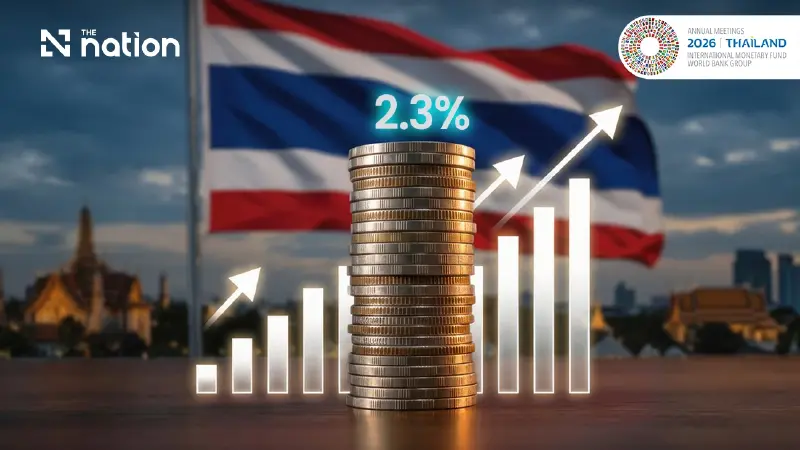


Thailand’s central bank forecasts export growth of 17–18% in 2026, while warning structural weaknesses have cut potential growth to about 2.7%.
- The Bank of Thailand (BOT) forecasts that Thailand's economy will grow by approximately 2.3% in 2026.
- A significant driver for this growth is the expected expansion of exports by 17-18%.
- Investment linked to artificial intelligence (AI) is also cited as a key factor sustaining economic momentum and supporting the growth outlook.
- Despite the forecast, the BOT governor warned that longstanding structural problems have lowered Thailand's potential growth rate to about 2.7%.
The Bank of Thailand (BOT) expects Thailand’s economy to grow by around 2.3% in 2026, supported by strong exports and investment linked to artificial intelligence (AI). Governor Vitai Ratanakorn warned, however, that longstanding structural weaknesses had reduced the country’s potential growth rate to about 2.7%.
Vitai’s assessment followed the International Monetary Fund (IMF) raising its 2026 growth forecast for Thailand to 2.1% from 1.9%. He said the BOT’s outlook was consistent with most analysts’ projections of between 2% and 2.3%.
Exports expected to grow by 17–18%
Thai exports are expected to expand by 17–18%, making them a major driver of the BOT’s growth outlook for 2026, according to Vitai.
Vitai also identified private investment and foreign direct investment (FDI) as key drivers, citing expected growth of up to 13%, a high rate compared with previous years. He said the wave of AI-related activity was helping to sustain investment momentum.
Inflation is expected to be around 2.2%, according to Vitai, who described Thailand’s economy as relatively stable and highly resilient. He said growth momentum had continued despite various challenges, including the recent flooding.
Thailand’s potential growth rate falls to 2.7%
Thailand’s potential growth rate has fallen to about 2.7%, according to Vitai. The measure describes the pace achievable when the country fully uses its available resources and technology.

Vitai warned that structural problems had progressively weakened Thailand’s economic performance, with actual growth slowing from 3–5% in the past to just over 2% today.
Decades of low investment, declining productivity and competitiveness in traditional industries, a shrinking workforce as the population ages, and weaknesses in the education system were among the constraints identified by Vitai.
High household debt and the burden of public debt also weighed on Thailand’s economy, Vitai said. He cited a household debt ratio of 86–87%, describing the level as among the highest in the world.
BOT expands role beyond monetary policy
The BOT has expanded its role beyond monetary policy to help address Thailand’s structural weaknesses, support the economy, improve living standards and strengthen small and medium-sized enterprises (SMEs), according to Vitai.
Thailand’s structural problems cannot be resolved through a single project, Vitai said, calling for all relevant agencies to accelerate coordinated efforts to address them.
