
Ekniti courts Japan’s chip firms for design and skilled jobs


Thailand offers incentives for Japanese chip partnerships that would build local design expertise, advanced manufacturing and skilled jobs.
- Thailand's Finance Minister, Ekniti Nitithanprapas, led a delegation to Tokyo to propose a strategic partnership with leading Japanese semiconductor companies, including Rapidus and Sony.
- The primary goal is to shift Thailand's role from a manufacturing base to a center for higher-value activities like joint chip design, development, and innovation.
- A key objective of attracting these firms is to create highly skilled jobs, supported by workforce development initiatives aiming to train at least 86,000 semiconductor workers by 2030.
- To secure these partnerships, Thailand is offering investment incentives such as project-specific grants, tax breaks, and fast-tracked government approvals.
Thailand is pitching semiconductor partnerships with Japanese companies to build domestic expertise in chip design and advanced manufacturing and create highly skilled jobs, offering investment incentives and workforce support to expand its role in the industry.
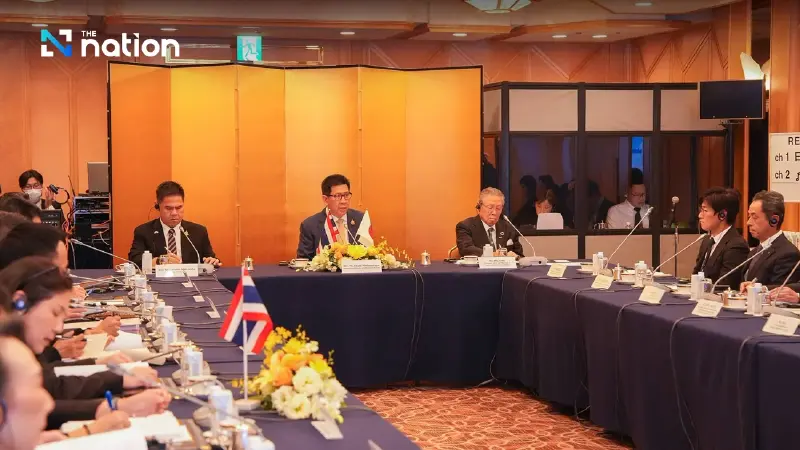
Deputy Prime Minister and Finance Minister Ekniti Nitithanprapas led the discussions in Tokyo at the Thailand–Japan Semiconductor Strategic Partnership Roundtable, according to Narit Therdsteerasukdi, secretary-general of the Thailand Board of Investment (BOI).
Speaking on November 18, 2026, Narit said the meeting brought Thai government and business representatives together with Japanese industry leaders to turn the national semiconductor strategy into practical cooperation and investment. It was the strategy’s first presentation overseas.

“The task today is not simply to invite Japanese semiconductor companies to set up factories in Thailand,” Ekniti said.
“It is the beginning of a strategic partnership that will turn world-class technology into opportunities for Thai people by moving Thailand from a manufacturing base into joint design, development and innovation.”
Incentives and training support higher-value production
The BOI is prepared to offer project-specific grants and tax incentives, alongside coordination with government agencies through Thailand FastPass to speed up approvals for advanced technology investments.
Workforce development would support those projects. The Siam Silica programme aims to develop a minimum of 86,000 semiconductor workers by 2030, while Skill Bridge allows industry to identify required skills and help design courses around investors’ needs.
The Long-Term Resident (LTR) Visa scheme would facilitate the arrival of foreign engineers and specialists.
“Thailand does not want investment capital alone. We want to work with Japan to build chip capabilities in design, advanced manufacturing and the development of Thai engineers,” Narit said.
“The BOI is ready to provide project-specific support packages, facilitate access to suppliers and skilled personnel, and coordinate with all relevant agencies so that promising projects can begin operations in Thailand quickly.”
Japanese chip leaders join Tokyo discussions
The Thai delegation met Tetsuro Higashi, chairman of the Leading-Edge Semiconductor Technology Center (LSTC) and Rapidus, Japan’s flagship advanced-chip company. Higashi previously served as chairman and chief executive of Tokyo Electron, one of the world’s largest chipmaking equipment suppliers.

Rapidus was established through cooperation between Toyota, Sony, NTT, SoftBank, Kioxia, NEC, Denso and MUFG Bank, with government support under Japan’s national strategy to strengthen its leadership in advanced chips.
It aims to produce 2-nanometre chips offering faster processing and lower power consumption for applications including artificial intelligence (AI), data centres, autonomous vehicles and intelligent robots.
Narit said executives from 11 leading Japanese semiconductor-related companies also participated. The companies included Sony Semiconductor Solutions, a global image-sensor leader, Canon Machinery and Nagase, an international materials and technology group. The president of the Japan External Trade Organization (JETRO) in Bangkok also attended.

Ekniti presented Thailand as a “Trusted Connector” and a secure investment base that could become a second home for Japanese semiconductor investors, drawing on the two countries’ cooperation in building Thailand’s automotive industry.
Japanese applications exceed THB59 billion
Japanese investors submitted 108 applications for investment promotion worth more than THB59 billion between 2023 and September 2026 across semiconductors, printed circuit boards (PCBs), circuit design and related electronics, according to the BOI.
These included 11 semiconductor-device and integrated-circuit manufacturing or testing projects worth more than THB10 billion. Another 11 PCB and component projects exceeded THB18 billion, covering materials, board production and assembly.
Japanese companies already operate across several parts of Thailand’s semiconductor supply chain. Sony and Toshiba Electronic Devices & Storage undertake chip assembly and testing, while Nisshinbo works in electronic circuit design and Yamaha Robotics produces equipment including wire bonders.
The existing investor base also includes ROHM, the world’s first commercial producer of silicon carbide power transistors known as SiC MOSFETs. These operations provide a foundation for cooperation in chip design, advanced assembly and testing, power semiconductors and other higher-value activities.
The BOI described Thailand as ASEAN’s largest PCB manufacturing base and the world’s fifth-largest, supported by established automotive and electronics industries and supplier networks.
Access to ASEAN markets could help Japanese companies expand capacity and diversify supply-chain risks, while technology transfer would enable Thai businesses and workers to move into higher-value activities.
Japan’s strengths extend from semiconductor materials and equipment to image sensors, power chips and advanced assembly and testing. The BOI cited Japanese companies’ global market shares of approximately 31% in chipmaking equipment and 48% in essential semiconductor materials.
It also cited a World Semiconductor Trade Statistics (WSTS) estimate valuing Japan’s semiconductor market at more than US$44.8 billion in 2025, alongside semiconductor and electronic-component exports exceeding US$43.9 billion and chipmaking equipment exports above US$30.4 billion.
National strategy sets investment targets through 2050
Thailand’s National Semiconductor and Advanced Electronics Strategy aims to attract a minimum of THB500 billion in investment by 2030 and more than THB2.5 trillion by 2050. These are national strategy targets, not a Japanese investment package.
The strategy also targets THB5 trillion in annual industry revenue and more than 230,000 highly skilled jobs.

The initial priorities are to upgrade chip assembly and testing towards advanced packaging, strengthen integrated-circuit (IC) design and establish the foundations for wafer manufacturing. The longer-term goal is a comprehensive semiconductor supply chain producing “Made in Thailand Chips”.
“By combining Japan’s technological strengths with Thailand’s industrial base and workforce, Thailand will not only be part of the global semiconductor supply chain but will also help shape the industry’s future,” Ekniti said.
“This is the first step in our ‘Second Take-Off’ and the path towards ‘Made in Thailand Chips’, creating highly skilled jobs, expanding opportunities for Thai businesses and laying the foundations for the country’s long-term growth.”
