
Thailand urged to curb Myanmar mineral trade over river pollution


Dr Suebsakun Kitnukorn urges tighter checks on Myanmar mineral trade as Thailand addresses arsenic and heavy-metal pollution in the Sai, Kok and Mekong rivers.
- An academic has urged Thailand to tighten controls on its mineral trade with Myanmar to tackle arsenic and heavy-metal pollution in the Sai, Kok, and Mekong rivers.
- The pollution stems from mines in Myanmar's Shan State, which are operated by various armed groups and businesses beyond the full control of Myanmar's central authorities, making diplomacy alone ineffective.
- Proposed measures include reviewing mineral imports to identify their origins, ending Thailand's role as a transit route for minerals to China, and controlling exports of mining machinery and chemicals.
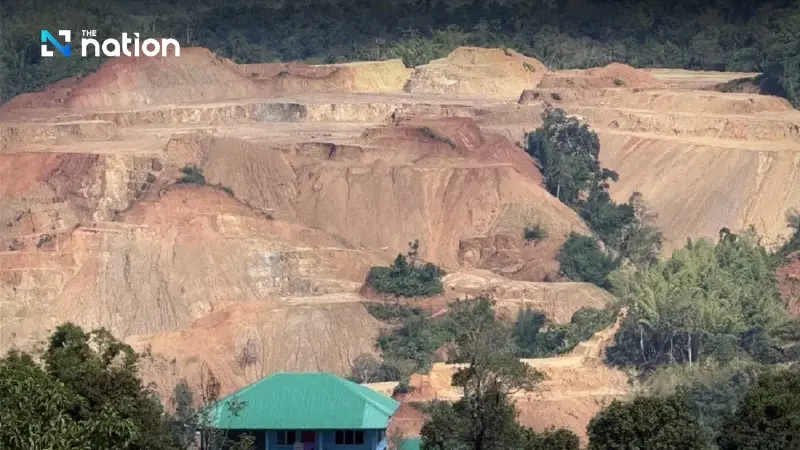
Thailand should tighten scrutiny of Myanmar mineral shipments and mining supplies as it seeks to tackle arsenic and heavy-metal contamination in the Sai, Kok and Mekong rivers, according to an academic who has identified three groups involved in mining near the waterways’ headwaters.
Dr Suebsakun Kitnukorn, a lecturer at Mae Fah Luang University’s School of Social Innovation, told Post Today that water testing and government-to-government talks alone would not address the problem. The mines are in Myanmar’s Shan State, where control is divided among armed groups, businesses and military authorities.
Three groups involved in mining
Suebsakun identified three main groups that Thailand would need to engage to tackle possible pollution at its source:
- Wa forces: Involved in overseeing rare-earth mines near the upper Kok River and some gold mining near the upper Sai River, according to Suebsakun.
- Shan forces: Linked to mining operations around Doi Ko Wan, across the border from Mae Fah Luang district in Chiang Rai province.
- Companies licensed by Myanmar’s authorities: About 20 mining businesses, comprising 12 gold-mining companies, six manganese-mining companies and two lead-mining companies. The tally excludes tin and antimony mining.

Receiving a licence does not establish that a mine has adequate waste management, chemical controls or safeguards against contamination, Suebsakun noted.
Myanmar’s military authorities, led by Senior General Min Aung Hlaing, do not exercise full control over the country. Ethnic armed organisations govern or influence some border areas, with their own military and commercial interests.
As a result, those granting mining permits, controlling territory and profiting from extraction may be different parties. Suebsakun argued that negotiating only with Myanmar’s central authorities would leave important actors outside the process.

Rare earths and mineral trade
Demand for rare earths, which are used in permanent magnets, electric vehicle motors, electronics and clean-energy technology, has added an international dimension to the pollution problem.
China plays a major role in mining, separating, processing and smelting these materials. Suebsakun raised concerns about some Chinese investment in Myanmar’s mining industry, including alleged links to informal business networks sometimes described as “grey” Chinese capital.
Poorly controlled extraction and processing can produce chemical waste and heavy-metal contamination, potentially shifting environmental risks to communities across the border.
He also cautioned that China’s economic influence in Myanmar does not mean Beijing can direct every armed group or business operating along the border. Western sanctions on Myanmar’s military authorities further complicate commercial and political relationships.
Thailand is part of the trade routes for minerals from the area, including tin, antimony, lead and manganese. Shipments pass through Mae Sai and Chiang Saen in Chiang Rai province. Some travel onwards to Laem Chabang Port, while others leave via Chiang Saen Port on the Mekong for China.
Suebsakun questioned whether existing checks could reliably identify the mines supplying these shipments and establish whether they were associated with pollution.

Four trade measures proposed
He urged Thailand to combine diplomacy with economic measures targeting supply chains linked to potentially polluting mines:
- Review mineral imports from Myanmar. Establish their origins and environmental risks, and consider suspending imports connected to polluting operations.
- End Thailand’s role as a transit route for mineral exports to China. Scrutinise shipments through Thai border crossings and ports, particularly Mae Sai and Chiang Saen.
- Control exports of mining machinery. Check whether equipment sent across the border could support environmentally risky mining operations.
- Control exports of mining chemicals. Verify the substances, end buyers and intended uses to prevent their use in processes that cause pollution.
These proposals would not require Thailand to end all trade with Myanmar, Suebsakun argued. Instead, stronger screening and traceability could help prevent Thai trade routes and suppliers from sustaining mining operations that may be contributing to the contamination.

Negotiations and water testing
Suebsakun proposed talks with all three groups, alongside engagement with the Myanmar and Chinese governments. He regarded efforts to arrange joint water-quality inspections with Myanmar as an important first step, particularly along the more accessible Sai River.
He also called for talks aimed at securing Chinese cooperation in overseeing investors and business networks involved in mining along Myanmar’s border.
Joint testing could establish evidence accepted by both sides, but results would also need to be traced back to the mines to determine responsibility and prevent further pollution.
“Thailand does not need to begin with severe measures, but it must be clear that, if negotiations fail, measures will be escalated,” he stated.
Without measures that change the behaviour of polluters, he argued, repeated tests, meetings and coordination would not resolve the problem.

Food safety and support for communities
The consequences extend beyond water quality to public health, agriculture, local livelihoods and food security, Suebsakun noted. He called for more comprehensive testing of water, soil and crops in affected areas, with results available before produce leaves farms.
If contamination is identified only after crops have reached markets, the resulting damage could affect farmers and consumers alike and undermine confidence in Thai agricultural products.
Thailand should therefore protect downstream communities while negotiations continue, rather than wait for agreement over mine operations in Myanmar.
The proposed response combines action at the source, controls over mineral trade, timely environmental and agricultural testing, and clear compensation measures for affected farmers and residents.
Source: Post Today
