
Five US trade proposals test Thailand’s negotiating red lines
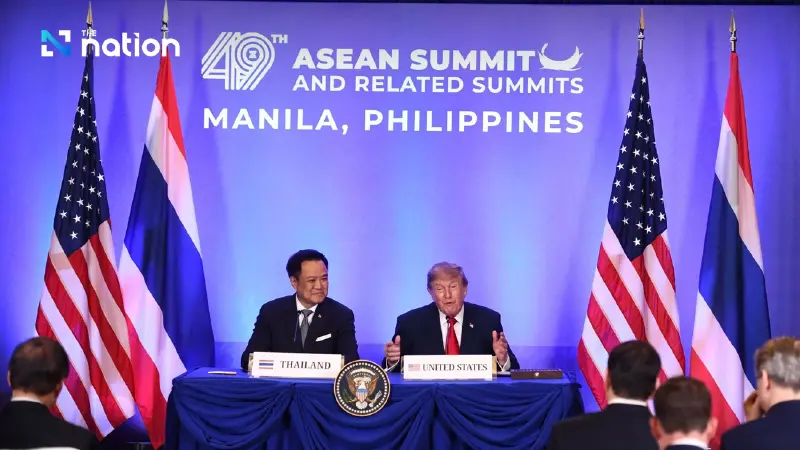


The commerce minister expects US reciprocal tariffs of no more than 19%, while an independent analyst questions the cost to Thai farmers and businesses.
Thai Prime Minister Anutin Charnvirakul and US President Donald Trump signed a non-binding joint statement in Manila on Tuesday (November 17, 2026), confirming that their countries had agreed in principle on a reciprocal trade deal.
Commerce Minister Suphajee Suthumpun called the signing a “positive signal” for Thailand’s largest export market, worth THB2.37 trillion and linked to employment for more than 1.25 million people.
She said Thailand qualified for the same tariff treatment as Malaysia, Indonesia and Cambodia.
She expected US reciprocal tariffs on Thai goods to be capped at 19% and said work could begin immediately to reduce the US Section 301 tariff over forced labour from 12.5% to 10%.
Suphajee said Thailand would open its market to US goods only where it already granted other countries access or domestic production fell short.
The government aims to finalise the legal text and submit the agreement to Parliament for approval within two months.
The US wants Thailand to reduce non-tariff barriers to American food and agricultural products, with meat and poultry a particularly sensitive area.
Proposed labour law amendments would strengthen workers’ rights to organise and bargain collectively.
The talks also cover child labour and controls on imports made with forced labour.
On intellectual property, both sides would make further commitments on geographical indications, which add value to Thai farm and community products.
The US digital trade proposals call for data to flow freely across borders under trusted arrangements.
Washington also wants Thailand to forgo digital services taxes, avoid discrimination against US digital products and refrain from imposing screening quotas on foreign films.
In telecommunications, it wants Thailand to ease foreign ownership limits and open its market to Starlink, the satellite internet service operated by Elon Musk’s SpaceX.
Suphajee previously identified public health, security and foreign investment as Thailand’s three red lines.
She cited pork imports containing substances that promote lean muscle growth and US interest in full ownership of businesses in sectors such as telecommunications.
Thailand is also concerned about the security of its digital infrastructure.
Independent academic and analyst Kritsada Boonruang questioned on November 18 whether the government had underestimated the costs to Thai farmers and businesses.
The joint statement gave few details, while the US account of the 2025 negotiating framework envisaged Thailand removing duties on 99% of US goods.
The analysis acknowledged that Thailand risked falling behind regional rivals if it did not sign.
It argued, however, that presenting market opening as a way to give consumers more choice was intended to soften the public reaction and played down the fierce competition Thai producers would face.
The analysis also questioned whether businesses could plan long-term costs with confidence while a US investigation into structural excess capacity remained under way and Washington could still raise tariffs.
It pointed to the risk of a trade policy clash between Trump and the incoming Congress after Democrats regained both chambers in the November 3 midterm elections.
The new Congress takes office in January 2027, around the time the agreement is expected to reach the signing stage.
