
Myanmar reconsiders ASEAN ties but keeps talks with members open
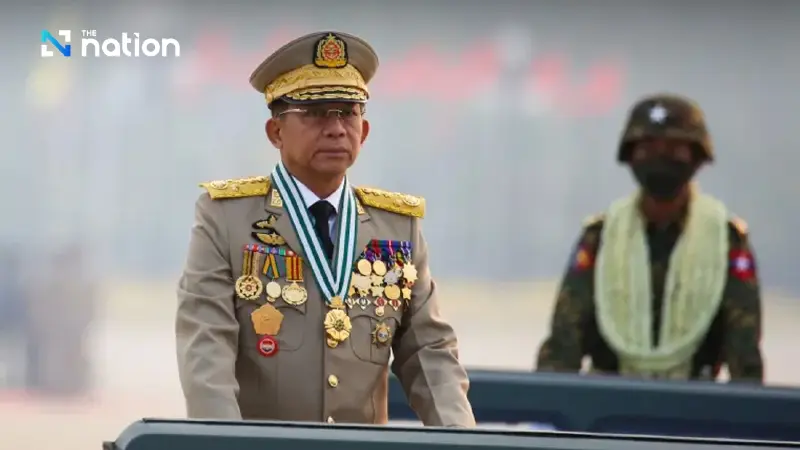


Min Aung Hlaing is reviewing Myanmar’s ASEAN ties as the bloc links full political representation to progress on its five-point peace plan.
- Myanmar's military-backed government is reassessing its relationship with the ASEAN bloc, with its leader accusing the group of unfair treatment.
- The reassessment was prompted by ASEAN's decision to maintain restrictions on Myanmar's political representation at summits and foreign ministers' meetings.
- Despite criticizing the regional bloc, Myanmar's leader signaled that bilateral discussions and engagement with individual member states will continue.
Myanmar’s military-backed government is reassessing its relationship with the Association of Southeast Asian Nations (ASEAN), while keeping open discussions with individual member states.
President Min Aung Hlaing outlined the review in parliament on November 18, 2026, accusing the regional grouping of treating Myanmar unfairly.
His remarks followed ASEAN’s decision to retain restrictions on Myanmar’s political representation, while leaving open the possibility of a gradual change if its peace initiative produces results.
Myanmar challenges regional pressure
Min Aung Hlaing argued that Myanmar had been singled out for pressure despite political crises and disputed elections elsewhere in Southeast Asia.
“They are imposing such pressure only on our country,” he said.
He indicated that further discussions would take account of Myanmar’s position and the views of other ASEAN governments, signalling that bilateral contacts would continue despite his criticism of the bloc.
After leading the 2021 coup, he became president in April following a widely criticised election dominated by an army-backed party. He has visited Thailand, Malaysia and Vietnam, while almost half of ASEAN’s members have increased bilateral engagement.
Political representation remains conditional
In their November 15 decision in Manila, ASEAN leaders retained the arrangement allowing Myanmar only non-political representation at summits and foreign ministers’ meetings until meaningful progress is made on the five-point consensus.
They agreed to approach engagement in stages, based on developments on the ground. They could consider gradually restoring full political representation, but only if Myanmar delivers sustained, concrete progress on the plan.
The restrictions do not cover every ASEAN forum: participation in other sectoral ministerial bodies and mechanisms should remain unrestricted.
Myanmar remains a member of the 11-country grouping.
Adopted after the 2021 military coup, the five-point consensus calls for an end to violence, dialogue involving all parties, mediation by an ASEAN envoy, humanitarian assistance and an envoy visit to meet those involved.
February peace conference proposed
Min Aung Hlaing also outlined plans for a peace conference in February, with the goal of ending the fighting within his government’s five-year term.

He offered few details of his first presidential peace conference. Previous negotiations have achieved limited results.
Myanmar’s conflict followed the military’s overthrow of the elected government in 2021, with opposition to the takeover developing into widespread armed resistance.
Reuters reported more than 100,000 deaths, millions displaced and continuing civilian deaths from military airstrikes.
The foreign ministry of the Philippines, ASEAN’s current chair, had not immediately responded to Reuters.
