
Nong Khai refers 17 residents for checks over arsenic levels
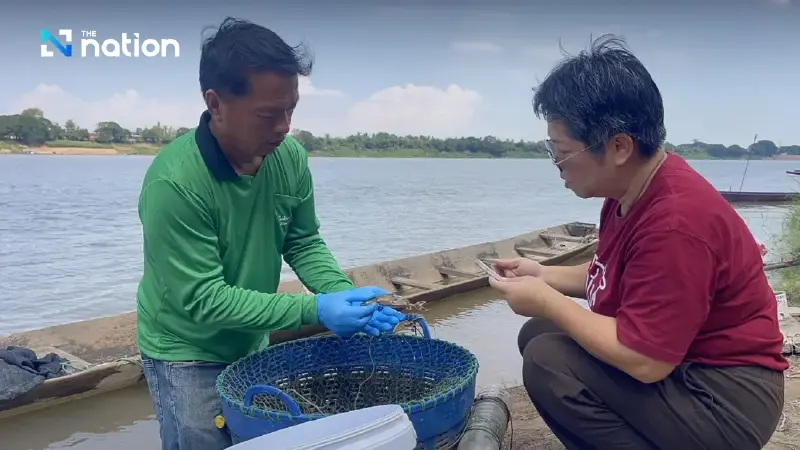


Seventeen Nong Khai residents were referred for further checks after elevated urinary arsenic results, as Mekong fishermen report falling sales.
- Seventeen residents in Nong Khai were referred for further health checks after tests found their urinary arsenic levels were above the reference standard of 100 micrograms per litre.
- The referrals followed a health screening program by the Department of Disease Control, which collected urine samples from 177 people assessed as being at moderate to high risk.
- The 17 individuals were sent to Nong Khai Hospital for additional assessments, including complete blood counts and liver-function tests.
Seventeen residents of Nong Khai have been referred for further health checks after tests found total urinary arsenic above the reference level, amid concerns over Mekong River contamination and its impact on fishing and farming.
Fishermen report declining catches and sales as customers avoid river fish, while growers who draw irrigation water directly from the Mekong say they need urgent advice on how to respond.
Community leaders are calling for wider environmental testing and clearer health guidance. The reported findings do not establish that river contamination caused the residents’ elevated test results or the lesions observed on fish.
Health screening and river tests
The Ministry of Public Health’s Department of Disease Control carried out screening through its Division of Occupational and Environmental Diseases in Hat Kham and Hin Ngom subdistricts of Mueang Nong Khai district and nearby areas.
The programme recorded 1,644 screenings and risk assessments, with urine samples collected from 177 people assessed as being at moderate to high risk. Seventeen had total urinary arsenic concentrations above the reference level of 100 micrograms per litre.
All 17 were referred to Nong Khai Hospital for further assessment, including complete blood counts and liver-function tests. Officials also collected urine samples from residents of four neighbouring households in a village where elevated results had been found.

Separately, September 2026 river monitoring by Environment and Pollution Control Office 9 in Udon Thani, under the Pollution Control Department, recorded arsenic at 0.011 milligrams per litre (mg/L) in Sangkhom district, 0.010 mg/L in Mueang Nong Khai and 0.012 mg/L in Phon Phisai.
The findings were published on October 18, 2026. Sangkhom and Phon Phisai exceeded the 0.010 mg/L water-quality standard, while the Mueang Nong Khai reading was at the limit.
Fishermen report lesions and falling sales
Khamfai Saisutta, 53, a fisherman from Ban Hat Sai Thong in Hat Kham subdistrict, said he had worked on the Mekong since he was 20. Catches once included large quantities of several fish species, but both the river’s condition and fishing returns had changed.

He reported lumps and lesions on pla khae, a type of catfish, and said he first noticed abnormalities about five years ago. More recently, contamination reports had made customers reluctant to buy Mekong fish.
“Fishermen in several villages are facing the same problem. Fish are harder to catch and sell, and incomes have fallen,” he said.
Khamfai raised concerns about steel factories in a neighbouring country and sand-dredging vessels operating on the Lao side of the river. He urged the authorities to investigate the changes affecting fishing communities.
Community network calls for a wider investigation
Ormbun Thipsuna, chairwoman of the seven-province Mekong River Community Organisations Council Network, said the network worked with Naresuan University and 14 schools to send river fish for testing every month.
She said monitoring since 2024 had recorded arsenic at 0.010 mg/L and that concentrations had subsequently increased. Citing Pollution Control Department data from August 2025 onwards, she expressed concern about contamination in Loei, Nong Khai, Bueng Kan and Nakhon Phanom.
Ormbun said August 2026 readings at some locations were more than four times the standard in Loei and two to three times the standard in Nong Khai, with concentrations varying between sites. Those figures referred to a different monitoring period from the September results.
She maintained that fish flesh could still be eaten, but recommended avoiding fish organs and intestines and temporarily refraining from eating bottom-dwelling species such as shellfish and prawns. No detailed fish-testing results were cited to support that assurance.
Ormbun called for sediment testing and clearer advice from the provincial public health office on precautions residents should take.
She also urged officials to investigate whether sand operations that stopped last year had genuinely been sand businesses or had served as fronts for gold mining. No evidence substantiating that suspicion was provided in the report.
Ormbun asked the authorities to establish how many sand operations existed and noted that villagers had reported problems with pla khae since the Covid-19 pandemic.
She called for provincial officials to work with communities on more extensive health screening and better public access to information.
Farmers await guidance on irrigation water
Ormbun distinguished water drawn for public tap supplies, which could be treated and controlled, from water pumped directly onto farmland. She said questions remained over the risks associated with agricultural pumping stations.

Phut Uyaphitang, a local farmer, said he had only recently heard about the contamination and had little information about what it meant for his work.

Maize grower Chalad Uyaphitang was preparing pipes to irrigate his crop, while chilli farmer Lamduan Khamtanit also reported a lack of guidance from government agencies.
The farmers said residents were continuing their usual routines, including fishing after working in their fields, because they had received little advice on what should change.
They urged the authorities to explain promptly whether they needed to alter their farming practices or daily activities.
