
Floods halt over 10 auto-parts plants with Oct 12 restart expected
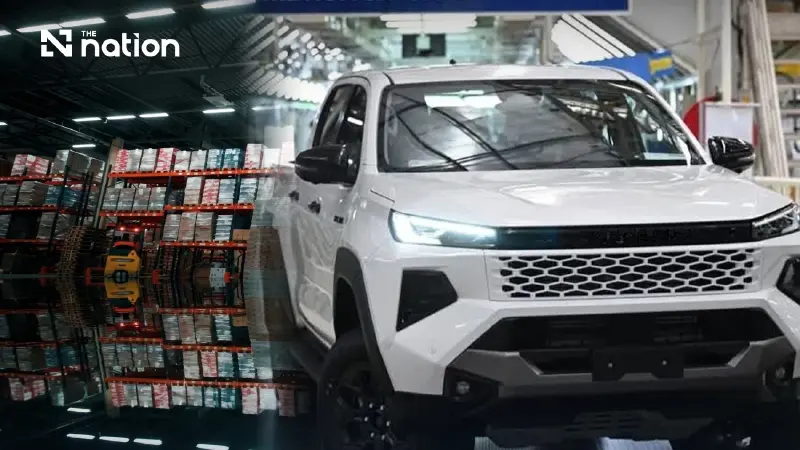


Thai suppliers may need costlier imported parts to meet carmakers’ contracts, while Toyota’s October 12 restart remains provisional.
- Flooding at Thailand’s Amata City Chonburi Industrial Estate has halted production at more than 10 auto-parts factories.
- The disruption has primarily impacted Japanese vehicle manufacturers, like Toyota, due to supply chain shortages, though assembly plants themselves were not directly flooded.
- Affected parts suppliers and carmakers are provisionally planning to restart production and deliveries on or around October 12.
- Suppliers unable to meet the restart date may have to import components at a higher cost to fulfill contracts with carmakers.
Flooding has halted production at more than 10 auto-parts factories at Thailand’s Amata City Chonburi Industrial Estate, with suppliers expecting to restart deliveries from October 12, 2026, according to representatives of the Federation of Thai Industries (FTI).
Supoj Sukpisan, honorary chairman of the FTI’s Auto Parts Industry Club, told Bangkok Biznews that suppliers unable to restore production in time would have to import components to fulfil contracts with carmakers and avoid penalties, despite the higher costs.
Changing suppliers offers little immediate relief, Supoj said, because approval can take almost a year, particularly for pickup trucks for which Thailand is the main production base. Nevertheless, Supoj remained confident that affected parts makers could recover within the expected timeframe.
Toyota’s October 12 restart remains provisional
Toyota Motor Thailand has provisionally planned to restart production on Monday, October 12, according to Suwat Supakarndechakul, chairman of the FTI’s Automotive Industry Club. Production would pause for the October 13 holiday and continue on October 14, subject to a further assessment of conditions.
Toyota’s disruption began on September 30, when flooding prevented employees from reaching work, before shortages at parts suppliers became a further obstacle. Operations at four Toyota plants, including Ban Pho in Chachoengsao, were temporarily suspended.
No vehicle assembly plant had been directly flooded, Suwat said, including those in Chachoengsao and Prachin Buri. The disruption instead stemmed from flooded suppliers and difficulties reaching workplaces.
Chinese and European carmakers were operating normally because they used different supplier networks, Suwat said. Most Japanese manufacturers, by contrast, had been affected and were assessing conditions and issuing updates day by day.
Five vehicle manufacturers had temporarily stopped production because suppliers could not manufacture or deliver components, or employees could not reach work, according to information from the Industry Ministry.
Industry Deputy Permanent Secretary Passakorn Chairat discussed the flooding with automotive businesses on October 6. The talks covered factories, machinery, raw materials, transport, distribution and suppliers, with the ministry asking companies to compile damage assessments and proposals for relief.
The Office of Industrial Economics, under the Industry Ministry, also brought together FTI executives and carmakers to assess the disruption and discuss assistance, including discounts on replacement parts and repair services for flood-damaged vehicles. The FTI has established a joint monitoring centre with the Thai Auto-Parts Manufacturers Association to track conditions.
Amata shortages expose limits of just-in-time production
More than 10 auto-parts factories were among 34 plants forced to stop production in zones 7, 8 and 9 of Amata City Chonburi after an earthen flood embankment collapsed, Suwat said.
Although floodwater had drained away at the estate, Suwat said the pace of recovery depended on cleaning and restoring machinery, with the extent of damage varying between factories.
Japanese carmakers’ reliance on just-in-time production and the Toyota Production System means they do not hold large component inventories, Suwat explained. The options depend on the type of part:
1. Replaceable components: Where several manufacturers supply a part, or temporary replacements can be imported from other Association of Southeast Asian Nations countries, vehicle production can continue.
2. Single-source components: Where a part is made only by a supplier at Amata and no alternative source exists, carmakers must delay production while the supplier restores its machinery.
“Suppliers that were not affected also have to slow production because they do not have enough warehouse space to keep building up stocks,” Suwat said.
Parts makers expect recovery within a week of waters receding
Affected parts manufacturers expect machinery recovery to take no more than a week after floodwater recedes, allowing production and deliveries to assembly plants to resume from October 12, Supoj said.
The supply chain in Amata’s phases 8 and 9 was disrupted by standing water, Supoj said. The main problems involved transport routes, employees’ journeys to work and production support facilities outside factory buildings, including wastewater treatment and waste disposal systems.
Government agencies and the Industry Ministry deployed pumps to accelerate drainage, allowing engineers and technicians to inspect and adjust machinery as factories entered the recovery phase, Supoj said.
Core production machinery had escaped flood damage because parts makers had business continuity plans that had been reviewed annually since the 2011 floods, Supoj said. Preparations included raising factory buildings and keeping sandbags, pumps and inflatable boats ready.
The current flooding came from overflowing local rivers and canals, unlike the 2011 disaster, when northern runoff and water spreading across fields inundated industrial areas, Supoj explained.
Vehicle assembly plants had strengthened their defences since 2011 through earthen embankments and flood barriers, Supoj said. Honda had also moved production to higher ground in Prachin Buri, helping explain why assembly plants had avoided direct inundation.
Preliminary industrial flood losses approach 6 billion baht
The FTI’s preliminary estimate of industrial flood losses has risen to nearly 6 billion baht from 1.5 billion baht the previous week, secretary-general Panitarn Pavarolavidya said, with the automotive parts sector particularly affected.
The industrial loss estimate remains provisional because flooding has not fully ended and further surveys are needed, Panitarn said.
Assembly plants with parts still in stock could continue producing, Panitarn said, although shortages could become more pronounced if the flooding and supply disruption were not resolved by October 12.
“Assembly plants still have some parts, so they can keep going for now. But if the situation is not resolved by October 12, problems will begin because there will be no parts to assemble,” Panitarn said.
Flooding has also affected agriculture, tourism, services and other manufacturing industries. The Thai Chamber of Commerce is gathering further information to assess the wider economic impact.
Source: Bangkokbiznews
