
Thailand finds no arsenic poisoning cases along four northern rivers
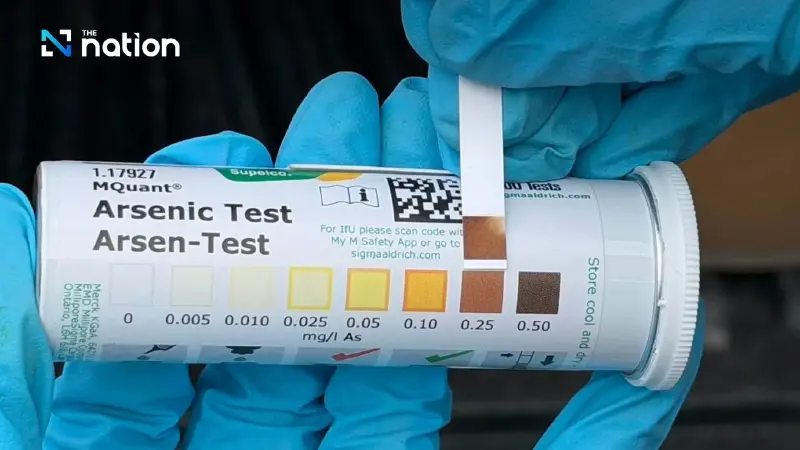


Local health authorities have been instructed to monitor people at risk for at least five years. The Department of Health plans to use a four-colour guide to arsenic levels in water.
- No cases of acute or chronic arsenic poisoning have been diagnosed in the at-risk population under surveillance.
- Ongoing monitoring by the Ministry of Public Health has found no arsenic readings in water above the critical threshold of 500 micrograms per litre.
- Despite the lack of poisoning cases, authorities will continue to monitor the health of at-risk individuals and water quality for at least five more years.
The Ministry of Public Health has so far recorded no arsenic readings above the red threshold of 500 micrograms per litre in its ongoing surveillance, screening and health follow-up of people at risk.
Dr Somlerk Jeungsmarn, the ministry’s permanent secretary, said on Sunday (November 22, 2026) that the latest data also showed no diagnoses of acute or chronic arsenic poisoning in the group.
He said a urine arsenic level above the reference value does not in itself establish a diagnosis of arsenic poisoning.
The result helps assess exposure and track the person’s health.
Local public health authorities have been instructed to continue monitoring the health of people at risk for at least five years while keeping water and food quality under surveillance.

The aim is to reduce exposure and prevent long-term harm to health.
Dr Thiti Sawaengtham, director-general of the Department of Health, said the department was preparing to change how it advises the public about arsenic in water.
It plans to report concentrations in micrograms per litre (µg/L) so people can more easily understand the readings and compare them with the standards.
The plan calls for two tools to explain the risks – the Arsenic Health Risk Scale (AHRS) and the Arsenic Health Risk Matrix (AHRM).
Dr Thiti said the AHRS sets out four risk levels for arsenic in water.


Green (10 µg/L or less)
- The water meets the standard for arsenic. It can be used for drinking, cooking and other household purposes if it also meets the other water quality standards.
Yellow (more than 10 but less than 100 µg/L)
- Do not use the water for drinking or cooking. It can be used for bathing, washing clothes and cleaning. Avoid swallowing the water and take particular care to ensure young children do not swallow any.
Orange (at least 100 but less than 500 µg/L)
- Act urgently to manage the risk. Do not use the water for drinking, cooking or watering vegetables grown for food. For other household uses, follow the advice of public health officials.
Red (500 µg/L or more)
- Stop all use of the water as a precaution. Arrange an alternative water supply that meets the standards without delay.
The AHRM compares the risks from two routes of arsenic exposure – drinking water and skin contact – and covers both acute and chronic health effects.
Exposure to high levels of arsenic over a short period may cause nausea, vomiting, abdominal pain and diarrhoea.
Sustained exposure to inorganic arsenic over a long period may increase the risk of skin and nervous system disorders, cardiovascular disease and some cancers.
Arsenic is generally less readily absorbed through the skin than when swallowed, so the approach to managing risk differs for each route.
An arsenic concentration above the standard of 10 µg/L in water does not mean acute poisoning will occur immediately.
People should avoid consuming the water to reduce their long-term risk.
Both tools are used to communicate and manage risk.
Neither is a criterion for the clinical diagnosis of arsenic poisoning.
“The Department of Health asks people to be aware of the risk and stay calm. Choose water from sources where the quality has been checked. Avoid consuming water straight from rivers in areas where contamination has been reported, and continue to follow advice from public health authorities. We stress that boiling water cannot remove arsenic. The Ministry of Public Health will work with the relevant agencies to monitor water quality, food quality and people’s health to protect public health now and in the long term,” Dr Thiti said.

