
Ministry of Public Health Partners with Bayer to Advance the Medical Investment Hub


Supporting THB 153 Million in Clinical Research and AI-enabled Eye Disease Screening for 4 Million People
The Ministry of Public Health is advancing the Medical Investment Hub by signing a Memorandum of Understanding (MOU) with Bayer, a global leader in life sciences and medical innovation. Bayer has proposed a potential clinical research investment of approximately THB 153 million as an initial phase, while promoting access to innovative medicines and advancing AI-enabled eye disease screening. The target is to expand screening coverage from 2 million to 4 million people, to increase the chances of detecting disease early and reduce the risk of vision loss.
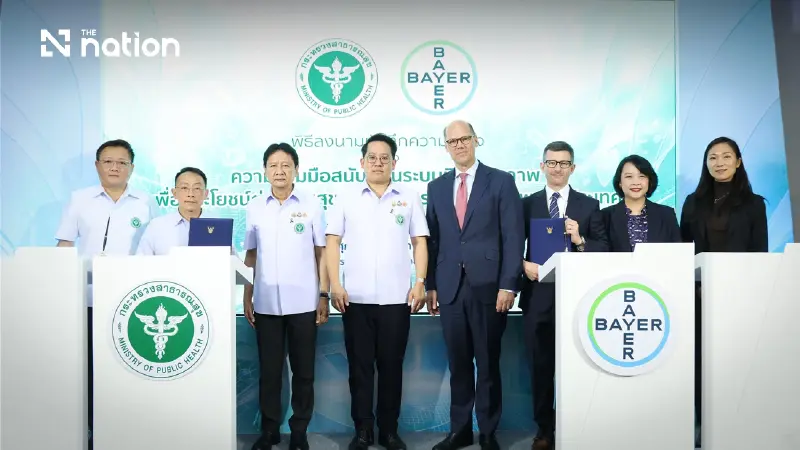
On 6 November 2026 (B.E. 2569), at the Chai Nat Narenthon Meeting Room, 2nd Floor, Building 1, Office of the Permanent Secretary, Ministry of Public Health, Nonthaburi Province, Mr. Pattana Promphat, Minister of Public Health, presided over the signing ceremony of a Memorandum of Understanding (MOU) on Cooperation to Support the Health Ecosystem for the Benefit of Thailand's Health System and Health Economy, between the Ministry of Public Health and Bayer Thai Co., Ltd. (Bayer). Dr. Somruek Chungsaman, Permanent Secretary of the Ministry of Public Health, signed on behalf of the Ministry.

Mr. Pattana Promphat, Minister of Public Health, said that the Ministry of Public Health is advancing the Medical Investment Hub policy to position the medical and healthcare sector as a new engine of economic growth for Thailand, through three pillars: the Service Hub, which enhances the quality and capacity of medical and healthcare services; the Research and Development Hub, which promotes medical research and clinical trials; and the Product and Health Manufacturing Hub, which strengthens pharmaceutical, vaccine and health product manufacturing. The policy aims to attract over THB 68 billion in new investment and generate an economic contribution of at least 0.5% of GDP. The policy is not only about increasing economic value, but also about using technology and innovation to improve the quality of public health services and people's quality of life.
"Our cooperation with Bayer is another important step in linking innovation investment with the development of the health service system. The company has proposed a potential clinical research investment of approximately THB 153 million as an initial phase, and supports the development of AI-enabled eye disease screening, with the goal of expanding screening coverage from 2 million to 4 million people. This will increase the chances of detecting disease early, reduce the risk of vision loss, and give people access to innovative medicine and modern medical technology."

Dr. Somruek Chungsaman, Permanent Secretary of the Ministry of Public Health, said that the Ministry places importance on using technology and innovation to improve the efficiency of the health service system, particularly early screening and diagnosis, the development of the patient referral system, and greater access to quality medical services. The Ministry also promotes clinical research and the use of real-world evidence to support health policy development.
"The Ministry of Public Health is committed to promoting the application of AI technology in retinal disease screening, especially for at-risk diabetic patients. We are also strengthening the capacity of healthcare facilities and the referral system so that screening, diagnosis and treatment are effectively connected, in order to increase access to services, reduce the risk of vision loss, and improve people's quality of life."
The cooperation also covers proposals to promote access to innovative medicines for patients with retinal diseases and prostate cancer, as well as studies on innovations to prevent recurrent stroke, together with investment in clinical research and the development of real-world evidence. These efforts aim to support the development of the health service system and strengthen Thailand's potential to become a hub for medical research and innovation under the Medical Investment Hub policy.
"Thailand has a clear ambition to strengthen its position as a hub for medical innovation, and Bayer is proud to support that ambition. Through our partnership with the Ministry of Public Health, we want to expand clinical research, help bring innovative treatments to patients earlier and further strengthen local research capabilities. By combining Bayer’s global expertise with Thailand’s strong healthcare ecosystem, we can support better outcomes for patients and contribute to the long-term development of the country’s healthcare system," said Sebastian Guth, Global Chief Operating Officer, Bayer Pharmaceuticals and President, Bayer U.S.
Mr. Simon Rosof, Head of Asia Pacific region, Bayer Pharmaceuticals, said: "Early detection can make a critical difference for patients. By using AI-enabled technology in retinal disease screening, we can help identify people at risk, particularly patients with diabetes, support more efficient referrals and connect them with appropriate care sooner.”
“Our ambition is to support patients across the healthcare journey, from earlier screening and opportunities to participate in clinical research to access to innovative treatments. At the same time, we want to contribute to Thailand’s ambition to strengthen health innovation and medical research. This reflects Bayer’s mission of ‘Health for all, Hunger for none’ and our commitment to supporting Thailand’s public health priorities for more than six decades.”
This collaboration marks another important step in supporting the development of the health service system, improve patient access to innovative medicines, and strengthening Thailand's potential to become a hub for medical research and innovation under the Medical Investment Hub policy.
