
Hong Kong jails Joshua Wong for 10 years on November 5
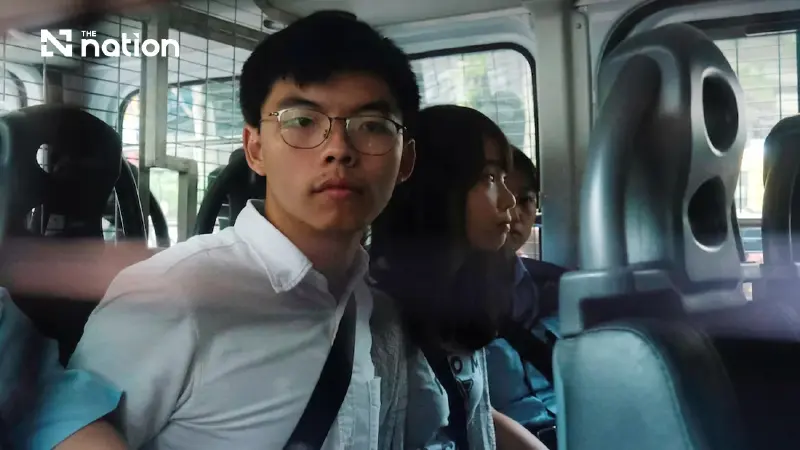


Joshua Wong pleaded guilty to foreign collusion under Hong Kong’s national security law, with his plea and remorse taken into account.
- Pro-democracy activist Joshua Wong was sentenced to 10 years in prison by Hong Kong's High Court on November 5.
- The sentence was for the charge of "conspiring to collude with foreign entities" under the city's national security law, to which he had pleaded guilty.
- The charge stemmed from his efforts to lobby foreign countries to impose sanctions or other hostile actions against the Hong Kong and Chinese governments.
- The judge cited the gravity of the offense, which carried a maximum penalty of life imprisonment, as a reason for the 10-year sentence.
Hong Kong’s High Court sentenced pro-democracy activist Joshua Wong to 10 years in prison on November 5, 2026, after he pleaded guilty to conspiring to collude with foreign entities under the city’s national security law.
Wong, 30, admitted the charge in September. The case concerned a conspiracy with self-exiled activist Nathan Law and others to ask foreign countries, bodies or individuals outside China to impose sanctions or blockades, or take other hostile action against the government.

Judge cites gravity of offence
High Court Judge William Tam told a packed courtroom that the sentence had to reflect the seriousness of Wong’s actions. The offence carried a maximum penalty of life imprisonment.
“The punishment must fit the gravity of the crime,” Tam said.
“It is also necessary for the court to express the community’s abhorrence of the defendant’s scheme and acts with others to collude with foreign forces or external elements to endanger national security.”
The offences covered July 1 to November 23, 2020. Tam described that period as one of “very high risk” to Hong Kong’s national security and rule of law.
Tam took account of Wong’s guilty plea, remorse and educational efforts in prison when determining the sentence.

Wong’s mitigation and earlier detention
Wong told the court during mitigation that he had neither advocated independence nor received overseas funding.
“I have never advocated Hong Kong independence, nor have I ever promoted the ‘collapse of China’ or regime change,” Wong said.
“I have also never received foreign funding or spent money to hire foreign political consultants.”
Wong acknowledged that he had subsequently realised his belief that his activities were lawful had been mistaken.
Before sentencing, Wong repeatedly nodded towards the public gallery. Wearing a blue shirt and dark-framed glasses, with his hair cut short at the back and sides, he was flanked by three guards.
Wong has been detained since November 2020, when he pleaded guilty to inciting and organising an unauthorised anti-government assembly during the protests that swept Hong Kong in 2019. Before the latest sentence, his release had been expected in January 2027.
Wong had previously been detained repeatedly for his role in organising pro-democracy rallies and became an internationally recognised figure in the movement.

Prosecutors detail international lobbying
Prosecutors used a September hearing to set out what they described as an international media and political campaign by Demosisto, the now-disbanded party Wong helped lead, to secure sanctions and other hostile measures against Hong Kong and China in 2019 and 2020.
The campaign included lobbying visits to Washington DC and meetings with Nancy Pelosi, then speaker of the US House of Representatives, and Marco Rubio, now US secretary of state but a senator at the time.
Demosisto also supported a referendum on Hong Kong’s sovereignty at one stage.
Tam said Wong and Law had entered the “international battleground” before the national security law took effect, then continued and “deliberately adapted” their activities to “further the offence”.
Wong’s contacts with politicians in the United States, Europe and elsewhere angered Beijing, which has called him a “black hand” of foreign forces.

Supporters voice fears over security law
Dozens of Wong’s supporters filled public galleries and waited outside the court. Among them was housewife ET Wong, who described widespread anxiety about the consequences of the security legislation.
“These harsh sentences have left many Hong Kong people deeply fearful,” ET Wong said.
“We don’t know what actions might break the law, what we say might break the law, what we write or what we draw. We just don’t know anymore.”
Beijing imposed the national security law on the former British colony in 2020 following demonstrations that sometimes turned violent. The sweeping legislation has effectively outlawed the protest activities of Wong and other young activists.
Beijing maintains that the law was needed to restore stability in the city.
Steve Li, chief superintendent of the police’s national security department, described Wong as not an “enemy”, but said he needed to respect the law and “understand his own country”.
International human rights groups and some Western and Asian countries are closely following Wong’s case and other prosecutions as they monitor the law’s implementation.
In February, media tycoon Jimmy Lai, one of Hong Kong’s most outspoken critics of China, received a 20-year sentence for collusion with foreign forces and sedition. The landmark trial drew international criticism.


