
Excise Department proposes inverter name change in electric pickup tax rules
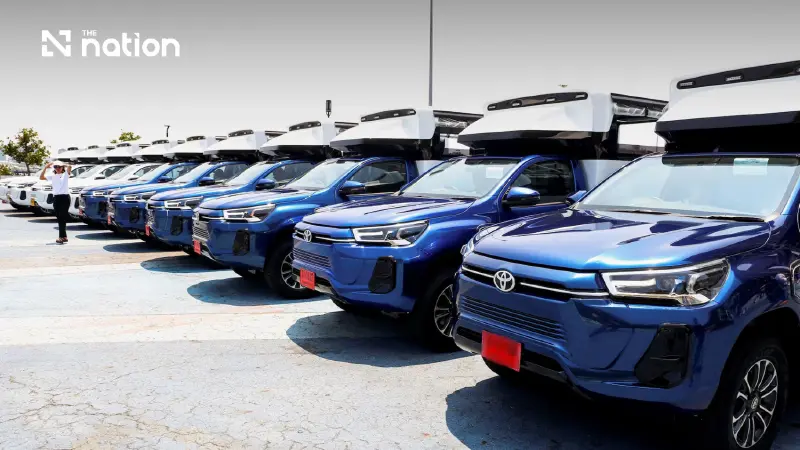


A draft would replace “PCU Inverter” with “Integrated Inverter” in Thailand’s electric pickup rules, retaining local-content deadlines.
- Thailand's Excise Department has proposed changing the name of a required component in electric pickup tax rules from “PCU Inverter” to “Integrated Inverter”.
- The change aims to resolve inconsistent terminology and align the rules for electric pickups with those already in place for hybrid and plug-in hybrid vehicles.
- This amendment only affects the component's name; it does not alter the list of required locally-produced components or the existing implementation deadlines.
Thailand’s Excise Department has drafted an amendment to electric pickup tax rules to resolve inconsistent terminology for a required locally manufactured component, while retaining the existing battery and local-content timetable.
According to a Finance Ministry source, the draft would amend the notification on electric pickup criteria, conditions and specifications dated 25 November 2025. It would replace “PCU Inverter” with “Integrated Inverter” in the list of key components required to be produced domestically.
Aligning electric and hybrid vehicle terminology
The proposed change addresses a mismatch between the component terminology used under the EV3 and EV3.5 schemes and that used in Excise Department notifications for hybrid electric vehicles (HEVs) and plug-in hybrid electric vehicles (PHEVs).
The hybrid and plug-in hybrid notifications already use “Integrated Inverter”. The differing names have created practical difficulties in applying domestic-component requirements.
The amendment would bring the terminology into line across the relevant notifications without changing the five-component list or the implementation timetable specified in the existing electric pickup rules.
Three local-production routes
Electric pickup manufacturers participating in EV3 or EV3.5 must produce their vehicles domestically and use locally manufactured batteries or components to qualify for the applicable excise tax treatment.
Participants can meet the conditions through one of three routes, depending on the level of battery production undertaken in Thailand.
The battery-cell route requires batteries manufactured domestically at cell level from 1 January 2026. This condition would remain unchanged under the draft.
The battery-module route requires locally manufactured modules from 1 January 2026. The draft would rename the locally produced component required from 1 January 2030 as “Integrated Inverter”, replacing “PCU Inverter”. From 1 January 2035, manufacturers following this route must also use one locally manufactured component from a specified list of five.
The battery-pack assembly route requires battery packs assembled domestically from 1 January 2026. The same inverter-name change would apply to its local-production requirement from 1 January 2030. From 1 January 2035, manufacturers following this route must use two locally manufactured components from the five-item list, compared with one under the module route.

The five components are a traction motor, reduction gear, air-conditioning compressor for battery-electric vehicles, battery management system (BMS) and drive control unit (DCU).
The draft neither adds nor removes any components from this list and retains the existing deadlines.
Vehicle limits and legal eligibility
The amendment concerns Clause 5 of the existing notification, covering participants in EV3 under the notification dated 21 March 2022 and EV3.5 under the notification dated 28 December 2023.
Eligible electric pickups must be designed for a gross vehicle weight, including payload, of no more than 4,000kg.
The applicable excise tax rate is specified in subparagraph (a) of item (9) under category 06.03 in the schedule to the Ministerial Regulation Prescribing Excise Tariff Rates B.E. 2560 (2017), as amended by Ministerial Regulation No. 23 B.E. 2565 (2022).
Conditions for firms outside EV3 and EV3.5
The existing notification also provides a route for electric pickup manufacturers and importers outside EV3 and EV3.5 to qualify for the same excise tax rate.
For the period from 1 January 2026 to 31 December 2029, the battery requirements under this route allow batteries manufactured or assembled in Thailand.
From 1 January 2030, eligible vehicles must use batteries manufactured domestically at module level or above.
EV board decision behind the draft
The draft follows the Cabinet’s acknowledgement of a report on the National Electric Vehicle Policy Committee’s first meeting of 2026, held on 10 September 2026.
At that meeting, the committee endorsed changes to the EV3 and EV3.5 conditions, including the revised component name, and assigned the Excise Department to take the necessary steps within its legal and regulatory powers.
The committee’s stated objectives are to improve the effectiveness of both schemes and strengthen the competitiveness of Thailand’s electric vehicle and key-component industries.
The changes are also intended to improve government budget management while supporting the transition of the country’s automotive and parts industries towards environmentally friendly vehicles.
Source: Thansettakij
