
Thailand plans EV tax tiers tied to Thai-made components
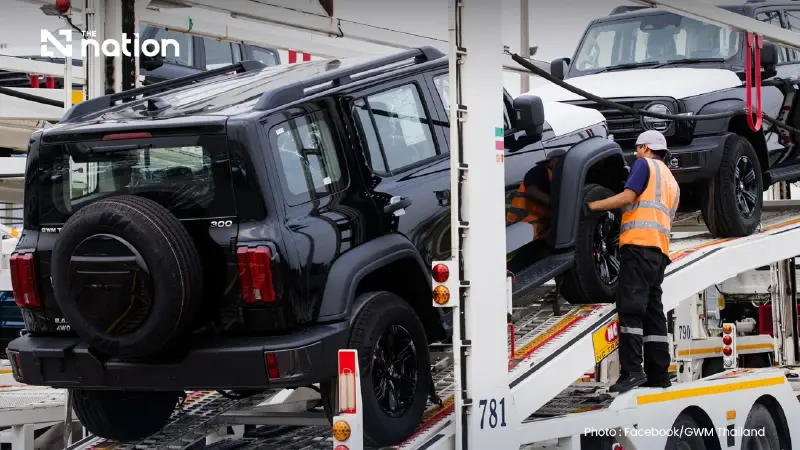


Thailand plans to link its lowest EV excise rate to genuinely Thai-made parts within three years, aiming to strengthen domestic suppliers.
- Thailand is planning a new three-tier EV excise tax system where the lowest rate will be conditional on using a certain percentage of genuinely Thai-made components.
- Under the proposed structure, local EV manufacturers meeting the "Made in Thailand" (MIT) content requirement will pay a 10% tax rate.
- Local producers who fail to meet the domestic content threshold will face a higher intermediate rate (approx. 15-20%), while fully imported EVs will be taxed at the highest rate of 35%.
- The MIT criteria will be based on identifiable physical parts, not accounting calculations, and manufacturers will have three years to adapt their supply chains.
Thailand plans to make the use of genuinely Thai-made components a condition for its lowest excise tax rate on electric vehicles (EVs) under new rules due within three years, extending its push for local production to the domestic automotive supply chain.
Finance Ministry Permanent Secretary Lavaron Sangsnit outlined new “Made in Thailand” (MIT) criteria that would distinguish manufacturers using locally produced parts from those operating Thai factories without meeting the domestic-content requirements.
Actual Thai-made parts would determine eligibility
The proposed system would assess identifiable components rather than rely on accounting or financial calculations, Lavaron indicated. Manufacturers would need to identify parts genuinely produced in Thailand, such as seats, doors, glass and tyres.
Lavaron argued that existing local-content calculations under customs rules or World Trade Organization (WTO) arrangements could include profits of 10–15% and utility expenses, such as water and electricity bills.
Such calculations could produce domestic-content figures of 20–40% despite limited use of actual Thai-made components, he maintained. The MIT criteria would not use those methods.
Lavaron cited 40% as a possible local-content threshold, stressing that any requirement would have to be met through components genuinely manufactured in Thailand. The percentage has not been presented as a final requirement.
Manufacturers would have three years to prepare, working with the Federation of Thai Industries (FTI) to plan their sourcing and draw up component lists.
Three tax tiers would distinguish production and sourcing
Under the planned three-tier EV excise tax structure, manufacturers with factories in Thailand that meet the MIT requirements would retain a 10% rate.

Local producers that fail to meet the domestic-content requirements could face an intermediate rate of approximately 15% or 20%. The Excise Department is still studying which rate would be appropriate.
Fully imported EVs would face the highest rate of 35%. The Cabinet approved the increase from 10% on November 3, 2026, as part of the effort to encourage manufacturers to establish production facilities in Thailand.
EV strategy moves beyond attracting factories
Lavaron described the Excise Department’s strategy as a ladder of three or four stages, planned from the outset.
He credited the first stage, involving the EV 3.0 and EV 3.5 incentive schemes, with encouraging consumer acceptance of electric vehicles and attracting major foreign carmakers, particularly from China. Their investments had brought approximately eight manufacturing plants to Thailand.
The next stage addresses the incentive for new entrants to import vehicles rather than manufacture them locally. At a 10% import excise rate, prospective ninth, tenth or eleventh investors could choose to pay the tax and compete with companies that had already invested in Thai factories.
“Once we saw that the number of factories had stabilised at eight, we needed to raise the excise tax on imported vehicles to 35%,” Lavaron said.
“The Cabinet approved the increase on November 3 to establish a tax barrier and create a clear difference in costs.”
Lavaron calculated that, on a tax-inclusive basis, the 35% levy would translate into an effective burden equivalent to as much as 49% of a vehicle’s price. He argued that the resulting price disadvantage for imports would encourage carmakers to establish local production.
AAS requests talks on a potential Thai factory
Lavaron identified AAS Auto Service Co., Ltd. as the ninth company to express interest, revealing that it had requested a meeting with the finance minister to discuss establishing a factory just one day after the Cabinet decision.
A tenth company was also preparing to hold discussions with the Excise Department during the same week.
The approaches were requests for discussions, rather than confirmed factory investments.
Lavaron stressed that the tax changes formed part of the department’s own staged policy programme.
“This restructuring is part of the Excise Department’s own plan and must proceed step by step,” he stated.
“It is not being done to appease Japanese carmakers or because of external pressure.”
Domestic suppliers and after-sales support are central goals
Lavaron emphasised that raising government revenue was not the main objective. The aim was to establish Thailand as a genuine automotive manufacturing hub, with domestic supply chains and Tier 2 and Tier 3 component suppliers developing alongside vehicle manufacturers.
He also linked a substantial local manufacturing presence to stronger consumer confidence over the longer term, particularly in after-sales service and the availability of parts for maintenance and repairs.
Lavaron expected those improvements eventually to help normalise EV insurance arrangements and premium rates.
Source: Thansettakij
