
Multi-Billion Baht Education Investment Anchors Bangna Growth as Dulwich College Bangkok Opens Sustainable Campus
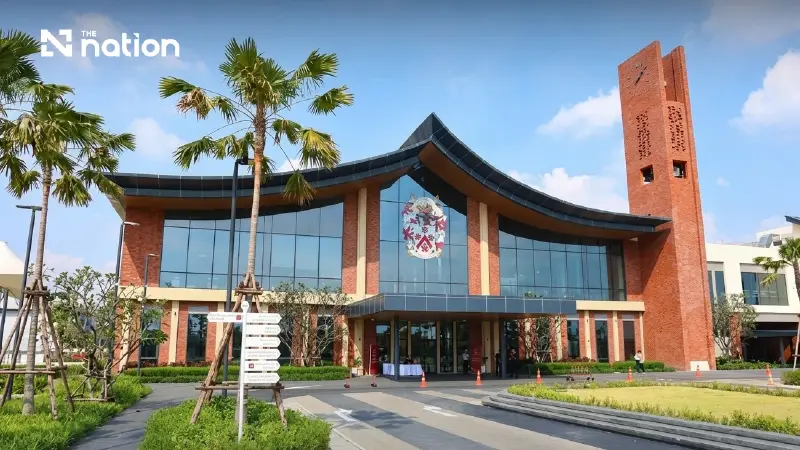


Global education leader EIM and Sakol Sathapat officially open Dulwich College Bangkok, bringing world-class British learning and dual sustainability
- Dulwich College International School Bangkok has officially opened on the Bangna-Trad road, representing a major strategic investment by global education leader EIM and Thai developer Sakol Sathapat.
- The school is the anchor of a 40-rai master plan designed to support the growth of Bangkok's eastern corridor and the Eastern Economic Corridor (EEC) by attracting families to the area.
- Engineered to be a benchmark for sustainability in Thailand, the campus is targeting both LEED Gold and WELL Gold certifications with features like solar power, wastewater recycling, and advanced air filtration.
- Positioned in the premium market with tuition fees over THB 700,000 per term, the school offers a British curriculum to serve a growing population of high-net-worth Thai and expatriate families.
Global education leader EIM and Sakol Sathapat officially open Dulwich College Bangkok, bringing world-class British learning and dual sustainability.
Global education leader Education in Motion (EIM) and Thai development partner Sakol Sathapat have officially marked the grand opening of Dulwich College International School Bangkok, anchoring a major strategic real estate and educational investment along the rapidly expanding Bangna-Trad road corridor.
The grand opening ceremony on 5 November 2026—preceded by an executive media briefing—showcased how long-term family land stewardship and international educational expertise are converging to shape a forward-thinking community hub in eastern Bangkok.
Presided over by Deputy Minister of Education Akaranun Kannakittinan and joined by distinguished guest of honour and Dulwich alumnus His Excellency Anand Panyarachun, former Prime Minister of Thailand, the launch highlights a strong commercial and civic commitment to developing human capital in the region.
The project represents a strategic collaboration between EIM, headquartered in Singapore, and the Wattanavekin family’s Sakol Sathapat, which has held landholdings in the area for decades.


Kanakorn Wattanavekin, director of Sakol Sathapat, noted that the vision for the 40-rai campus stems from a deep-rooted belief that education forms the foundational pillar of community and national development.
"We didn't want to do anything half-heartedly, so our partner had to be world-class," Kanakorn explained during the briefing, noting that initial discussions with EIM leadership began years ago during the COVID-19 pandemic.

By positioning the school as the focal point of a wider 40-rai master plan—which includes upcoming commercial and retail spaces such as the Pio community mall scheduled to open next year—the development is designed to serve the rising influx of families and expatriates migrating toward Bangkok's eastern growth gateway and the Eastern Economic Corridor (EEC).
From a business and operational perspective, EIM Chief Executive Officer Marc Ledermann and Founder and Chairman Fraser White emphasised that the campus combines a rigorous British curriculum with cutting-edge technological and environmental frameworks.
Operating under a "Students Come First" philosophy, the Bangna campus is engineered to set a new benchmark for sustainable school design in Thailand, targeting both LEED Gold certification from the US Green Building Council and WELL Gold certification for occupant health and wellbeing.

For its initial phase of operation, Dulwich College Bangkok is enrolling students from nursery up to year 7. The curriculum integrates the UK Early Years Foundation Stage (EYFS) and the English National Curriculum alongside Thai and Mandarin language programmes, as well as signature STEAM initiatives and AI critical thinking frameworks.
Having opened its doors to instruction in August 2026, the campus currently hosts a pioneer cohort of approximately 200 students
Designed with an initial Phase 1 capacity of 1,000 students, the school plans to expand its offerings up to Year 13 over the next five years, targeting an ultimate capacity of 2,000 pupils.

Addressing the school's commercial positioning amidst broader demographic shifts, CEO Marc Ledermann noted that Dulwich College Bangkok is deliberately positioned in the top-tier premium segment, with tuition fees starting at over THB 700,000 per term.
Ledermann emphasised that this pricing structure reflects a strategic focus on delivering uncompromising educational quality and holistic student experiences rather than competing on price.
Despite declining birth rates in various countries, Ledermann remains highly confident that the school's unwavering commitment to academic excellence, sports, music, arts, and character development will drive robust growth, as high-net-worth Thai families and expatriate professionals operating in Thailand consistently seek out the absolute best educational investments for their children.

The campus architecture breaks away from traditional high-rise school models, adopting a human-scale, low-rise "Thai Village" layout inspired by traditional Ayutthaya structures arranged around a central village hub. To combat regional climate challenges and urban air quality concerns, every classroom is equipped with positive-pressure air handling, commercial HEPA filtration, and real-time environmental sensors.
Furthermore, the campus integrates solar power panels, wastewater recycling, and advanced learning technologies designed to prepare students for a rapidly shifting technological landscape.
With balanced demographics comprising approximately 50 per cent Thai students and 50 per cent international and expatriate families, the school draws on the proven global university matriculation pathways of the wider Dulwich College International network, which saw recent graduates secure placements at elite institutions including Oxford, Cambridge, and Ivy League universities.
