
More Than a School: How Dulwich College Bangkok Is Redefining International Education in Thailand


With a Thai village-inspired campus, a 400-year heritage and a mission rooted in putting children first, Dulwich College Bangkok is not just another international school
- The school's campus is uniquely designed like a traditional Thai village with a "students first" philosophy, targeting top certifications for sustainability (LEED Gold) and wellbeing (WELL Gold).
- It offers a rare dual academic pathway for senior students, allowing them to choose between A Levels and the International Baccalaureate (IB) Diploma Programme.
- A unique SE21 programme focuses on STEAM, Entrepreneurship, and 21st-century skills to prepare students for the future workplace.
- While following an Enhanced British Curriculum, the school intentionally integrates local Thai culture, geography, and language into its learning approach.
With a Thai village-inspired campus, a 400-year heritage and a mission rooted in putting children first, Dulwich College Bangkok is not just another international school.
Amid a wave of prestigious British schools setting up campuses in Thailand, one newcomer is generating particular anticipation. Dulwich College Bangkok (DCBK) is set to open its doors in Bangna this August 2026, and it arrives not merely as another international school option but as a purposefully designed institution that its founders believe sets an entirely new benchmark for what a school can and should be.
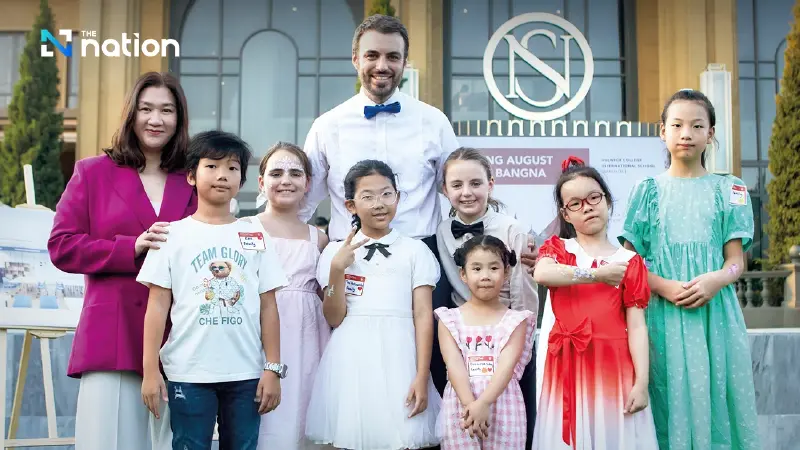
The school recently welcomed prospective families at a Garden Party, offering an early glimpse of the community that is beginning to form around it.
For the parents and children who attended, it was a first taste of what the leadership team describes as something genuinely rare: the chance to be among the very first families at a school with Dulwich's storied reputation.
A Legacy That Spans Four Centuries
Dulwich College Bangkok draws directly from the heritage of Dulwich College in London — an institution founded in 1619 by actor and impresario Edward Alleyn.
Over more than four centuries, Dulwich has cultivated a reputation for academic rigour, pastoral care, and the development of well-rounded individuals.
That legacy now travels to Southeast Asia through Education in Motion (EiM), the education group that operates the wider family of Dulwich College International (DCI) schools across Singapore, Seoul, Shanghai, Beijing, and Suzhou.
Bangkok represents the latest addition to this network – and the group's first campus in Thailand – established through a partnership with Thai developer Sakol Sathapat, formalised in May 2024.

Mr Thomas Banyard, Head of College at DCBK, describes what this heritage means in practice.
"We are truly one family of schools, linking that 400 years of heritage from our school in London to over two decades of experience in our schools in China, in Singapore, in Korea," he says.
That family extends further still to sister schools such as the Hochalpines Institut Ftan (HIF) in Switzerland — where Dulwich students can experience boarding overseas — and Green School in Bali, which lends the network its particular emphasis on sustainability and purpose-driven learning.

A Campus Designed With Children at Its Heart
From the moment families see the campus plans, one philosophy becomes unmistakable: students come first. It is not simply a motto — it is, as both Mr Banyard and Head of Primary Mr Mark Verde are quick to stress, the foundational principle that shapes every decision from architecture to timetabling.
The campus itself is a striking departure from the conventional school design. Inspired by the concept of a traditional Thai village, the site features low-rise, human-scale buildings connected by open pathways, with a lively Village Centre at its heart linking the Junior School, DUCKS (Early Years and Key Stage 1), library, and dining areas. Classrooms are not arranged in straight, institutional lines.
"We have a design that's based on a Thai village to promote flow, to promote connection, to promote learning," says Mr Banyard. "We have spaces that are replete with natural light because we know that our design is centred around putting children first."
DCBK is also targeting Thailand's first international school to achieve both LEED Gold certification — recognising best practices in sustainable building design — and WELL Gold certification for promoting health and wellbeing. The ambition reflects a conviction that a school's physical environment is as important as its curriculum.
Mr Verde, who has three decades of teaching and leadership experience, puts it plainly: "The environment is the third teacher. I've never seen an environment like the environment at Dulwich College Bangkok."
He describes spaces designed to accommodate both exuberant activity and quiet reflection: "There are spaces to run in, but also spaces to be quiet. The way the light will come inside — as well as the outside — is great for children’s minds, so they always feel alive."
When fully operational, the campus will offer an air conditioned and filtered swimming pool a large indoor sports complex, SE21 innovation workshops, a FIFA-standard football pitch, the latest technology in clean air filtration, and — in a future phase — a Performing Arts Centre inspired by Shakespeare's Globe Theatre.

The Dulwich Difference: Academic Excellence and Beyond
DCBK will follow an Enhanced British Curriculum, progressing to Cambridge IGCSE examinations. Where the school stands apart most distinctly from many of its peers is at the top of the school: in Year 12 and Year 13, students will have the choice of pursuing either A Levels or the International Baccalaureate (IB) Diploma Programme.
This dual pathway, rare among international schools, ensures that students can shape their educational journey according to their own strengths and ambitions.
"They can do both A Levels and IB when they get up to Year 12 and Year 13, so that they can truly shape their own learning," says Mr Banyard.
Underpinning this is SE21—a flagship programme unique to the Dulwich network. The name carries a dual significance: it references the London postcode of the original Dulwich College while also serving as an acronym for STEAM (Science, Technology, Engineering, Arts, and Mathematics), Entrepreneurship, and 21st-century skills.
Through SE21, students do more than master academic subjects; they learn to apply them—developing the business acumen, innovation literacy, and problem-solving skills necessary for the evolving global workplace and a sustainable future.
"We don't know what jobs they're going to do. We don't know what that workplace will look like," Mr Banyard acknowledges. "And obviously AI is a big disruption in that workplace. So we do practical things as well as making sure we're focusing on those human aspects of empathy and compassion."
Supporting students' university journeys will be a comprehensive counselling programme that draws on expertise across the entire Dulwich family – from Bangkok to Singapore, Seoul, and London – ensuring that students are prepared to apply to leading institutions across Asia, the UK, the United States, and beyond.

Learning That Begins in Thailand
For the Primary School, the vision is articulated through what Mr Verde calls a child-centred, curiosity-led approach to learning — one that is firmly rooted in the place where the children actually live.
"Thailand is a very important place, so learning has to be meaningful," he explains. "When we connect that learning, we relate it back to Thailand. If we study rivers, it's the Chao Phraya. When we look at rainforests, it's Khao Yai. When we look at artists, we want artists from Thailand."
The school will offer Thai language programmes for both native and non-native speakers, as well as Mandarin — building genuine multilingual capability within a curriculum that benchmarks against the UK's national standards. The curriculum is differentiated throughout, teaching to high aspirations while ensuring every individual child's needs, gaps, and strengths are known and addressed.
"We always teach to the top for all our children," says Mr Verde. "Not only is it academic, which is very important, but we build other things around them — the ECA programme, residential visits — and then we interconnect that learning so that it is meaningful."
Wellbeing sits squarely at the centre of this picture. Mr Verde articulates the ambition with characteristic directness: "Our children are going to be the leaders of Thailand eventually. The doctors, the dentists, the politicians, the nurses. We have to make sure their hearts are right and their minds are right."

Teachers Drawn from Across the World
Both leaders emphasise the quality of the teaching team being assembled. DCBK has received more than 100 applications for every teaching position, and nine teachers are joining directly from other Dulwich schools worldwide, bringing first-hand knowledge of the Dulwich ethos and educational approach to Bangkok from day one.
For Mr Verde, the role of teachers goes well beyond delivering lessons.
"The most important thing they have to do is know their children," he says. "They have to know what their strengths are. They have to build that trust so that children talk to them, they have to feel that their children are listened to. Children spend a long time in school, so that teacher is really, really valuable and important to them."

Pioneering Families: A Once-in-a-Generation Opportunity
DCBK is beginning the 2026–27 academic year with nursery through to Year 7 before expanding progressively to accommodate the full Senior School and Sixth Form by 2029.
The campus at Bangna will ultimately serve up to 1,800 students. For families enrolling now, the invitation is to be among the pioneers.
"It's very, very rare that you can do that in a school with Dulwich's reputation," says Mr Banyard, who has himself been part of founding schools in Dubai, China, and now Bangkok. "We're still friends and connected to families and teachers that are part of founding schools in the past — because it's such a close community."
Mr Banyard, who has enrolled his own three daughters at DCBK, is candid about what drives his conviction.
"I know that academic success will come with a Dulwich reputation," he says. "But I want my children to grow up both confident in themselves and humble. I don't want them to be arrogant. I want them to go on to make a positive difference, whether it's through sustainability initiatives or through care and empathy about helping the communities they live in."
Mr Verde, too, is unambiguous about the founding vision.
"For me, we're truly a school for the children of Bangkok," he says. "We want to ensure that every child that comes to our school has that sense of belonging; understands Thailand, this beautiful country — its host country and its culture — and always leaves with amazing memories. Whether it's day one or their final day, they've just got to have a wonderful time."
Dulwich College Bangkok is located at Soi Ramkhamhaeng 2, Dok Mai, Prawet, Bangkok. The admissions office is currently at True Digital Park West. The school is scheduled to open in August 2026, initially welcoming students aged 3 to 11 in Early Years and Junior School. For admissions enquiries, visit bangkok.dulwich.org.
