
Thailand outlines 20 transport projects under THB1.38tn plan
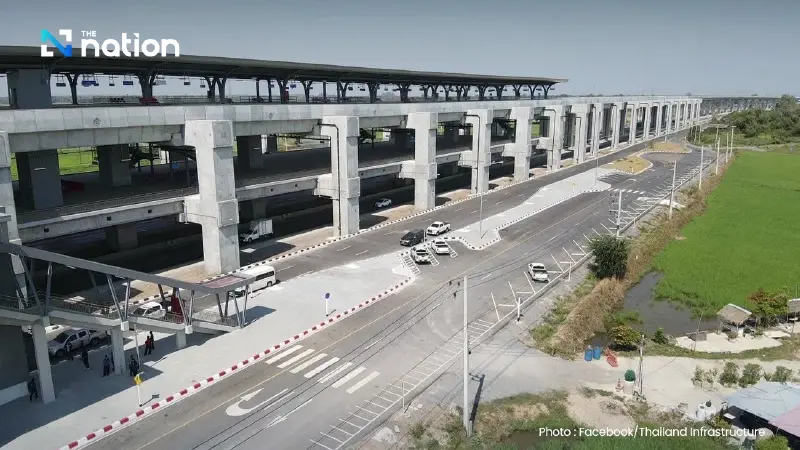


Phiphat says the Transport Ministry will prioritise road maintenance and prepare 20 major projects worth over THB1.38 trillion.
- Thailand's Ministry of Transport has outlined 20 key projects valued at over THB 1.38 trillion, with most to be implemented via public-private partnerships to reduce state investment.
- The plan encompasses land, rail, air, and water transport, featuring major initiatives such as new expressways, double-track railway lines, and significant airport expansions.
- Among the most notable projects are the THB 900 billion "Land Bridge" initiative, the development of Don Mueang and Suvarnabhumi airports, and the construction of several new expressways and motorways.

Transport Minister Phiphat Ratchakitprakarn said the Prime Minister had laid down policy directions for preparing the budget under an expenditure framework of THB3.788 trillion.
He said the guidelines required spending to be “targeted and precise” and to support the “10 Plus” policy, aimed at steering the country through the crisis while laying the foundations for sustainable development and accelerating Thailand’s move out of the middle-income trap.
The approach will be implemented through five key policy areas: the economy, foreign affairs and security, society, disasters and the environment, and public administration and legal reform.
The Prime Minister also stressed that government agencies must use the budget based on value for money and zero-based budgeting, taking into account necessity, urgency and appropriateness under the current situation.
Unnecessary expenditure must be cut, while requests for additional budget allocations must not exceed 20% of the previous year’s allocation and must be for investment expenditure only.
The government is also seeking to promote clean energy, including the use of electric vehicles and the installation of solar rooftops at various agencies, as part of efforts to cope with the long-term energy crisis and strengthen all-around security readiness.

For the Ministry of Transport, the Prime Minister instructed the ministry to focus on maintaining and repairing existing road networks so they remain efficient and ready for continuous use, rather than prioritising new construction projects.
The approach is intended to ensure value for money in resource use, reduce state expenditure and sustainably improve transport safety.
“The Ministry of Transport and its affiliated agencies are ready to apply the Prime Minister’s policies and operational guidelines in planning and preparing the budget so that concrete results can be achieved,” Phiphat said.
“The ministry has also instructed all agencies under its supervision to prepare budget requests in line with government policy, with priority given to the development of efficient transport infrastructure, while placing the highest importance on the interests of the public and the country. This will help support the government’s policy drive and enable it to achieve its goals,” he added.
Meanwhile, key investment projects under the Transport Ministry’s plan will be gradually submitted to the Cabinet or relevant committees for approval. Most will be implemented under public-private partnership arrangements to reduce state investment. There are 20 projects in total, worth more than THB1.38 trillion.

The land transport projects
- The Chalong Rat–Bangkok Outer Ring Road Expressway, eastern Bangkok, is worth THB13.655 billion.
- The Bang Pa-in area network development project, including links with the M6 motorway, Asian Highway and M9 motorway, is worth THB9.651 billion.
- The second-level elevated expressway, or Double Deck, on the Ngam Wong Wan–Rama IX section, is worth THB34.8 billion.
- The M8 Nakhon Pathom–Pak Tho motorway, worth THB54.562 billion.
- The Srinakarin–Suvarnabhumi Airport Expressway, worth THB20.811 billion.
- The Phuket Expressway, Mueang Mai–Ko Kaeo–Kathu section, is worth THB46.751 billion.
- The eastern section of the third outer ring road motorway, from Highway 305 to Highway 304.
- The eastern Hat Yai bypass construction project on a new alignment, from the Highway 43 junction to the Highway 4 junction.
The rail transport projects comprise double-track railway construction on three sections
- Chumphon–Surat Thani, worth THB30.42253 billion.
- Surat Thani–Hat Yai–Songkhla, worth THB66.27051 billion.
- Hat Yai–Padang Besar, worth THB7.77290 billion.
The air transport projects
- The East Expansion of the passenger terminal building at Suvarnabhumi Airport, worth THB13.829 billion.
- The Suvarnabhumi Airport Development Master Plan, 2025 edition.
- The Don Mueang Airport development project, Phase 3, is worth THB69.285 billion.
- The Chiang Mai Airport development project, Phase 1, is worth THB16 billion.
- The Phuket Airport development project, Phase 2, is worth THB6.211 billion.
- The preliminary feasibility and investment-worthiness study for Andaman Airport and Lanna Airport.
The water transport projects
- The development of a cruise terminal to accommodate large cruise ships in the Koh Samui district, Surat Thani province.
- The Land Bridge project, worth THB900 billion.
- The development of waterborne freight transport along the Pak Nam Pho–Samut Sakhon route, linking the MR–MAP–13 route.

