
Leading with Purpose: How Seven Women Shape a School’s Soul
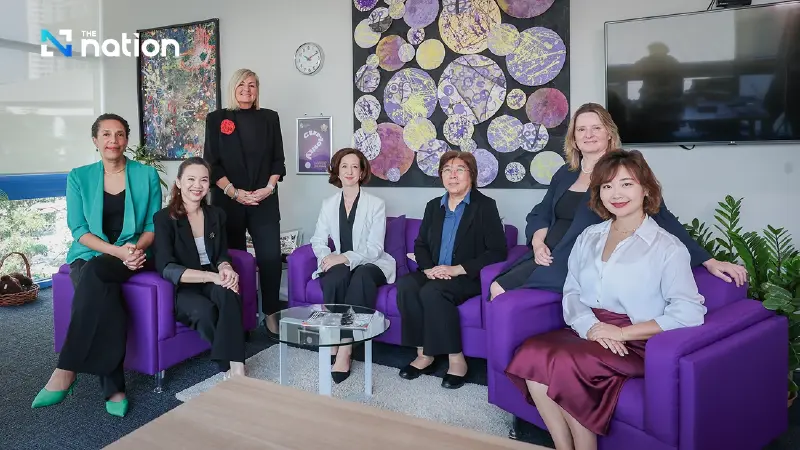


At Shrewsbury Bangkok City Campus, female leaders across academics and operations prove excellence emerges when strength meets care
- The school's culture is shaped by seven female leaders who prioritize a philosophy of "warmth as strategy," blending high academic expectations with deep, supportive care for students.
- Their leadership is defined by collaboration over competition, integrating all aspects of the school—from academics and bilingual education to operations and safety—to create a unified and trusting environment.
- These leaders model a leadership style that balances firmness with empathy, reframing traditionally male-dominated operational roles as "care work" and demonstrating that authority can be both compassionate and effective.
- By visibly leading across all school departments, they serve as powerful role models, teaching students that leadership is about integrity and showing that strength and kindness can coexist.
At Shrewsbury Bangkok City Campus, female leaders across academics and operations prove excellence emerges when strength meets care.
International Women’s Day has long been a moment to celebrate women’s achievements. But at Shrewsbury International School Bangkok City Campus, it offers something more: a case study in what happens when women lead not just classrooms, but every pillar holding up a school—from Early Years education to finance, from curriculum design to safety systems.
Here, seven women form a leadership ecosystem where academic rigour meets operational precision, where care doesn’t compromise accountability, and where the whole truly exceeds the sum of its parts. This is leadership as collaboration, not competition. As empathy, without losing edge.

Building Warmth Through Connection
When Founding Principal Amanda Dennison speaks about the school’s defining quality, she doesn’t mention exam results or facilities first. She talks about warmth. Not as sentiment, but as strategy.
‘Children are always at the heart of what we do,’ Dennison says. ‘From the very beginning, building a caring community has been our priority. We may have wonderful facilities, but it is the people inside them who make this school.’
That intentionality began with small but telling details. When the school opened, staff received ‘people in your pockets’ notebooks—a simple tool to ensure everyone connected from day one.
The principle scales upward: staff eat lunch with children they don’t teach, adults know students beyond their own year groups, and respect flows through every interaction.
‘Respect is a non‑negotiable,’ Dennison explains. ‘Whether in the classroom, the playground, or the staff room, adults model it with each other and with students. Tone, language, and presence matter.’
Her leadership philosophy centres on holding two truths simultaneously: children must be challenged academically, and they must feel deeply cared for. ‘We hold high expectations, always paired with high support,’ she says. ‘We believe children can do hard things, but we walk beside them as they do.’

Vision Into Practice
For Vice Principal Fiona Betts, leadership means translating vision into the ordinary moments of school life.
‘A vision only matters if it is visible,’ she says. ‘I work closely with staff to ensure expectations are clear, consistent, and rooted in what is best for our students.’
Betts, who also serves as Designated Safeguarding Lead, sees safeguarding not as a separate strand but woven through everything the school does.
‘When staff, students, and families experience consistency and care day after day, trust grows,’ she observes. ‘That trust is what allows the community to flourish.’
She draws a clear distinction between managing and leading.
‘Managing is about systems, timetables, and structures; leading is about people, purpose, and relationships. Strong systems create stability, but it’s noticing, listening, empathy, and shared responsibility that create belonging.’
Shaped by leaders who led with integrity and humility over her 30-year career, Betts offers direct advice to young women stepping into responsibility: ‘Find your voice. You don’t need to lead like someone else. Leadership is about knowing your values, staying curious, and having the courage to act with kindness and conviction.’

Leadership Across Learning Stages
Cath Okill, Assistant Principal for Early Years and Key Stage 1, focuses on the foundation years where emotional security enables academic growth.
‘In Early Years, our youngest learners thrive when they feel safe, valued, and confident, because this strong sense of belonging allows them to fully embrace and engage in their learning journey,’ she explains. ‘My role is making sure every child knows they belong and that adults understand their individual needs.’
Ms Cath (how the children called her) emphasises that leadership in a school must flow through all levels.
‘We expect all staff to be leaders in their own right, whether male or female,’ she says. ‘They need to take on that leadership role so children become leaders in the classroom, leading their own learning.’
She also acknowledges the hard-won nature of female leadership positions.
‘Male dominated leadership is quite common,’ she observes. ‘When you have female leadership, it means they are exceptional in their field. They have to work harder than males to get into those positions.’

For older Primary students, Courtney Grollé, Assistant Principal for Key Stage 2, balances structure with agency.
‘As children grow, they need more independence alongside clear boundaries,’ she says. ‘My focus is helping teachers create environments where students take ownership of their learning whilst still receiving the guidance they need.’
Grollé articulates the team’s learning-first mindset: ‘As leaders, we’re all learners first. We’re curious. To choose the right path, we start with why we want to do it, what we’re doing, and who it will impact. It comes back to the children always—what can we do better every day for the 600 hearts and minds that come here?’

Bridging Cultures, Building Futures
Luna Cao serves as Chinese Principal of the Hanqing Bilingual Pathway, overseeing a bilingual learning pathway where children learn through both English and Mandarin. Her journey from China to Thailand embodies the courage she hopes to inspire in others.
‘Few Chinese teachers will step outside China because the home country is their comfort zone,’ Cao explains. ‘Most are very family oriented, staying in their hometown with parents and big families. I stepped out after 40 years. I want to inspire young teachers to have courage. The world belongs to you if you decide it does.’
Cao’s leadership extends beyond curriculum delivery to building trust across cultures.
‘Coordinating bilingual education means ensuring children develop rich bilingual skills whilst maintaining the British curriculum’s academic standards,’ she says. ‘Strong bilingual education depends on strong adults working together to provide the right support for children.’
As both an educator and a mother, Cao sees how these identities strengthen her work.
‘We are not only leaders in school, but mothers,’ she reflects. ‘We need to manage time and balance work and life. That gives us strength to have more empathy for parents. We wear different hats and feel for the parents.’
She carries a Chinese saying into her leadership: ‘刚柔并济 (Gāng róu bìng jì) —true strength lies in balancing firmness with gentleness. This belief shapes how I lead: being strong with purpose, while always leading with empathy and humanity.’

When Operations Become Care Work
Suparom Magroodtong’s role—Director of Business Services overseeing operations, safety, and daily logistics—has traditionally been male terrain. She reframes it entirely.
‘People sometimes think operational leadership is only about logistics or rules, but it’s actually very people-focused,’ Suparom says. ‘It’s about listening, caring, and making thoughtful decisions every day.’
Her leadership philosophy centres on invisible excellence.
‘Leadership isn’t about being visible all the time,’ she explains. ‘It’s about quietly making sure everything is in place so teaching and learning can happen without disruption. When systems work well, people don’t notice them, which is a good thing.’
Much of Suparom’s work happens before problems arise: traffic flow planning, medical response procedures, facility checks, contingency planning.
‘Parents don’t usually see this work, but it’s what keeps the school feeling calm and organised,’ she says. ‘When children feel safe and adults feel prepared, the whole environment is more relaxed.’
She builds a safety culture by normalising rather than dramatising it.
‘Clear routines, regular practice, and simple language go a long way,’ she notes. ‘When safety becomes part of everyday life, it feels reassuring instead of scary, and the campus stays warm and welcoming.’
To young women, Suparom offers forthright counsel: Be a risk-taker, be resilient, lean into that natural resilience within us that makes us unique in embracing challenges ahead of us.

Numbers Serving People
Phannee Tangpagasit, School Manager responsible for accounting, finance, and licences, ensures the school’s financial foundation supports its educational mission.
‘The financial side does our best to support the smooth inflow and outflow of daily activities together with a long-term investment plan,’ she explains.
Her work encompasses both visible and invisible dimensions.
‘My role as a back officer supporter is essential to the smoothness of daily operations,’ Phannee says. ‘Information from various departments must be summarised and analysed to support papers and reports requested by management, owners, shareholders, government agencies, and auditors.’
Phannee embodies the team’s flexibility around resources.
‘Although the school leads by budget, it can be flexible,’ she notes. ‘We have budgets to support education, but if there’s something additional that supports learning, we can request approval case by case. Numbers can always be adjusted to satisfy people matters.’
Her advice to young women eyeing fields that are still seen as unwelcoming or challenge the premise: ‘I would say, don’t judge the book by its cover. Encourage them with positive thinking: if other people can do it, why can’t I? Don’t judge anything before starting.’

Collaboration as Core Strength
What distinguishes this leadership team is how they work together. Betts names it directly: support.
‘In this outstanding female leadership team, there’s a lot of support and collaboration,’ she says. ‘Male ego can sometimes override the actual role. We’re very collaborative. That’s one of our strengths, running right through our spinal cords.’
Grollé pushes back gently on gendered assumptions about leadership styles.
‘There are times when there needs to be strong directive thinking,’ she notes. ‘I wouldn’t say that’s owned by men. What’s powerful about this table is we recognise our own unique strengths.’
For Cao, the team’s diversity itself signals possibility.
‘One reason I decided to join City Campus is the diversified leadership from different cultural backgrounds,’ she says. ‘Female leadership can lead. We show leadership in different ways.’
The team describes their dynamic in vivid terms. ‘We have different expertise depending on the situation,’ Cao explains. ‘We finish each other’s sentences. We know the trust comes from the right heart. Together we’re very powerful.’

Cultivating the Inner Compass
What do these leaders hope students will carry forward? Dennison speaks of developing an ‘inner compass’—values embedded so deeply that young people can navigate independently.
‘During their time here, we want children to develop their own inner compass, one that helps them make wise decisions, treat others with respect, and carry integrity into every part of their lives,’ Dennison says. ‘Strengthening that compass is as important as academic success, because our ultimate goal is to nurture not only learners, but good citizens who contribute positively to their communities.’
Dennison continues: ‘True leadership is not measured only by test scores. It is measured by whether children leave school feeling engaged, happy, safe, secure with who they are, and guided by values that will serve them for life.’
Ms Cath sees this compass developing through how teachers model leadership themselves.
‘As a primary-focused school, we pride ourselves on a faculty comprised entirely of primary education specialists. This singular focus ensures that our pedagogy is perfectly tuned to the unique developmental needs of our younger learners,’ she notes, ensuring children experience leadership that understands their developmental stage.
Betts extends the vision to students’ futures: ‘These children will likely be leaders themselves—in companies, organisations, family businesses. We want them to be ethical leaders who can make a difference to Thailand or wherever they end up.’

Seeing Women Lead
Dennison articulates what children learn from witnessing female leadership. ‘All leaders can show that strength can be kind, that authority can be firm yet compassionate, and that confidence is about lifting others while standing tall yourself,’ she says. ‘But when children see women leading, those lessons become especially vivid.’
‘Girls see that their voices belong in the room and their ideas deserve respect. Boys see that strength and kindness can coexist. And all children learn that leadership is not about control, but about dignity; measured by the respect you show, the fairness you choose, and the way you treat people when no one is watching.’
Cao hopes her presence sends a particular message to students not only from China but from around the world: ‘You can be seen, recognised, and valued globally. The skills you are developing now—your languages, your mindset, your approach to learning—truly matter. If you believe in yourself and stay open to the world, there is space for you to contribute, to lead, and to belong on a global stage.’
A Call to the Sector
Asked what one action the education sector should take regarding women in leadership, Dennison’s answer is direct: ‘Employ more women in leadership positions.’
The statistics support the urgency. Betts cites patterns from the UK: whilst primary teaching is overwhelmingly female, headteacher roles flip to male dominance. Dennison notes that at FOBISIA (The Federation of British International Schools in Asia) conferences for Southeast Asian school principals, women now constitute perhaps 13 per cent—still a stark minority.
Suparom’s message to young women is unequivocal: ‘You don’t have to be the loudest voice to make a meaningful impact. Feel confident stepping into roles that influence how organisations run, even if those roles are behind the scenes.’

The Shrewsbury Difference
In Bangkok’s crowded international school landscape, what makes Shrewsbury Bangkok City Campus distinct? Dennison points to continuity and commitment. ‘A leadership team who have been here from the start,’ she notes. ‘Fifty percent of us are the founding leadership team. As we’ve grown, many of the best additions to our team have continued to be women.’
That continuity creates coherence. Care shows up in daily choices: in how the school designs environments with light, warmth, and beautiful materials; in how staff engage students with broad, exciting opportunities; in how behaviour challenges receive restorative approaches.
The team reminds themselves and students with shared language—phrases like ‘We do hard things together’—that excellence and empathy are not opposites, but partners.

Leadership as Role Modelling
As International Women’s Day approaches, the visibility of women leading across every dimension of school life matters not just symbolically, but practically. These seven women demonstrate daily that a school truly thrives when learning, people, systems, and safety work in harmony.
Dennison’s quiet judgment calls—choosing fairness, protecting confidentiality whilst remaining transparent, balancing consistency with compassion—form the scaffolding that makes the school strong, caring, and trustworthy. Betts’ translation of vision into practice creates the consistency that builds trust.
Ms Cath and Grollé ensure children feel secure enough to take academic risks. Cao bridges cultures whilst maintaining academic standards. Suparom makes safety feel normal rather than frightening. Phannee ensures resources flow where learning needs them.
Together, they embody what Dennison articulates as the school’s foundation: ‘Safety before success. Emotional and physical safety is the foundation of learning; without it, achievement cannot flourish.’
For the 600 students who walk through Shrewsbury International School Bangkok City Campus each day, leadership isn’t an abstract concept.
It’s the women they see making decisions, solving problems, showing up with both clarity and care.
It’s learning that you don’t need to choose between being kind and being competent, between having high standards and offering high support, between leading with strength and leading with heart.
That, ultimately, is the lasting impact of women’s leadership here: not just what these seven accomplish, but what the next generation comes to believe is possible.
About Shrewsbury International School Bangkok City Campus
Shrewsbury International School Bangkok City Campus offers British curriculum education for children aged 2-11 (Nursery through Year 6). Located in central Bangkok, the school provides two learning pathways: the British International Pathway and the Hanqing Bilingual Pathway (Mandarin-English). Currently serving approximately 550 students from diverse backgrounds, the school is part of the Shrewsbury family, which opened its first Asian campus—Riverside—in 2003.
