
Thai economist links Bessent’s IMF–World Bank absence to Trump’s bilateral focus
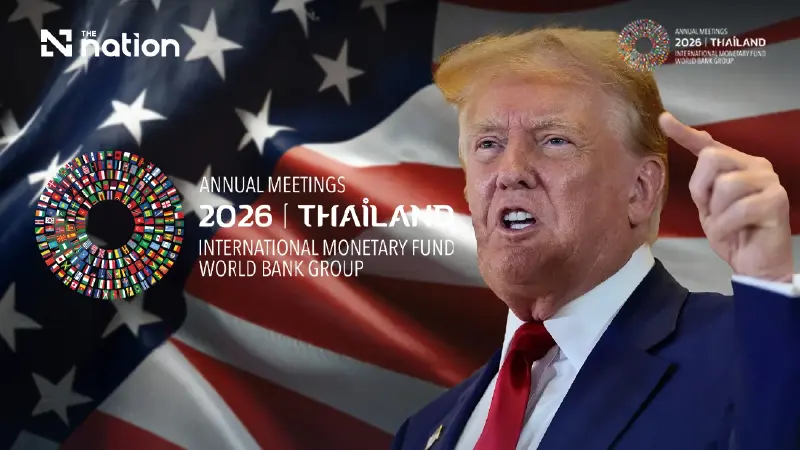


Aat Pisanwanich urges Thailand to turn the IMF–World Bank meetings into action on artificial intelligence, growth, digital finance and green investment.
- Thai economist Aat Pisanwanich asserts that US Treasury Secretary Scott Bessent's absence from the IMF and World Bank meetings reflects the Trump administration's preference for bilateral negotiations over multilateral forums.
- Aat argues that the Trump administration favors direct negotiations with individual countries as it gives Washington greater control over trade, investment, and economic sanctions.
- The economist suggests that as a result, the outcomes of the IMF and World Bank discussions may have limited influence on US economic decisions, especially if they don't align with the administration's policies.
US Treasury Secretary Scott Bessent’s absence from the International Monetary Fund (IMF) and World Bank annual meetings in Bangkok reflects President Donald Trump’s preference for making economic and trade decisions independently of multilateral forums, according to Thai economist Aat Pisanwanich.
Assoc Prof Aat Pisanwanich, a lecturer at Rangsit University’s Faculty of Economics, offered the assessment on the programme Inside Thailand, arguing that the Trump administration places greater emphasis on negotiations with individual countries.
Aat said the United States remained a major economy with an important role in both institutions. The Treasury secretary’s absence did not remove the significance of the meetings, as other member countries continued to participate.
However, Aat argued that Bessent’s absence could reduce opportunities for negotiations and international cooperation through the multilateral gathering.
Bilateral negotiations give Washington greater control
Aat said the Trump administration tended to favour direct negotiations with individual countries over reaching collective agreements through international forums.
Aat linked that preference to Washington’s approach to trade, investment and economic sanctions, areas in which the United States can make decisions without waiting for conclusions from international meetings.
Consequently, Aat argued, the outcomes of IMF and World Bank discussions might have limited influence on US economic decisions, particularly where the recommendations did not align with the Trump administration’s policies.
Aat cited green investment and reductions in carbon dioxide emissions as examples of issues that Washington might not prioritise to the same extent as other countries.
Four priorities for Thailand as meeting host
Thailand should use its role as host to secure concrete economic benefits beyond the positive image associated with organising an international event, Aat said.
Aat urged the government to translate key discussions into practical economic policies, identifying four priorities.
1. Use artificial intelligence to add economic value
Aat said Thailand should apply artificial intelligence (AI) to improve productivity, create jobs and increase the value of goods and services.
Agriculture, manufacturing and services offered opportunities to put AI into practical use, Aat said. Thailand could benefit substantially from the technology even without being one of the world’s major AI technology owners.
2. Monitor the global and Thai economic outlook
Aat identified the IMF’s economic forecasts as another important area for Thailand to follow.
Aat noted that the IMF had previously projected Thai economic growth of 1.9% in 2026. Any upward or downward revision would have implications for economic policy and preparations to manage future risks.
3. Build secure digital financial systems
Aat urged Thailand to accelerate the development of safe and reliable digital financial systems to address financial scams and online crime.
Aat said these threats affected both individuals and the wider economy, making security and public trust essential to the development of digital finance.
4. Extend green investment support to smaller businesses
Aat said reducing carbon emissions and adapting to a green economy were important challenges for Thailand, although larger companies were better equipped to invest and change their production processes than farmers and small businesses.
The government should therefore provide access to finance, technology and expertise so that businesses of all sizes could adapt, Aat said. Support should enable that transition without imposing additional costs that undermine competitiveness.
Aat said all four priorities should form part of Thailand’s follow-up to the international meetings, delivering long-term economic benefits beyond those generated by hosting the event.
The government needed to turn proposals and knowledge gained from the meetings into policies that increased economic value, strengthened competitiveness and prepared Thailand for changes in the global economy, Aat said.
