
AOT cuts passenger target as Middle East war weighs on travel
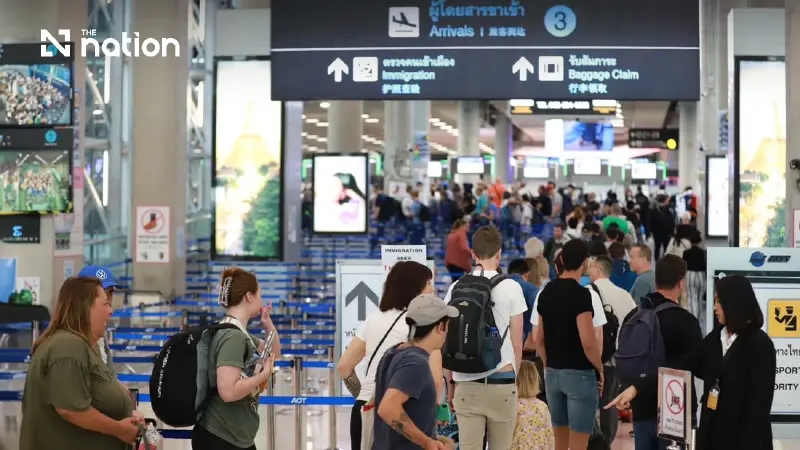


AOT expects passenger numbers at its six airports to remain flat this fiscal year at around 126 million, before growing by 2% next year.
- Airports of Thailand (AOT) has cut its passenger growth forecast for the current fiscal year to 0%, keeping volume flat at 126 million, due to the war in the Middle East.
- The conflict has caused oil price volatility, which increases airline fuel costs—a major component of ticket prices—thereby affecting passengers' travel decisions.
- Despite the current situation, AOT projects a conservative 2% passenger growth for the next fiscal year, assuming the geopolitical situation improves.
- To mitigate the impact, AOT is pursuing new routes in high-demand markets such as India, China, and Europe, and offering incentive schemes to airlines.
Paweena Jariyathitipong, president of Airports of Thailand Public Company Limited (AOT), said the war in the Middle East had prompted AOT to revise down its business targets.
Under the latest forecast, passenger growth across AOT’s six airports for the current fiscal year, ending in September 2026, is expected to stand at 0%, or remain flat from the same period last year. Passenger volume in the previous year was around 126 million.
Paweena said the conflict in the Middle East had affected oil-price volatility. Fuel costs account for as much as 40% of air ticket prices, while the passenger service charge (PSC) accounts for only about 5%. Even if the war ends, AOT expects oil prices to remain high for some time, which could affect passengers’ travel decisions.
However, AOT remains confident that the aviation industry will return to growth in the next fiscal year if global unrest eases. The company is also preparing strategic plans to cope with volatility from external factors.
Passenger numbers forecast to grow 2% next year
For the next fiscal year, AOT has adopted a conservative forecast, expecting passenger numbers to grow by around 2% to approximately 129 million, up from the 126 million expected this year. The forecast is based on hopes that the war situation will ease and travel sentiment will improve during the winter flight schedule.
Advance slot bookings for the winter schedule are currently about 2% higher than last year. Although the increase is modest, AOT views it as an improved signal compared with last year, when 17% of slots were cancelled as airlines lost confidence amid uncertainty.
AOT has been working closely with airlines this year, seeking their cooperation in maintaining flight slots so that passenger volumes into Thailand can be forecast more accurately.
New markets and routes targeted
Despite geopolitical tensions in the Middle East affecting travel decisions, flight routes, airline fuel costs and other factors, AOT sees an opportunity to accelerate the opening of new markets and routes that do not yet have direct flights.
The focus will be on high-demand markets such as India, China and Europe, while also increasing regional connectivity and supporting connecting routes.
AOT is currently offering an aviation market stimulation scheme for airlines that open new routes to AOT airports. The scheme, which runs until October 28, 2028, offers discounts on landing charges, aircraft parking charges and passenger boarding bridge fees.
AOT will also take part in route development meetings and business negotiations to present the feasibility of new air routes and encourage airlines to open new services or increase flights to Thailand.
Unused airport land to generate new revenue
AOT also plans to make use of vacant land around airports to support aviation and tourism, create new revenue for the organisation, distribute income to surrounding communities and generate employment.
The land could be developed into airport hotels, logistics parks, aviation parks, vehicle service and maintenance centres, electric-vehicle charging stations, rental offices and recreation centres offering health and entertainment activities. AOT plans to invite private-sector operators with relevant expertise to invest in these projects.
AOT pushes green airport development
On its path towards net-zero greenhouse gas emissions, AOT has announced an environmental policy aimed at making all six airports leading international airports that are sustainable and friendly to both the environment and surrounding communities.
The plan includes reducing greenhouse gas emissions through solar rooftop power systems installed on passenger terminal buildings, with the electricity generated to be used within airports.
AOT has also introduced a policy requiring all vehicles operated by AOT and airport businesses seeking permission to operate inside airports to be electric vehicles. New buildings developed under AOT’s plans must also be energy-efficient or green buildings.
AOT said it remains committed to strengthening airport operations as part of its goal to become a world-class aviation hub. The company will continue raising safety and service standards through modern technology, while upholding good governance, transparency and accountability to support stable and sustainable growth in line with Thailand’s long-term national development goals.
