
CP Group launches Reforest Tokenisation to turn forest recovery into Thailand’s natural capital model
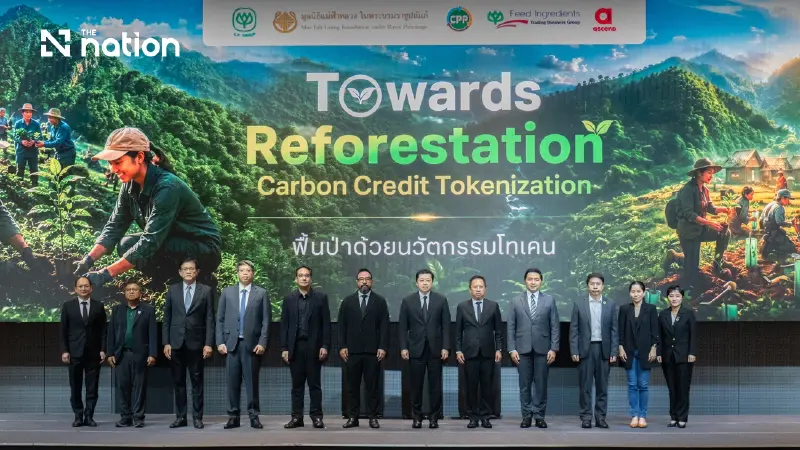


CP Group has launched its Reforest Tokenisation initiative, with the Mae Fah Luang Foundation under Royal Patronage serving as the first partner in a pilot covering more than 10,000 rai in Chiang Mai, Chiang Rai and Tak. The initiative aims to connect carbon credits, blockchain and community forest income as part of Thailand’s wider natural capital economy.
Charoen Pokphand Group (CP Group) has launched a Reforest Tokenisation model aimed at turning Thailand’s natural capital into part of the digital economy, beginning with a pilot project covering more than 10,000 rai in Chiang Mai, Chiang Rai and Tak in partnership with the Mae Fah Luang Foundation under Royal Patronage.
The model is designed to use digital technology and blockchain to connect the economic value of forest restoration and conservation with a transparent and verifiable system.
According to CP Group, the Mae Fah Luang Foundation is the first partner under the initiative and will help develop a new value-creation model for conservation that can generate income for forest communities while supporting the wider development of Thailand’s natural capital economy.
Carbon credits will be merely the starting point for the scheme, before the model is expanded to cover broader forms of natural capital, including ecosystems, biodiversity, water resources and the value created by communities that protect forests.

Forests as natural capital
Suphachai Chearavanont, Senior Vice-Chairman of CP Group, said future forest conservation must create economic incentives for people living with forests, enabling them to earn income from protecting natural resources rather than from activities that damage them.
He explained that Reforest Tokenisation was intended to turn forests into digital assets that represent natural capital, linking conservation with economic mechanisms and opening a practical channel for participation by the public, businesses and other sectors.
Suphachai noted that forests play a vital role in human survival, absorbing 31% of carbon generated by human activity, serving as the source of 75% of the world’s freshwater, providing habitats for 80% of terrestrial life and supporting the livelihoods of 90% of the world’s poorest population.
He also pointed to continued forest loss in the Mekong region between 1990 and 2025, with Cambodia losing 42% of its forest area, Laos 9.5%, Myanmar 3.9% and Thailand 2.9%.
Although Thailand has preserved its forests better than several neighbouring countries, he stressed that the country’s goal should go beyond protection to include forest expansion, while also tackling wildfires and PM2.5 pollution.
Drawing on field experience in Nan province with the Mae Fah Luang Foundation, Suphachai said effective conservation was not only about planting trees, but also about enabling people to live with forests in balance, with better quality of life and sustainable livelihoods.
He added that forests carried value beyond carbon absorption, including watershed protection, biodiversity, wildfire prevention and community stewardship. The tokenisation model would convert these values into economic incentives, with revenue returning to communities that care for forests.
Under the pilot, about 200 households responsible for roughly 10,000 rai of forest could potentially earn an additional 10,000–15,000 baht per household per month from conservation, alongside high-value crop cultivation.
CP Group believes this could help shift incentives away from forest degradation and towards long-term protection, creating a model that can be expanded across Thailand and the region.

ML Dispanadda Diskul, secretary-general and chief executive officer of the Mae Fah Luang Foundation, said natural resource conservation must progress alongside improvements in community quality of life.
Communities living closest to forests often form the first line of defence against environmental crises, he noted, adding that nature cannot survive if local people cannot sustain themselves.
He called for a new way of calculating business costs that includes natural capital and the future quality of life of communities. He also warned that the “cost of inaction” would be higher if natural resource bases collapsed, with the impact eventually returning to the business sector.

Roadmap to 2030
CP Group has set out a roadmap for the project from 2026 to 2030. The plan aims to build a mechanism that can systematically connect data on forest restoration, carbon storage and natural resource outcomes with partners across sectors.
In the first phase, within 2026, carbon credits from forest areas developed by the Mae Fah Luang Foundation will be offered through the TrueMoney application.
The model will allow users to support forest conservation through an instant-redeem format. At this stage, users will not hold coins or tokens in a digital wallet. Instead, digital technology and blockchain will be used to connect the process of selecting, paying for and receiving a carbon offset certificate in one experience.
In later phases, CP Group plans to develop Reforest Tokenisation into a full mechanism under relevant laws and regulatory supervision.
Tokens would be used to link the value of natural resources, not only carbon credits but also ecosystem restoration, biodiversity and other ecosystem services.
The aim is to enable businesses, investors and the public to help build Thailand’s natural capital while allowing conservation to drive economic, social and environmental progress in parallel.
The pilot areas in Chiang Mai, Chiang Rai and Tak cover more than 10,000 rai, with an estimated 10,000 tonnes of carbon dioxide equivalent in carbon credits.
CP Group also plans to work with the Mae Fah Luang Foundation to develop a revolving fund for forest restoration worth 30 million baht by 2030, enabling resources generated from conservation to continue supporting communities and restoration work.

Technology, communities and collaboration
The initiative was presented at the “Tokenizing Reforestation: Reviving Forests through Token Innovation” event at True Digital Park’s Grand Hall in Bangkok, under the theme of building a future where nature, technology and communities grow together.
More than 250 representatives from the government, the Thailand Greenhouse Gas Management Organisation, international organisations, the private sector, academia and CP Group businesses attended.
The event also featured a panel discussion titled “Unlocking Forest Value through Collaboration”, focusing on how forest restoration can become a scalable model through community participation and economic incentives.
Smitthi Harueanphuech, Head of Nature-Based Solutions at the Mae Fah Luang Foundation, emphasised that sustainable forest conservation must begin with communities by listening to their needs, building knowledge and using technology together with transparent verification systems.
When communities earn income from carbon credits, he said, they gain a stronger incentive to protect forests, reduce wildfire problems and support conservation models that are transparent and free from greenwashing.

Jhomkitti Sirikul, Executive Vice President Head of Sustainability Development : Public Sector and Corporate Relations at Charoen Pokphand Group, said the group had worked with the Mae Fah Luang Foundation and the Royal Initiative Discovery Foundation for more than a decade to improve the quality of life of communities living with forests.
The work has focused on creating sustainable careers and income through economic crops that can coexist with forests, such as coffee, while developing traceability systems and extending the model to carbon credits.
Worasit Sittivichai, Chief Operating Officer, Carbon Credit Business at Charoen Pokphand Produce, said CP Group’s businesses are closely connected with agriculture and farmers, including communities located near forests.
He noted that forest encroachment and burning remained key challenges, and that carbon credits could become an important mechanism to encourage conservation, reduce monoculture farming and support better water resource management.
Apinand Dabpetch, Managing Director of Ascend Bit and Group Head of Wallet & Growth at TrueMoney, said blockchain would be used to make participation in environmental projects easier, more transparent and verifiable.
Through the TrueMoney application, users will be able to choose carbon offset packages and receive certificates confirming their contribution.

The project positions Reforest Tokenisation as more than the use of digital technology in forest conservation. It seeks to lay the foundation for a new mechanism that turns forests into digital assets representing natural capital, creates income for communities that protect them and connects local knowledge, development expertise, digital tools, government, businesses and partners in support of people, forests and the country’s long-term natural capital.
