
TG's Cargo disruption puts Thai exports, buyer confidence, supply chain at risk
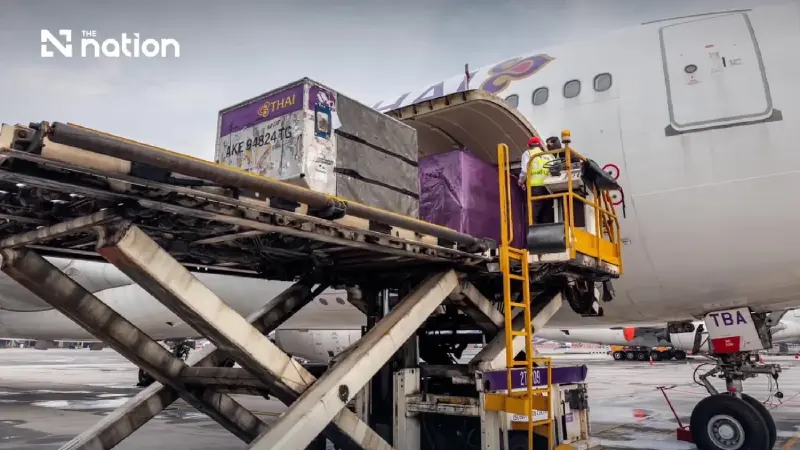


Thai Airways’ cargo disruption threatens exports and buyer confidence, while the Transport Ministry pledges to keep warehouse services operating
- A Thai Airways cargo suspension, caused by flooding that led to staff shortages, has created a major backlog of goods and prompted government intervention to keep services operational.
- The disruption severely impacts Thailand's export supply chains, particularly for time-sensitive goods like electronic components, threatening to halt overseas production lines.
- Officials and business leaders warn that missed delivery deadlines risk eroding international buyer confidence, which could lead to a permanent loss of customers to foreign competitors.
- The crisis is exacerbated by existing bottlenecks in cargo handling and a reduction in freight capacity due to numerous flight cancellations by the airline.
Thai Airways’ cargo disruption at Suvarnabhumi Airport has raised fears of missed export deliveries, interrupted production and lost overseas customers, prompting the Transport Ministry to intervene to keep warehouse services operating. Thai Airways had announced a suspension of cargo acceptance for October 1–6, 2026, after flooding prevented employees from reaching work and left goods awaiting delivery to customers or transfer to flights. The announcement drew criticism from businesses and government officials concerned about the consequences for imports and exports.
Transport Ministry moves to keep cargo services open
Deputy Prime Minister and Transport Minister Phiphat Ratchakitprakarn said on September 30 that Thai Airways had been asked to continue operating its cargo warehouse because a shutdown would have widespread consequences. The Transport Ministry would coordinate additional personnel to address staffing shortages.
Phiphat said Airports of Thailand (AOT) had also been asked to allocate temporary space at Suvarnabhumi Airport to consolidate stranded cargo from Thai Airways’ warehouse. Under the ministry’s intervention to keep cargo moving, import and export warehouse services would remain open, although freight acceptance could slow to match handling capacity.
Thai Airways’ wider disruption had already led to an announcement cancelling 37 flights between September 29 and October 1. Flight cancellations also reduced the space available for freight carried in passenger aircraft holds.
Electronics delays threaten production and future orders
Dhanakorn Kasetrsuwan, chairman of the Thai National Shippers’ Council (TNSC), said the cargo disruption was severely affecting export supply chains. Businesses choosing air freight depended on goods reaching their destinations on schedule.
“Goods have been produced, but there is nowhere for them to go. Aircraft can still fly, yet the goods cannot move onwards and are piling up at the airport,” Dhanakorn said. “The problem had already been developing and became most severe when Thai Airways stopped accepting goods and asked businesses to delay deliveries for two or three days.”
Dhanakorn said the principal goods affected were electronic components, which were small and lightweight but shipped in large quantities. Moving those consignments by sea was unsuitable because the products were delicate and the journey would take too long. The main affected markets included the United States, South Korea and Taiwan.
Dhanakorn warned that delivery failures could leave overseas manufacturers without materials needed for production. Buyers switching to alternative suppliers could also mean Thai exporters permanently losing customers.
“Thai Airways needs to mobilise staff to clear both the paperwork and the goods so that shipments can move smoothly again as quickly as possible,” Dhanakorn said.
The TNSC urged AOT to provide more cargo space and handling channels. The council also called on the Civil Aviation Authority of Thailand (CAAT) to remove unnecessary procedural steps while maintaining safety standards required by the International Civil Aviation Organization (ICAO).
Existing bottlenecks leave exporters few alternatives
Visit Limlurcha, vice-chairman of the Thai Chamber of Commerce and president of the Thai Future Food Trade Association, said air freight primarily served high-value goods, urgent shipments and products that needed to remain fresh.
Visit said rapid growth in electronics during 2026, including chips, hard disk drives and components, had increased pressure on cargo management and inspection systems. Imported components used in Thai assembly plants also depended on air transport.
Visit explained that air cargo underwent several inspection stages to meet ICAO standards and destination-country requirements. Goods potentially suitable for dual use required close scrutiny to prevent misuse, while the capacity of sniffer dogs used to detect suspicious materials was constrained by required rest periods.
“These problems had been building for some time before the heavy rain and the suspension of cargo services. Inspection equipment may be insufficient or too outdated to handle the increase in goods,” Visit said.
Visit said exporters could consider other operators or transport modes during a six- or seven-day interruption, but switching was difficult because alternative providers were already handling substantial volumes. Shipments to nearby countries offered more options, provided the additional journey time was comparable to the period of disruption.
Visit identified the United States, Europe, China, Japan, South Korea, the Philippines, the Middle East and South Asia as important markets served by Thailand’s air exports. Some shipments travelled in passenger aircraft holds, while certain international airlines operated dedicated freighters.
Visit said air freight cost several times more than sea transport, but contractual penalties for late delivery could exceed the additional freight expense. Delays also threatened exporters’ credibility and future orders.
“Manufacturers have to choose between paying higher air freight costs and missing delivery deadlines, facing penalties and damaging their credibility and orders,” Visit said. “A six- or seven-day cargo suspension could cause consignments due for delivery to accumulate. The backlog must be cleared while preparations are made for incoming goods to prevent the problem recurring.”
Cargo handling capacity is concentrated among major operators
Thai Airways has been developing its cargo business as a source of revenue beyond passenger fares. Krungsri Research recorded 155 cargo operators in Thailand as of June 2026, illustrating the breadth of the sector even as major warehouses account for substantial handling capacity.

Commerce warns that buyer confidence is at risk
Deputy Prime Minister and Commerce Minister Suphajee Suthumpun said air freight accounted for 26–27% of Thailand’s total export value. Suphajee described the effects over the preceding six days as short term, adding that their significance for overall exports could not yet be assessed.
“What is more worrying than the effect on export value is the impact on the confidence of trading partners and businesses,” Suphajee said. “For goods that need to travel by air, such as electronic components, missed delivery deadlines could prompt importers to turn to exporters in other countries.”
Suphajee said exporters could consider rerouting shipments or using other providers because Thai Airways was not the only air cargo operator. Resolving the disruption required cooperation among the Department of International Trade Promotion, the Department of Foreign Trade, CAAT, the Transport Ministry and the Customs Department.
Separate figures for January–July 2026 put Thailand’s air exports at 2.42 trillion baht, equivalent to 33% of total export value. Important products included electronics and components, fresh vegetables, fruit, flowers, chilled and frozen meat, seafood and premium food products, all with varying sensitivity to delivery times and quality controls.
The reported figures for 2025 valued electronics and components exported by air at 1.32 trillion baht. Those products included electronic circuit boards, semiconductors and hard disk drives, which form part of global technology supply chains.
Agricultural and food exports shipped by air were valued at approximately 380.804 billion baht in 2025. Fruit, seafood and premium food products were particularly vulnerable to delays and failures in quality control, potentially causing spoilage and lost income for exporters.
Customs remains operational as flight cuts reduce freight space
Customs Department director-general Phantong Loykulnanta said customs officers and related agencies continued to work normally, with more than half of personnel reporting for duty because they lived locally.
Panthong said Thai Airways needed to identify the causes of its operational problems, noting that other large cargo warehouses, including BFS Cargo, remained operational. Panthong suggested that reliance on outsourced workers employed on a daily basis might have contributed to staffing difficulties.
Panthong said cargo volumes had fallen significantly as commercial flight cancellations, particularly those involving Thai Airways, removed freight capacity from passenger aircraft holds.
The Customs Department and other agencies were working to accelerate the clearance of goods while closely assessing warehouse staffing and handling capacity over a seven-day response period.
