
Spirits and Beer Lift ThaiBev Full-Year Profit to 31.63 Billion Baht Despite Flat Demand


Lower raw material costs and operational efficiencies offset softer sales revenue of 331.04 billion baht, while food losses persist amid cautious spending
- ThaiBev's full-year net profit rose 1.5% to 31.63 billion baht, primarily driven by the performance of its spirits and beer businesses.
- Despite a 0.7% drop in total sales revenue and flat demand, the spirits and beer divisions saw net profits climb 7.8% and 9% respectively.
- The profit growth was attributed to lower raw material costs and operational efficiencies, which offset weaker sales and losses in the company's food division.
Lower raw material costs and operational efficiencies offset softer sales revenue of 331.04 billion baht, while food losses persist amid cautious spending.
Thai Beverage Public Company Limited (ThaiBev) posted a 1.5 per cent rise in net profit to 31,634 million baht for fiscal year 2026 (October 2025 – September 2026), as lower raw material costs and operational efficiencies in its core spirits and beer businesses offset slightly softer overall sales revenue.
Total sales revenue edged down 0.7 per cent year-on-year to 331,037 million baht, with top-line growth confined to the spirits and food divisions amid subdued consumer spending across key markets.
Segment Performance and Margin Drivers
Spirits and beer continued to serve as ThaiBev’s primary earnings engines, accounting for 64.4 per cent and 21.7 per cent of group net profit, respectively.
Together, the two alcoholic beverage divisions generated 72.5 per cent of total revenue, nearly evenly split between spirits (36.4 per cent) and beer (36.1 per cent).
Spirits: Revenue rose 1.5 per cent to 120,342 million baht, while net profit jumped 7.8 per cent to 21,008 million baht. Although overall domestic consumption remained flat, margins expanded on lower raw material expenses, improved operating efficiency, and reduced finance costs, outweighing higher income tax expenses.
Beer: Revenue declined 3 per cent to 119,490 million baht due to foreign exchange fluctuations and subdued demand, but net profit climbed 9 per cent to 7,089 million baht as lower input costs more than compensated for higher logistics expenses.
Non-Alcoholic Beverages (NAB): Revenue fell 1.5 per cent to 63,802 million baht (19.3 per cent of group revenue), while net profit decreased 3.6 per cent to 4,954 million baht (15.2 per cent of group profit), weighed down by border tensions, higher packaging costs, and expenses linked to dairy farm operations in Malaysia.
Food: Revenue grew 3.8 per cent to 22,731 million baht (6.9 per cent of group revenue), but the division recorded a net loss of 168 million baht, widening by 31.5 per cent. Performance in its quick-service restaurant portfolio, led by KFC, was pressured by cautious consumer spending, rising labour costs, and higher income tax charges.
Others: Revenue edged up 0.2 per cent to 5,011 million baht (1.5 per cent of group revenue), posting a net loss of 263 million baht, an 8.2 per cent contraction, with inter-segment eliminations accounting for -0.2 per cent of revenue.
Sales Volumes and Market Strategy
Across product volumes, spirits rose 0.8 per cent to 662 million litres, while soda slipped 0.1 per cent to 39 million litres.
Total beer volume declined 1.1 per cent to 2,347 million litres, alongside a 5 per cent drop in ancillary drinking water to 121 million litres.
Non-alcoholic beverage volume increased 1.2 per cent overall to 3,289 million litres, driven by an 8.1 per cent expansion in drinking water to 1,559 million litres.
By contrast, carbonated soft drinks dipped 0.9 per cent to 1,104 million litres, dairy products fell 2.6 per cent to 357 million litres, and ready-to-drink tea contracted 18.1 per cent to 269 million litres.
In Thailand, ThaiBev’s core spirits stronghold, the group focused on value-orientated offerings—including accessible products priced under 100 baht—alongside cross-brand product launches aimed at younger adult consumers.
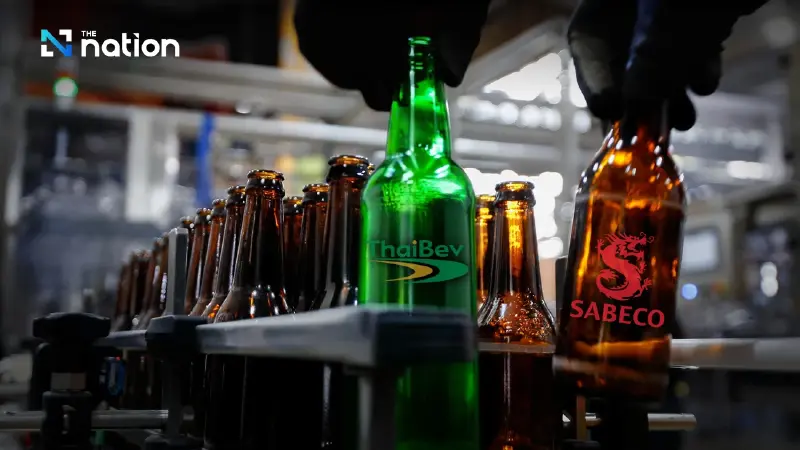
In the beer division, operations remained anchored in Thailand and Vietnam, where subsidiary SABECO navigated a K-shaped economic recovery and uneven purchasing power that kept sales growth in the single digits despite an internal double-digit growth target.
