
Thailand Turns to Green Transition as Energy Insecurity Threatens Growth
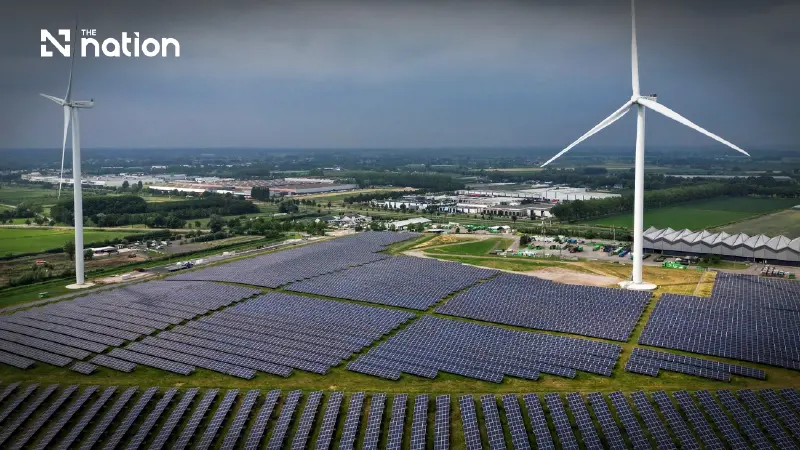


SCB EIC chief economist warns that Thailand's deep reliance on imported energy threatens long-term growth — and says the green transition is the structural fix the country can no longer delay
- Thailand's heavy reliance on imported energy, costing nearly 10% of its GDP, makes its economy highly vulnerable to global price volatility and threatens long-term growth.
- An accelerated green transition away from fossil fuels is being advocated as a crucial structural solution to improve energy security and provide an economic safeguard.
- While solar power is a key part of the transition, its economic impact is currently limited by the need to import panels and components.
- Experts argue that clear government policies and regulatory reforms, such as rules for selling surplus power to the grid, are more critical than public funding to attract private investment in green energy.
SCB EIC chief economist warns that Thailand's deep reliance on imported energy threatens long-term growth — and says the green transition is the structural fix the country can no longer delay.
Thailand must accelerate its shift away from fossil fuels or risk falling permanently behind its regional peers, the chief economist of SCB Economic Intelligence Centre (EIC) warned this week, as the kingdom's heavy dependence on imported energy leaves it acutely vulnerable to global volatility.
Speaking at a press conference on Thailand's economic outlook for 2026–2027, Dr Yunyong Thaicharoen said energy security had become one of the defining structural challenges for the country, particularly in the wake of continued instability in the Middle East.
"We are a country that imports energy worth nearly 10% of GDP, which is very high," Dr Yunyong said. "If we can succeed in reducing our reliance on imported fossil fuels, that is the KPI."

A Fragile Economy Exposed
Thailand's outsized energy import bill makes it unusually sensitive to swings in global oil prices. With energy expenditure equivalent to roughly a tenth of the country's entire economic output, any sustained rise in commodity prices ripples rapidly through domestic costs, squeezing both households and businesses.
To reduce that vulnerability, Dr Yunyong said nations — including Thailand — were increasingly seeking to diversify their energy sources and import origins, reducing over-reliance on any single region or supplier.
The green transition, he argued, offers not merely an environmental benefit but a long-term economic safeguard. Reducing the country's dependence on fossil fuels would directly address one of its most persistent structural weaknesses.

Solar Energy: Promising, but Not Without Caveats
Solar power featured prominently in Dr Yunyong's remarks as a critical pillar of the transition. He noted that the economics of rooftop solar have improved dramatically, with payback periods for households now as short as three to five years — a significant improvement that makes adoption increasingly attractive.
Yet he cautioned that in the near term, solar installations — alongside the uptake of electric vehicles — may deliver less of an economic boost than many expect, because the panels, batteries, and components are largely imported. This creates what economists call "leakage": capital flows out of the country rather than circulating within it.
To unlock the full potential of solar energy and draw in private capital at scale, Dr Yunyong argued that regulatory reform was more urgent than additional public spending. He called on the government to clarify the rules around Net Metering and Third Party Access (TPA) — frameworks that determine how households and businesses can sell surplus power back to the grid and access energy infrastructure.
"Clear policy is perhaps more important than money itself," he said. "If we can clear the rules, it will crowd in private investment."

Government Funding and Business Adaptation
A portion of the government's 400-billion-baht emergency decree has been earmarked to support the green transition, with the bulk of disbursements expected from the fourth quarter of this year and into 2027.
Manufacturing and transport sectors are already shifting towards so-called "Smart and Green" models, including wider adoption of electric vehicles.
SCB EIC has itself been channelling financing towards this transition. Dr Yunyong revealed that the bank had exceeded its three-year sustainable finance target of 150 billion baht, reaching 230 billion baht — a figure he described as reflecting genuine momentum in the private sector's appetite for green investment.

Structural Reform, Not Just Stimulus
Dr Yunyong was candid about the scale of the challenge facing Thailand's economy more broadly. SCB EIC has trimmed its GDP growth forecast for the current year to 2%, reflecting an "uneven" or K-shaped recovery in which high-tech industries are advancing while much of the wider economy lags behind.
He argued that approximately 70 to 80 per cent of Thailand's economic problems are structural in nature, requiring sustained reform rather than short-term fiscal stimulus.
"We will be like the 'sick man of Asia'... our growth is lower than others and has been low for many years. Therefore, 70–80% of the problem is structural," he said.
Among the reforms he advocated were using external commitments — such as OECD accession or new free trade agreements — as "anchors" to drive domestic change that the Thai bureaucracy has historically struggled to implement from within.
He also called for serious action on corruption, which he said imposed costs that undermined Thailand's international competitiveness.
Fiscal space, he warned, was narrowing. With global interest rates remaining elevated for longer, debt servicing costs were rising, compounding pressure on the national budget at a time when households are increasingly reliant on state support.

Skills for a Green Economy
Dr Yunyong also highlighted the need for investment in human capital alongside infrastructure and technology. Building a workforce equipped with "green skills" — capable of supporting new eco-friendly industries — would be essential to ensure that the economic gains from the transition remain within Thailand rather than accruing to foreign suppliers of technology and expertise.
Thailand's challenge, he concluded, was not a lack of plans or ambitions.
"Thailand's problem is not setting goals — we have many plans and goals," he said. "The challenge is execution and continuous implementation regardless of which government is in power."
