
Permanent Disorder: How Trade Wars and Geopolitical Fractures Are Rewriting the Rules of Investment
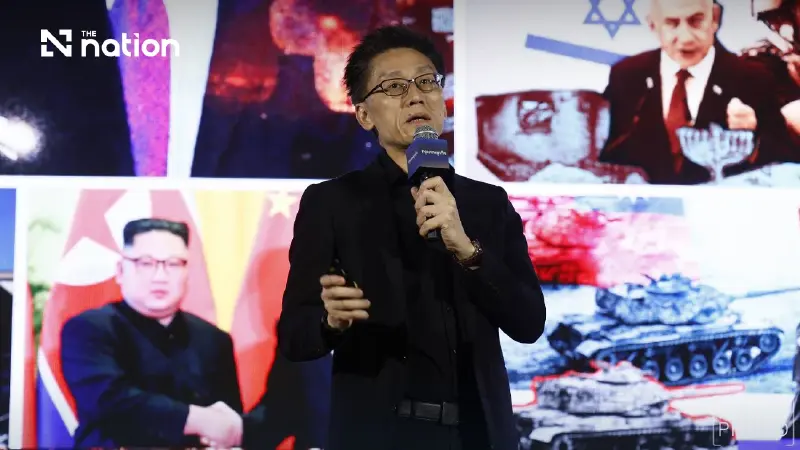


FETCO's Paiboon Nalinthrangkurn warns the era of low rates and free trade is dead, but agile investors can still find value in AI and non-aligned hubs
- The era of stable globalization, low interest rates, and free trade has ended, replaced by a "permanent disorder" driven by high geopolitical friction, economic fragmentation, and structural trade wars.
- This new environment forces companies to abandon cost-efficient "just-in-time" supply chains for more secure but less profitable "just-in-case" models, a trend intensified by a predatory "China Shock 2.0."
- Investment rules are being rewritten, with agile investors finding value in the infrastructure supporting AI (such as energy) and in geopolitically non-aligned countries that serve as safe havens for capital.
FETCO's Paiboon Nalinthrangkurn warns the era of low rates and free trade is dead, but agile investors can still find value in AI and non-aligned hubs.
The world has entered a structural, lasting era of disorder. The comfortable macroeconomic certainties of the past three decades have dissolved, and investors who blindly cling to old playbooks do so at their peril.
That was the central message delivered by Paiboon Nalinthrangkurn, chairman of the Federation of Thai Capital Market Organisations (FETCO), during his keynote address at the Thailand Investment Forum 2026 on Saturday.
Speaking at the event hosted by Krungthep Turakij at the Stock Exchange of Thailand, Paiboon mapped out the collapse of the post-Cold War international order and what it means for global capital.
However, his outlook was not entirely bleak. He argued that Thailand—strategically positioned as a geopolitically neutral player—is uniquely placed to navigate the gathering storm.
The Death of a Benign Era
Paiboon contrasted the current volatility with the unusually stable 30-year window that ran from the fall of the Soviet Union in the early 1990s up to 2019. During this golden era of globalisation, interest rates trended steadily downward, supply chains were optimised for absolute cost efficiency, and global GDP growth remained reliably predictable.
"It was a period when managing a business was easier, and managing an economy was easier," Paiboon noted. "Because when interest rates are falling, everything tends to go well."

That era is now definitively over. In its place, Paiboon identified six compounding structural risks: escalating geopolitical friction, economic fragmentation into opposing trade blocs, persistent supply chain disruptions, protracted trade warfare, the arrival of "China Shock 2.0", and an unsustainable mountain of global sovereign debt.
Geopolitics and the End of Efficiency
Citing the Geopolitical Risk Index, Paiboon pointed out that global tensions have surged to their highest levels in half a century, echoing the stagflationary Cold War landscape of the 1970s and 1980s.
Recent spikes in oil prices beyond $100 per barrel following Middle Eastern conflicts and the temporary closure of the Strait of Hormuz illustrate how quickly political flashpoints trigger economic shocks.
This friction is driving a systematic undoing of cross-border integration.
Driven by the rise of China and protectionist US policies under President Donald Trump’s second term, corporate strategies are shifting away from "just-in-time" supply chains to "just-in-case" models. Security, friendshoring, and nearshoring have replaced cost-optimisation. When security replaces efficiency, Paiboon observed, corporate profit margins inevitably suffer.
Furthermore, trade wars have shifted from temporary cyclical disputes to a permanent structural reality. With average effective US tariff rates hovering near 20%—levels not seen since the Great Depression—and Thailand currently facing Section 301 trade investigations by Washington, global trade dynamics remain highly adversarial.

The Threat of 'China Shock 2.0'
One of the most pressing structural shifts detailed was "China Shock 2.0." During the first China Shock after Beijing entered the World Trade Organisation (WTO) in 2001, China’s global export market share rose from 4% to 11%.
However, because China imported vast amounts of raw materials and components, trading partners shared the economic gains.
In this second wave, the dynamics have turned predatory. China’s export market share has climbed to 16%, but its import growth has stalled. Chinese manufacturers now source their inputs domestically, absorbing the entire value chain and flooding global markets with cheap finished goods.
"When you order from Shopee or Lazada today, almost everything is from China," Paiboon warned, noting that Thailand's lack of political appetite for aggressive protectionist barriers leaves local manufacturing exposed to severe displacement.
Compounding this is a global fiscal crisis. Sovereign debt has climbed from 60% of world GDP 25 years ago to roughly 100% today. Major economies are so heavily leveraged that governments will be severely constrained in deploying fiscal stimulus during the next inevitable economic downturn.
The Counterweights: AI Infrastructure and the Thai Advantage
To offset these headwinds, Paiboon highlighted a powerful technological counterweight: the artificial intelligence revolution.
Citing data from the US National Bureau of Economic Research, he pointed out that large firms deploying AI are already achieving 2% to 3% annual productivity gains per employee.
For smart investors, the best value no longer lies in hyperinflated, headline tech stocks but in the unglamorous infrastructure backing them.
"AI isn't just Nvidia. It's an entire ecosystem of energy, infrastructure, models, and applications," Paiboon said. "Without energy, there is no AI. The energy sector remains attractively priced and indispensable."

Thailand’s Strategic Playbook
For domestic markets, Thailand’s strict geopolitical non-alignment has transformed into a core competitive advantage. As multinationals seek neutral hubs to escape trade war crossfire, foreign direct investment is increasingly redirecting toward Thai shores.
The Thai government has stated an ambition to raise the investment-to-GDP ratio from its current stagnant level of around 22% up to 30%, using Vietnam's higher investment rate as a benchmark. This underpins the broader national goals of achieving 3% economic growth within four years and joining the ranks of high-income economies within twelve years.
Thai equities are already showing signs of a renaissance. The SET Index has outperformed global markets year-to-date, rallying roughly 22% against a 9% gain for the MSCI World Index—its first outperformance in four years. Trading at roughly 12 times forward earnings, the market remains reasonably valued.
Furthermore, Paiboon highlighted two key domestic catalysts: a corporate "Value Up" programme (Jump+) modelled on Japan and South Korea to improve capital efficiency, and a forthcoming long-term investment savings scheme offering permanent tax incentives to retail investors.
Paiboon concluded with a call for tactical selectivity: focus on global companies with highly visible dividend income, target AI power and infrastructure over software applications, and accumulate Thai equities backed by improving corporate earnings momentum.
