
Nine Voices, One Message: Thailand-US Ties Must Add Value
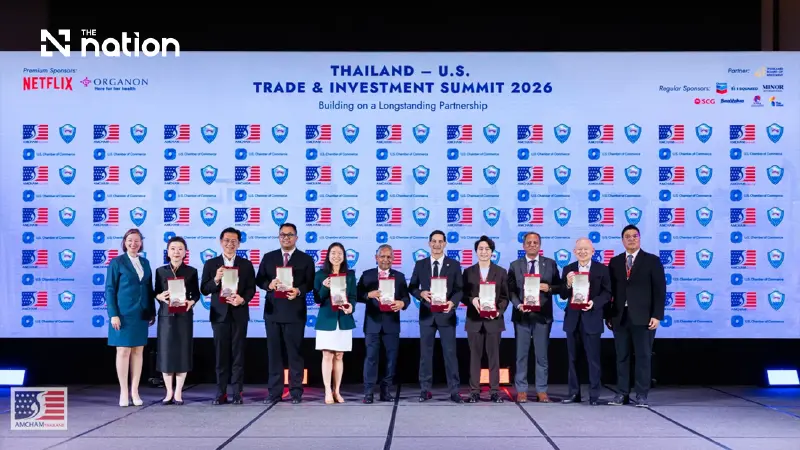


Nine industry leaders told the Thailand-US summit that deeper, tech-driven cooperation — not just trade volume — will define the next chapter
- Nine industry leaders agreed that the Thailand-US partnership must evolve from focusing on raw trade volume to creating higher value through technology-driven, trust-based cooperation.
- Thailand is positioning itself as a strategic platform for advanced industries and a key node in regional supply chains, rather than simply a low-cost manufacturing base.
- This value-added growth is being driven by significant investment in key sectors such as the digital economy (AI and cloud), tourism, healthcare, and the creative industry.
- To succeed, Thailand must address critical gaps in energy capacity and skilled talent, while the US needs to provide more predictable trade policy.
Nine industry leaders told the Thailand-US summit that deeper, tech-driven cooperation — not just trade volume — will define the next chapter.
Nine business and government leaders, given nine minutes each, converged on a single conclusion at the Thailand-US Trade & Investment Summit's "9-9-9 Flash Briefing" on Monday: the two countries' partnership is shifting from raw trade volume towards higher-value, technology-enabled and trust-based cooperation – but only if Thailand can close gaps in energy capacity, talent and regulatory clarity and if trade policy on the American side becomes more predictable.
From cloud computing to tuna exports, speakers repeatedly framed Thailand not as a low-cost manufacturing base but as a platform for advanced industries.
As Thailand Trade Representative Nongnuth Phetcharatana put it, opening the session: "Thailand is not simply a manufacturing location in Asia; we are positioning ourselves as a strategic node in regional supply chains, a platform for advanced industries, and a bridge between the US and the wider Asian economy."
She cited Thailand's membership of the 18-economy Regional Comprehensive Economic Partnership, a new free-trade deal taking effect in January, progress in EU negotiations, and regulatory reform tied to Thailand's OECD accession bid as pillars of a "trusted partnership" strategy.
Sutida Tambunlertchai, Citibank's country head of commercial banking, added the investment lens, noting two-way goods and services trade reached US$120 billion in 2025.

She highlighted US$30 billion in new tech-sector investment applications to Thailand's Board of Investment in the first quarter alone, alongside three trends reshaping the corridor: a shift towards high-end technology investment, persistent volatility, and businesses embedding AI directly into operations.
"What we are really seeing," she said, "are two economies leveraging each other's strengths."
Dillip Rajakarier, group chief executive of Minor International, argued tourism was "no longer a recovery story" but "an investment, competitiveness and partnership story".
Thailand welcomed 33 million visitors in 2025, down 7 percent on weaker Chinese and regional arrivals, even as Bangkok declared 2026 a "year of investment", backed by roughly US$15.5 billion in pending private investment.
Minor, which operates more than 640 hotels across 60 countries, is expanding into Miami and New York, aided, he said, by a US tariff reduction from 19 to 15 percent and a weaker baht.
Agribusiness leader Dr Chanintr Chalisarapong, representing the Thai Tuna Industry and Pet Food Trade Associations, offered a starker note: food and agriculture account for only about 5 percent — roughly US$5 billion — of Thailand's US$100 billion trade with the US, despite sustaining an estimated 60 percent of Thai household income.
He pressed for the sector to be negotiated separately from industrial tariffs and transshipment concerns and called for greater US corn, soybean and seafood exports to Thailand in exchange for expanded Thai food exports.
"We are complementary partners," he said, arguing bilateral food trade could double to US$10 billion within five to seven years under a fairer deal.

On the digital economy, Hadri Sopri, AWS's head of trade policy for Asia-Pacific, said Thailand's total investment applications hit US$43.6 billion in the first half of 2026, up 37 percent year-on-year, with the digital sector alone accounting for US$33 billion.
AWS has committed more than US$5 billion to cloud and AI infrastructure in the country. Yet 71 percent of Thai organisations cite a shortage of technical talent as their top barrier to AI adoption.
"Investment alone doesn't necessarily create good outcomes," Sopri said. "What you build on top of it — skills, policy, ecosystem — is what determines whether investment delivers for Thailand."
Jerin Raj of Black & Veatch, which has operated in Thailand since the late 1950s, warned that large-scale AI data centres represent "a new asset class" straining a power grid built for stable, fuel-based generation.

Renewables bring intermittency, he said, while consumer behaviour and electric-vehicle charging add further complexity — pushing nuclear power, including small modular reactors, back onto the agenda.
"You can build data centres faster than you can build the energy and water systems" needed to support them, he cautioned.
Wachirachai Koonamwattana, SCG's chief sustainability officer, urged businesses to treat sustainability as risk management rather than idealism, pointing to extreme flooding in southern Thailand last year and Middle East-driven energy shocks.
"If we redefine sustainability as how we cope with risk," he said, "it becomes realistic, practical and relevant to us all," calling for patience and closer collaboration across supply chains and the region.

Mo Yasin, Thailand's country lead for Organon, linked healthcare directly to economic competitiveness, noting Thailand's 2026 health budget of 177 billion baht (4.5 percent of GDP).
He cited an ageing population, a fertility rate of roughly one child per woman, and persistently high rates of unintended teenage pregnancy as under-appreciated economic threats to the workforce.
"Thailand's sustained investment in healthcare sends a powerful message that health is a strategic priority and a foundation for future prosperity," he said, pointing to the Apex Smart Families initiative — now spanning 21 APEC economies — as a model for turning policy into practice.

Closing the session, Ruben Hattari, Netflix's director of global affairs for Southeast Asia, said Thailand's creative economy contributes more than 8 percent of GDP — well above the roughly 5 percent average among regional neighbours — and supports nearly a million jobs.
Netflix invested US$200 million in Thai content between 2021 and 2024, generating 750 million viewing hours in 2024 alone.
"Thailand's creative economy is one of the country's strongest growth stories," he said, while flagging skills gaps, weak IP-backed financing and piracy – which he said still affects 44 percent of consumers across the Asia-Pacific – as unresolved constraints on growth.
Taken together, the nine briefings painted a partnership less defined by raw trade figures than by whether Thailand can convert investment momentum — in AI, energy, healthcare, tourism and content — into durable, higher-value growth for both economies.
