
PM Anutin sets out case for THB400 billion economic crisis loan decree


The borrowing would be split equally between support for affected groups and the energy transition, while public debt is projected at no more than 70% of GDP.
- The THB400 billion loan is presented as a necessary response to an unprecedented global energy crisis, stemming from Middle East conflict, which is severely impacting Thailand's economy and cost of living.
- Prime Minister Anutin argued that existing fiscal tools are insufficient to handle the emergency, making the loan decree an unavoidable last resort for a timely response.
- The funds will be split, with THB200 billion for immediate relief to people and businesses affected by the crisis, and THB200 billion to accelerate the country's long-term transition to renewable energy.
- The government asserts the borrowing will remain within the legal public debt framework (under 70% of GDP) and will be managed transparently to ensure funds are used effectively.
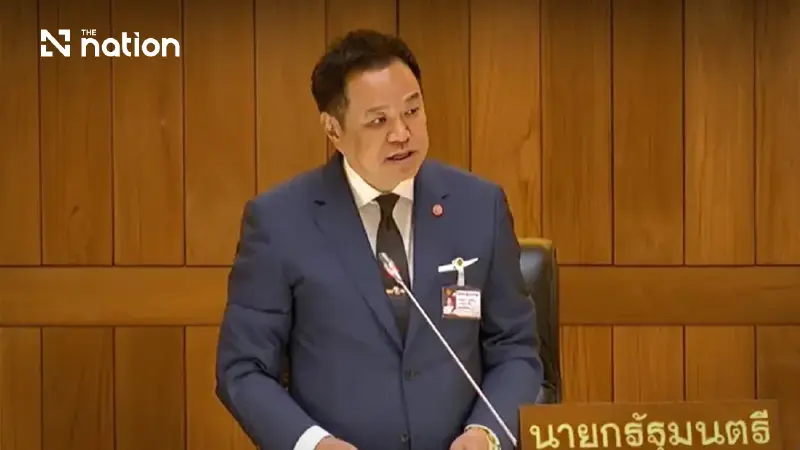
Prime Minister Anutin Charnvirakul addressed a meeting of the House of Representatives to explain why it was necessary to issue a 2026 emergency decree authorising the Ministry of Finance to borrow up to THB400 billion to address the impact of the energy crisis and advance the country’s energy transition.
The decree was approved by the Cabinet on May 5 and took effect on May 9.
The Constitutional Court found the decree constitutional on July 9 because the Cabinet considered it necessary to protect the country’s economic security and respond to an unavoidable emergency.
Anutin links global energy crisis to Middle East conflict
At the start of his explanation, Anutin said the conflict amounted to an unprecedented global energy crisis and differed completely from previous crises.
He contrasted it with earlier periods when member countries of the Organisation of the Petroleum Exporting Countries (OPEC) banned oil exports and restricted production, causing a shortage on world markets.
During those crises, however, oil and gas wells, oil refineries, gas separation plants and oil and gas pipeline systems were not destroyed.
By contrast, he said, the armed conflict in the Middle East in 2026 had destroyed oil and gas wells, oil refineries, oil pipelines, oil depots and oil terminals, while also closing shipping routes, particularly the Strait of Hormuz.
The prime minister said the closure of the Strait had almost completely halted production and shipments from major global oil sources, while worldwide demand remained unchanged.
Oil prices had risen rapidly, he said, and other sources could not expand production quickly enough to replace the lost supply.
The situation remained highly uncertain.
He said Thailand imported almost 50% of its oil from the Middle East, while the production of goods and services, transport and agriculture still depended on fossil fuels as the primary energy source.
The shift to renewable energy remained limited.
A fossil-fuel shortage therefore had a direct and severe effect on goods and services prices, the transport and agricultural sectors, and most people in the country.
Anutin warns of five waves squeezing Thai livelihoods
A central point in Anutin’s statement was his warning that Thailand faced a major cost-of-living crisis that would not come in a single wave but would be followed by several more waves.
He identified five waves of pressure on the Thai economy:
- Panic.
- Higher fossil-fuel prices.
- Rising food, goods and service costs.
- A higher cost of living.
- Lower purchasing power as incomes remain unchanged or fall while business costs rise.
Anutin said growing risks to production and employment would place businesses and the public under pressure from two directions: incomes would fall while costs rose.
This would weaken purchasing power and increase the risk of an economic slowdown accompanied by high inflation, or stagflation.
If allowed to develop, he warned, it would have severe consequences and be difficult to address.
Anutin said no one could predict when the conflict in the Middle East would end, although it was expected to continue for several more years.
Oil production and exports from the region might never return to previous levels, he said, leaving Thailand highly dependent on fossil-fuel imports unless it seriously restructured its energy system.
Existing fiscal tools insufficient, decree the last resort
Anutin gave a detailed account of the limits of existing fiscal tools.
He said the central budget’s THB99 billion reserve for emergency or essential expenditure in fiscal 2026 had already been used for flood and severe-disaster relief in several areas, unrest along the Thai-Cambodian border, state security expenditure and other urgent tasks arising during the fiscal year, leaving insufficient funds to meet spending needs.
He said there was also an urgent need for about THB140 billion in additional spending, including disaster response and border security costs.
Even combining the remaining central budget with a further THB50 billion from the reserve fund under Section 45 of the Budgetary Procedures Act 2018 would not be enough.
More than 72% of the fiscal 2026 budget had already been disbursed, leaving very limited scope for budget transfers.
The borrowing limit available to finance the budget deficit under the Public Debt Management Act had only THB17 billion remaining, which was also insufficient.
Enacting a supplementary budget would take at least two months, while the fiscal 2027 budget would not take effect until October, too late for the emergency.
“If this emergency decree were not issued in time to meet the situation, failing to act at this point could prolong the crisis or increase systemic risks to the economy in the next phase. It is therefore necessary to issue this emergency decree,” Anutin said.
Loan split between relief and energy transition
Anutin said the THB400 billion borrowing framework had two main objectives: first, to help people, farmers and businesses affected by the Middle East crisis; and second, to reduce fossil-fuel use as rapidly and extensively as possible.
Under the schedule attached to the decree, the funding is divided between two programmes:
- THB200 billion to help people, farmers and businesses affected by the energy crisis, easing their expenses and allowing them to continue earning a living or operating their businesses.
- THB200 billion to promote efficient energy use and support the transition from fossil fuels to renewable and alternative energy across the public and private sectors, communities and the general public, while developing related skills and innovation.
The Ministry of Finance must sign the loan agreements or issue the debt instruments by Thursday (September 30, 2027).
Anutin said the government intended short-term relief and long-term restructuring to proceed in parallel.
He emphasised that developing renewable and alternative energy skills would also equip people with skills for the future, as global development was increasingly moving towards greater use of those energy sources.
Anutin says borrowing will remain within fiscal framework
Responding to MPs’ concerns about fiscal discipline, Anutin said this borrowing, when combined with other loans, would remain within the public-debt management framework set by the law on state fiscal and financial discipline.
The public debt-to-GDP ratio was projected at no more than 70%.
The initial plan was to borrow primarily from domestic sources and introduce a systematic repayment plan to spread risks and keep borrowing costs at an appropriate level.
To ensure transparent and cost-effective use of the funds, the government requires every project to pass consideration by a loan-spending screening committee.
Each project must serve the decree’s objectives, fall solely within the programmes listed in its attached schedule and avoid duplicating budget funding or other financing sources.
The responsible agency must also be ready to begin implementation immediately.
Anutin presents 5T framework and asks House for approval
Anutin summarised the government’s “5T” framework for loan spending: Target, directing funds towards their intended purposes and where they are needed; Transition, accelerating the shift and reducing energy vulnerability; Transformation, delivering structural change through investment that supports economic recovery; Transparent, ensuring spending is transparent and open to scrutiny; and Together, working together across all sectors.
He said the framework was intended to ensure that every baht and satang spent delivered the greatest possible value to the public and Thailand.
“The energy crisis is severe. The government has concluded that, to safeguard the country’s economic security, this is an emergency of pressing and unavoidable necessity. I therefore respectfully ask this honourable House to join together in considering and approving this emergency decree,” Anutin said.
