
Thailand braces for LNG supply squeeze as prices near Russia–Ukraine war levels
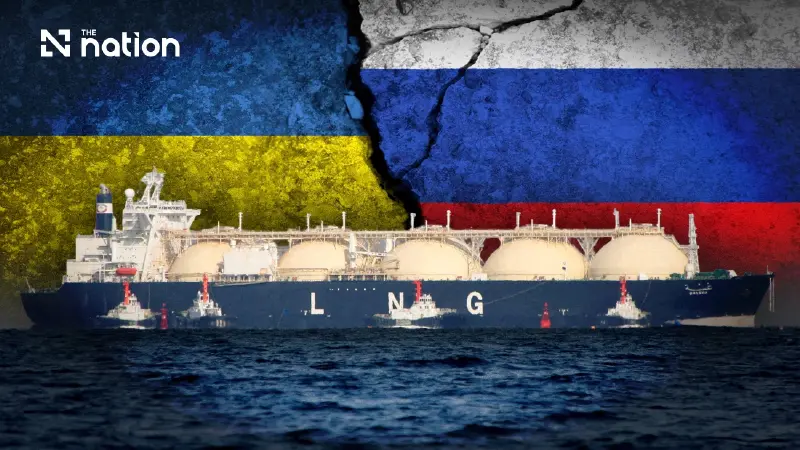


Thailand plans Andaman gas exploration and greater use of long-term supply contracts as the Hormuz crisis drives up imported energy costs
- The situation in the Strait of Hormuz has pushed global LNG prices to US$28 per million British thermal units, close to levels seen during the Russia–Ukraine war crisis.
- The government is accelerating efforts to develop domestic energy resources, preparing a new petroleum concession bidding round, particularly in the high-potential Andaman Sea, to reduce reliance on imports.
- The Energy Regulatory Commission says the crisis requires Thailand to redefine energy security by incorporating flexibility and diversifying fuel sources to reduce concentration risks.
- Private-sector operator EGCO warns about the risks of relying on imported LNG for 30% of supplies and regards faster domestic exploration as an urgent priority.
- The Energy Ministry is preparing to manage long-term LNG contracts to cushion the impact of sharply rising spot-market prices.
The Strait of Hormuz crisis has driven LNG prices to US$28 per million British thermal units, putting pressure on Thailand’s public and private sectors to undertake a major review of their energy strategies. The response ranges from adding “flexibility” to the energy-security framework to accelerating domestic gas exploration, advancing small modular reactor technology and restructuring major energy companies.
Dr Poonpat Leesombatpiboon, secretary-general of the Office of the Energy Regulatory Commission (ERC), told Bangkok Biznews that geopolitical instability was accelerating a global reassessment of energy policy. The definition of energy security needed to expand beyond ensuring adequate supplies to include adaptability and flexibility.
The existing framework rests on three pillars: security, affordability and sustainability. Flexibility must now be added, with energy infrastructure designed to accommodate change, reduce reliance on a narrow range of fuels and diversify energy sources.
Poonpat said uncertainty over how long the situation in the Strait of Hormuz would last was significantly affecting LNG shipments from the Middle East. Other suppliers, including the United States and Australia, therefore needed to be tapped more quickly, although alternative supplies could not be secured immediately.
These factors have pushed global LNG prices to US$28 per million British thermal units, close to the initial Russia–Ukraine crisis, when prices rose from US$12 to US$25 per million British thermal units. Experts estimate that alternative producers would need at least two to three years to increase capacity. Prices could fall quickly if the situation eased soon, but a prolonged crisis could mean that prices would only begin declining in one to two years.
Accelerating petroleum bidding in the Andaman Sea
Poonpat said the government attached the highest priority to domestic energy resources. At Gastech 2026, Thailand and Malaysia signed parallel agreements covering Block 8/B17, or the B-17 field, to accelerate gas supplies to both countries. Preparations were also under way for a new petroleum concession round and assessments of two deepwater prospects that could potentially replace supplies from the Gulf of Thailand.
Wattanapong Kurovat, director-general of the Energy Policy and Planning Office (EPPO), said Thailand needed to open new gas exploration concessions, particularly in the Andaman Sea, which had considerable potential. However, the undertaking would be challenging as Thailand’s first deepwater exploration venture. Global companies such as Chevron, as well as PTT Exploration and Production Public Company Limited (PTTEP), were interested in bidding.
The situation in the Middle East has sharply increased crude oil, refined fuel and natural gas prices. The Energy Ministry is preparing to manage long-term LNG contracts to mitigate the impact.
Meanwhile, the Oil Fuel Fund has a deficit of 80 billion baht. The Energy Ministry will try to prevent it exceeding 100 billion baht, but persistently high global prices could require increases in domestic retail prices and faster promotion of biofuels.
EGCO warns of risks from heavy reliance on imported LNG
Tawatchai Sumranwanich, president of Electricity Generating Public Company Limited, or EGCO Group, said energy management required a balance between three considerations: power-system security, environmental sustainability and national competitiveness. Natural gas remained an important transition fuel, helping to accommodate fluctuations in renewable energy generation.
Thailand’s gas supplies for electricity generation currently come from the Gulf of Thailand, accounting for 60% of domestic consumption, followed by Myanmar at 10%, with imported LNG supplying the remaining 30%. However, Gulf gas production is declining, and supplies are also used by the petrochemical industry. Exploration in the Andaman Sea therefore needs to accelerate. Although development could take 10 years, work must begin immediately to align with the new Power Development Plan (PDP), which aims to maintain the combined share of Gulf and Myanmar gas at 70%.
B.Grimm studies SMRs to transform gas-fired power plants
Nopadej Karnasuta, chief executive of B.Grimm Power, said the company was preparing for energy challenges amid global volatility. It planned to sign an agreement with a European partner to study the feasibility of using small modular nuclear reactors (SMRs), considering capacities of 300–400 megawatts. These would be comparable in scale to industrial gas-fired plants of 200–300MW, which together account for about 9,000MW in the system.
It would be technically possible to replace gas turbines with SMRs while retaining steam turbines and existing infrastructure. The Eastern Economic Corridor (EEC) was considered the first target because most industrial-estate customers were Japanese investors familiar with nuclear energy.
Nopadej said developing energy through the industrial sector to support data centres could immediately generate an economic multiplier effect of 30–40%. He pointed to delays in PDP policy over the past 10 years, while Malaysia aimed to use nuclear power within three years and Vietnam had already moved ahead with conventional nuclear plants. If the PDP provided clarity, the private sector would be ready to announce investment plans immediately.
Banpu makes gas and power its core businesses
Sinon Vongkusolkit, chief executive of Banpu Public Company Limited, said the world was in an era of “energy addition”, using several forms of energy alongside one another before moving towards a longer-term energy transition.
Banpu is focusing on expanding its gas and power businesses in the United States, where it has gas operations in Texas and a 1,500MW power plant in Austin. The company is also advancing two gas-fired power projects to serve data centres in Temple and Jackson County, with power purchase agreements (PPAs) expected to be signed late this year or early next year.
“Natural gas is no longer merely a transition fuel, but a clean, long-term core energy source that Thailand and the region will continue to need for a long time. Increasing energy exploration in Thailand would also reduce dependence on imported LNG, which is exposed to volatility in global supply chains.”
For investment in new technology, Banpu has allocated a total budget of 3 billion baht, focusing primarily on gas and power. Around 10% is earmarked for venture-capital investments in artificial intelligence (AI) and SMRs, while the company is beginning to study graphics processing unit (GPU) access as a service. Banpu aims for gas and power to account for more than 50% of its cash flow within five years. It also supports the “Bangkok Dialogue” concept to promote Thailand as a regional hub for the economy, energy and AI–data centre supply chains.
EGAT promotes “Bridging to the Next Era”
Narin Phoawanich, governor of the Electricity Generating Authority of Thailand (EGAT), said the government was managing natural gas supplies by accelerating production in the Gulf of Thailand and procuring gas from Myanmar and Malaysia. The emphasis was on long-term contracts to reduce reliance on the spot market.
Clean energy currently accounts for 20% of Thailand’s electricity supply. The draft PDP 2026 sets out scenarios under which this share would rise to 60–90% over the next 25 years. According to the draft plan’s estimates, investment of 300–700 billion baht would be required for smart grids, transmission lines and energy storage systems.
EGAT has established three strategic pillars: “Bridging Energy Security”, through the Lao PDR–Thailand–Malaysia–Singapore Power Integration Project (LTMS-PIP), which purchases electricity from Laos for transmission through Thailand and Malaysia to Singapore; “Bridging Energy Transition”, through an expansion of the transmission system, likened to widening a motorway to accommodate more vehicles; and “Bridging Sustainable Future”.
Europe faces a jet fuel crisis
Europe’s situation could worsen towards the end of the year as the Iran war disrupts Middle Eastern supplies, forcing buyers to turn to imports from as far away as Asia. South Korean jet fuel exports to Europe have consequently reached their highest level in almost four years, while European inventories have fallen to a seven-year low.
Europe faces a jet fuel shortage in the fourth quarter after the Iran war disrupted supplies from the Middle East, prompting increased imports from more distant sources. South Korea, in particular, has raised jet fuel exports to Europe to their highest level in almost four years.
Energy consultancy Energy Aspects estimates that Europe could face a jet fuel shortfall of as much as 510,000 barrels a day in the fourth quarter. By contrast, the United States is forecast to have a surplus of 18,000 barrels a day, while the Asia-Pacific region could have a surplus of 419,000 barrels a day.
Source: Bangkokbiznews
