
FTI estimates members’ September flood losses at 1.02 billion baht
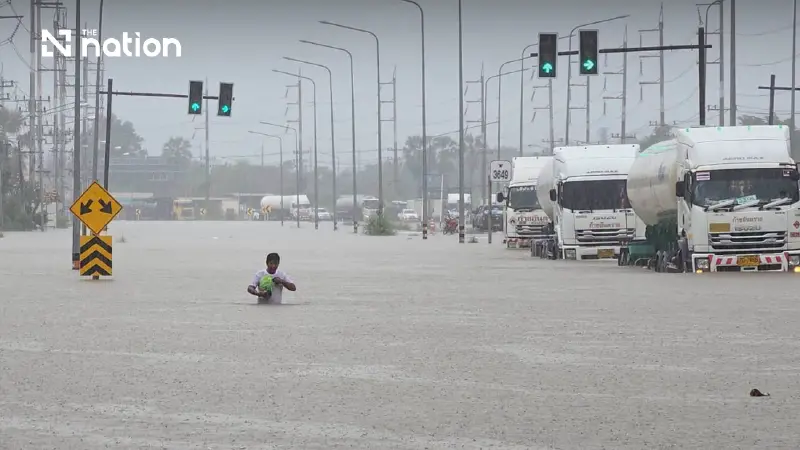


Thailand’s industry federation calls for six areas of recovery support as flood damage reports from Chonburi industrial estates remain incomplete.
- The Federation of Thai Industries (FTI) has provisionally estimated that its members suffered 1.02 billion baht in losses from flooding that occurred between September 24–30.
- This initial estimate includes damage to physical assets (machinery, materials, vehicles), production stoppages, lost sales, and other business disruptions.
- The calculation is based on a partial survey of members in affected areas across Bangkok and 14 provinces and will be revised as more damage reports are collected.
- In response to the estimated losses, the FTI is requesting government assistance in six areas, including low-interest loans, tax relief, and faster insurance processing to help businesses recover.
The Federation of Thai Industries (FTI) has provisionally estimated flood-related losses among its members at about 1.02 billion baht following flooding on September 24–30, 2026, as it calls for government assistance to help affected businesses recover.
The FTI’s initial calculation of 1,018.36 million baht assumes that about 40% of its members in affected areas have suffered impacts. The estimate combines partial survey information with the size of business establishments and their membership status.
The FTI is still collecting damage reports from members, particularly in industrial estate areas in Chonburi, and will revise the estimate as businesses provide further information on their actual losses.
FTI counts physical damage, production stoppages and lost sales
The FTI assessment covers both damaged assets and disruption to business operations, including company vehicles, factory electrical and utility systems, machinery, raw materials, supply chains, production tools and equipment, and finished goods.
Production stoppages caused by employees being unable to reach work are also included in the FTI estimate, alongside indirect losses from goods that businesses have produced but cannot sell, and other lost business opportunities. Further information on production systems, transport and logistics disruption is still being gathered.
FTI chairwoman Pimjai Leeissaranukul said the flooding was affecting more than communities, with consequences extending to factories, machinery, electricity supplies, raw materials, transport and workers’ journeys to their workplaces. The federation was collecting member reports continuously to establish the actual impact and direct assistance towards businesses’ needs.
“The immediate priority is to help affected businesses stay in business and resume operations as quickly as possible,” Pimjai said.
Pimjai said recovery efforts needed to address support for workers, access to finance, factory and machinery repairs, insurance procedures and environmental management after floodwaters recede. Better prevention and early-warning systems were also needed to prepare the industrial sector for future flooding.
FTI requests six areas of government recovery support
The FTI has identified six areas of government assistance based on damage reports and requests from members, covering immediate financial pressures and the practical work needed to restore operations.
- Support for workers and employees. The FTI asked the government to consider assistance for affected employees, including compensation or contributions towards labour costs while businesses cannot operate normally. The proposed support is intended to help employers retain staff and reduce the impact on workers.
- Finance and liquidity. The FTI requested low-interest recovery loans, working capital and emergency credit, alongside consideration of debt-payment holidays, debt restructuring and measures to reduce interest burdens. The aim is to give businesses sufficient liquidity to restore operations.
- Taxes, fees and government charges. The FTI proposed exemptions, reductions or deferrals of government fees and expenses applying to affected factories and businesses. It also called for consideration of tax measures and extensions to payment deadlines during recovery.
- Insurance and compensation. The FTI requested faster coordination with insurers to assess damage and process claims, together with help resolving delays or obstacles in compensation procedures. Businesses need timely access to insurance payments to finance recovery, the federation said.
- Factory and machinery restoration. The FTI proposed deploying specialists to assess damage to factories, machinery, electrical systems and production systems, and advise on repairs and the safe resumption of production. It also requested help connecting businesses with suppliers of the machinery, equipment and technology needed for recovery.
- Post-flood waste and environmental management. The FTI called for systematic collection and management of flood-damaged materials and waste, particularly industrial waste, to prevent environmental and public health impacts. Assistance should also cover materials and equipment requiring special handling after water levels fall.
FTI identifies flood impacts in Bangkok and 14 provinces
The FTI’s September 24–30 review identified affected communities, transport routes, factories and industrial estates in Bangkok and 14 provinces. Membership totals for affected areas describe businesses located there, rather than a confirmed count of companies with damage.
In Bangkok, flooding affected 16 districts containing 2,261 FTI members, comprising 940 ordinary members and 1,321 associate members.
In Samut Prakan, six districts were affected, with 1,269 FTI members located in those areas. The FTI reported that water remained high in Bang Phli and that factories had suffered substantial disruption, including at Bang Phli Industrial Estate and along the Thepharak–Bang Sao Thong corridor.
In Pathum Thani, the affected districts were Mueang Pathum Thani, Khlong Luang, Thanyaburi and Lam Luk Ka, containing 681 FTI members. Floodwater remained in some areas and travel continued to be difficult, according to the federation.
In Nonthaburi, flooding affected Pak Kret and Mueang Nonthaburi districts, with an initial 26 FTI members identified as affected. Most cases involved premises surrounded by water.
In Phra Nakhon Si Ayutthaya, six districts were affected, mainly through flooding of homes and transport routes. The FTI reported no direct impact on its members, most of which are based in industrial estates in Ayutthaya.
In Chonburi, flooding affected 10 districts, including tourist areas, industrial estates and residential communities. The FTI reported impacts on factories at Amata City Industrial Estate, with confirmed damage figures still pending, while the Ministry of Industry and the Industrial Estate Authority of Thailand were closely monitoring conditions.
In Rayong, Klaeng was the hardest-hit district, according to the FTI. The district contains 48 members, with preliminary information indicating that some had been affected.
In Nakhon Nayok, flooding affected Mueang Nakhon Nayok and Ongkharak districts. Seven FTI members were reported to be experiencing difficulties, including a severe case with losses preliminarily estimated at more than 100 million baht.
In Prachin Buri, the affected districts were Mueang Prachin Buri, Kabin Buri, Prachantakham, Ban Sang and Si Maha Phot. Homes and agricultural areas accounted for most of the impacts, while preliminary information indicated that 18 FTI member companies had been affected.
In Kanchanaburi, one FTI member was initially identified as affected, while factories beside rivers remained under observation. One member in Chachoengsao also reported an impact.
Flooding also affected areas in Nakhon Pathom, Samut Sakhon, Chanthaburi and Sa Kaeo, where the FTI was continuing to monitor conditions and gather information about member businesses.
FTI prepares recovery guidance and machinery repair advice
The FTI is preparing information for flood-affected businesses covering risk assessment, preparedness, flood-response contact numbers, post-flood factory inspection checklists and environmental management. The material also includes public- and private-sector assistance, insurance claims and the handling of damaged lithium-ion batteries.
The FTI’s water, environment and climate change institute is monitoring water conditions and issuing early warnings to members, helping businesses prepare and limit potential damage. The federation’s unit handling Association of Southeast Asian Nations (ASEAN) affairs and logistics is collecting information on transport disruption and additional support required by businesses.
Pimjai said the FTI would continue gathering member reports to improve the completeness of its assessment and coordinate between industry, government and relevant agencies so assistance could reach affected businesses promptly.
“Restoring one factory does not mean helping only that business. It also means preserving employment, production and the continuity of the country’s supply chains,” Pimjai said.
The FTI also plans to provide machinery maintenance and repair advice through its machinery and automation industry group, Pimjai added. Teams of engineers and specialists will advise members on caring for and repairing flood-affected machinery and automation equipment.
The FTI cautioned that the loss estimate remains provisional and may change as further reports arrive from members and affected areas. The federation will continue monitoring conditions and updating its assessment.
