
Severe Floods Inundate Thai Factories, Causing Over $30m in Direct Losses
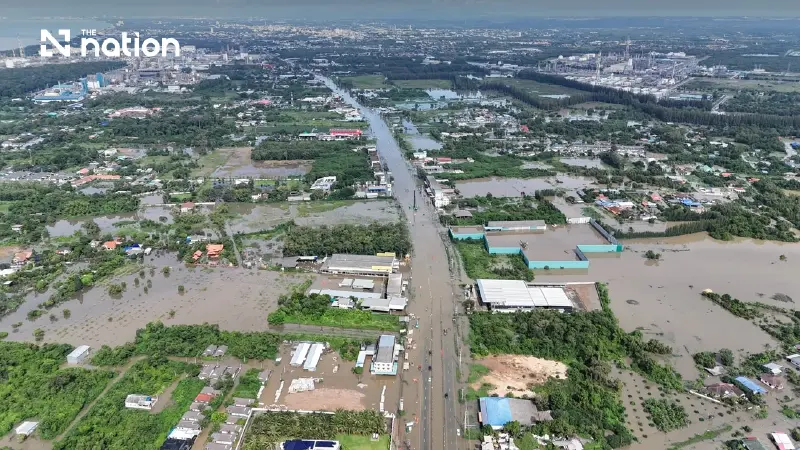


The FTI warns of severe supply chain fallout as breached dykes submerge key industrial estates and broader economic losses near $2bn nationwide
- Severe flooding across Bangkok and 14 provinces has caused an estimated $30.4 million in direct losses to Thai manufacturers, according to the Federation of Thai Industries (FTI).
- The Amata City Chonburi Industrial Estate was the most severely impacted area, with at least 34 factories damaged after a breached dyke led to significant flooding.
- While direct factory damages are over $30 million, the broader economic impact, including agricultural and supply chain disruptions, is estimated to be near $2 billion nationwide.
- The initial loss estimates cover damage to equipment, loss of raw materials, and major disruptions to supply chains and logistics for affected companies.
The FTI warns of severe supply chain fallout as breached dykes submerge key industrial estates and broader economic losses near $2bn nationwide.
Thai manufacturers face severe operational disruptions and mounting financial losses following widespread flooding across Bangkok and 14 provinces, with initial manufacturing damage estimated at $30.4 million (1.018 billion baht).
According to a report by Krungthep Turakij, water management authorities remain on high alert due to seasonal high tides expected between 1 and 4 October 2026, alongside heavy rainfall forecast across the North, Central, East, and South regions from 5 to 8 October.
The Federation of Thai Industries (FTI) reported that preliminary loss estimates—based on an assumed 40% impact rate among members in affected zones—cover direct equipment damage, raw material losses, supply chain halts, and logistical disruptions.
Amata City Chonburi Estate Hit Hardest
Amata City Chonburi Industrial Estate has emerged as the most severely impacted zone. Floodwaters surged 30–70 cm across Phases 7, 8, 9, and 10 after an earthen dyke breached.
At least 34 factories sustained direct damage, with repair teams working to seal perimeter breaches. FTI Chairwoman Pimjai Leeissaranukul stated that detailed loss surveys are being compiled to deliver targeted relief.

In response, the Industrial Estate Authority of Thailand (IEAT) ordered full-system tests of flood defenses across all at-risk estates and dispatched officers to inspect off-site drainage channels.
IEAT Governor Sumet Tangprasert confirmed to Krungthep Turakij that water levels at Lat Krabang and Bangchan industrial estates have stabilized.
Regarding northern runoff moving toward Phra Nakhon Si Ayutthaya, he expressed confidence in existing flood barriers, noting that internal water levels at Bang Pa-in, Nakorn Luang, and Hi-Tech estates remain well within safe thresholds.
The IEAT Board will hold an extraordinary meeting to approve relief packages for operators.
Regional Industrial Impact Breakdown Bangkok: 16 districts affected, encompassing 2,261 FTI member plants.
Samut Prakan: 6 districts impacted, with deep flooding in Bang Phli affecting 1,269 FTI member facilities along the Thepharak–Bang Sao Thong corridor and Bangplee Industrial Estate.
Pathum Thani: 4 districts affected (Mueang, Khlong Luang, Thanyaburi, Lam Luk Ka) covering 681 member firms, with persistent standing water.
Nonthaburi: 26 member firms affected across Pak Kret and Mueang districts, primarily surrounded by floodwaters.
Phra Nakhon Si Ayutthaya: 6 districts affected, though member plants inside industrial estates remain protected.
Chonburi: 10 districts affected, spanning tourism, residential, and industrial zones.

Macroeconomic Exposure & Recovery
Beyond factory floors, broader economic assessments highlight significant macroeconomic risks. Assoc. Prof. Dr Aat Pisanwanich, an economist at Rangsit University, estimated total agricultural and industrial supply chain losses at $2.06 billion (69 billion baht), or roughly 0.36% of GDP.
Farmers face the largest burden at $747 million (25 billion baht), followed by processors at $538 million (18 billion baht) and exporters at $161 million (5.4 billion baht). Increased consumer food costs are projected at $388 million (13 billion baht).
Dr Aat urged immediate post-flood intervention, including debt moratoriums, low-interest recovery loans, seed distribution, and raw material rerouting to prevent prolonged shutdowns at rice mills, animal feed plants, and processing facilities.
