
Thailand Must 'Remake its Operating System', Not Patch It, Panel Hears
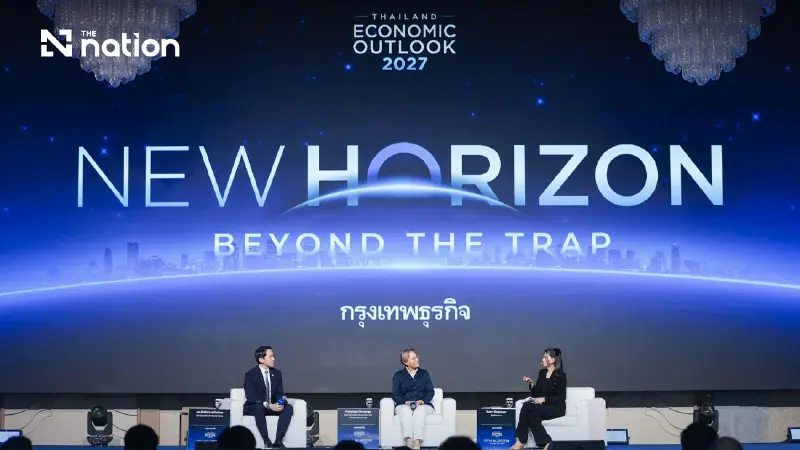


Finance vice-minister and World Bank economist say piecemeal tweaks cannot lift growth from 2%; productivity, AI uptake and investment must align
- Economic leaders argue that to escape its persistent low-growth trap of around 2%, Thailand needs a fundamental overhaul of its economic "operating system" rather than incremental policy "patches".
- The proposed "remake" requires a unified pivot towards boosting national productivity, accelerating the adoption of technology like Artificial Intelligence (AI), and securing high-value investment.
- A major challenge is Thailand's low AI adoption rate, with only 12% of firms using the technology compared to 43% in the US, due to a lack of know-how, cost, and data security concerns.
- The government's role is not to control the overhaul but to enable it by creating a skilled workforce, ensuring reliable energy, and providing a clear, predictable policy environment.
Finance vice-minister and World Bank economist say piecemeal tweaks cannot lift growth from 2%; productivity, AI uptake and investment must align.
Overcoming Thailand's persistent low-growth trap will require a complete overhaul of the nation's economic "operating system" rather than minor policy tweaks, top global and local economic leaders said at the Thailand Economic Outlook 2027 conference on Thursday (October 8).
They urged a unified pivot towards productivity, technology adoption, and high-value investment. The argument is that incremental "software patches" are no longer enough to push Thailand beyond growth of around 2% a year.
It ran through a special session titled "New Horizon Beyond the Trap", where Santitarn Sathirathai, vice minister of finance, shared the stage with Franziska Ohnsorge, the World Bank's chief economist for East Asia and Pacific.
The stakes are high. Organisers said that reaching high-income status by 2037, the target set out in a new World Bank report on Thailand, would require sustained growth of roughly 4% a year, about double the current pace.
A system that has "missed quite many updates"
Asked to imagine Thailand's economy in 2027 as a computer and say which part should be replaced first, rather than simply upgrading the software, Santitarn did not hesitate. The hardware, he suggested, is not the problem.
"What we need to change is the operating system," he said, describing a system that has "missed quite many updates" and can no longer simply be refreshed.
Thailand has considerable strengths, he said, but the task is to build a system that "connects the dots", overcomes silos and gets every piece working together.

He added that the rewriting need not be left to the state alone. In an age of AI and distributed connectivity, he argued, the government does not have to be the only coder.
Businesses, universities and individuals can all take part in writing what he called a new chapter, a new horizon and a new operating system.
Pockets of excellence, a long tail of lagging firms
Ohnsorge supplied the diagnosis behind the metaphor. Parts of the Thai economy, she said, already perform at high-income levels.
There are world-class firms as productive as their peers in rich countries, and Thai students in science, technology, engineering and mathematics outperform those in some advanced economies on international tests.
"The challenge is now to move beyond these pockets," she said, and broaden prosperity across the wider economy. With the population stabilising, that comes down to productivity, which can be lifted in two ways: by allocating resources more efficiently, largely through competition, and by technological change that raises output from the existing workforce.
Artificial intelligence (AI) promises a large productivity gain, but Thailand is not capturing it yet. East Asia is deeply embedded in global supply chains for AI-enabling goods, yet the actual use of AI lags.
According to the latest World Bank survey data cited by Ohnsorge, 12% of Thai firms report using AI-enabled technology, compared with 43% of firms in the United States.
She identified three barriers: cost, a lack of know-how, and concerns over data security. The know-how gap is the most striking. Some 80% of firms that have not adopted AI expect no productivity gains from it, she said, because they are still trying to work out how to use it.

What the new system needs from government
Ohnsorge separated the state's role into AI-specific and general functions. On AI, governments can use the technology more widely in their own service delivery and act as regulators.
The aim of regulation, she stressed, is not necessarily to restrict use but to clarify the boundaries within which firms can operate, easing worries about data security and privacy.
More broadly, the World Bank's work on firm adoption and data-centre location points to the same enabling conditions.
Governments need to build a skilled workforce able to produce new technology, ensure reliable and expanding energy supply, and offer a predictable, clear policy environment.
Asked for a single recommendation to Thai policymakers, Ohnsorge said she would double down on getting those conditions right.
Doing so, she argued, allows an economy to exploit both negative and positive shocks, and East Asia, including Thailand, is well placed given its solid manufacturing base and vibrant services sector.
For Santitarn, the constraint is fiscal. With limited room in the budget, he said, the government cannot do everything. It must be selective with money, time and focus and play an enabling role.
The central question, in his words, is not only how to attract the capital now flowing into Thailand but also how to turn it into local capabilities.
One example he offered was an "AI for All" approach, in which simple AI features are built into mass-scale government schemes rather than leaving small businesses to fend for themselves.
In the most recent fiscal stimulus, he said, a basic analytics tool was embedded in merchant platforms. A street vendor selling chicken kebabs can see whether ingredient costs are eating into profits and which day of the week sells best.
"AI sounds scary to them," he said, but once vendors try it they find it simple and useful.

One told him she had never known Monday was her best day. Over time, he said, the data can help such vendors build financial records and gain access to credit.
Crisis as catalyst Both speakers returned to the idea that shocks can speed up reform.
Santitarn said that "within crisis and big shocks… that's where opportunity for transformation lies", adding that his guiding principle is "don't let that crisis go to waste".
He cited the energy transition, which has risen to the top of the national agenda. Without recent energy shocks, he said, that shift might not have happened at all.
Geo-economic fragmentation is doing something similar, prompting companies to diversify supply chains and bringing a wave of foreign direct investment to Thailand that officials want to capitalise on.
That matters, he said, because the pace of structural reform is often underestimated. Such reforms are widely assumed to take a very long time, he said, but "once you get the first piece going", some move much faster than expected.
The key is not to reinvent the wheel but to ride trends already under way.

Ohnsorge, for her part, stressed that the same enabling environment determines who benefits.
A World Bank study of the earlier wave of predictive AI found that adopters were concentrated among multinational firms and among those near universities with strong quantitative skills and those already using enterprise software.
In other words, firms that already had the right conditions in place.
A global audience next week
The discussion comes days before Thailand hosts the annual meetings of the World Bank Group and the International Monetary Fund in Bangkok. The meetings run from 12 to 18 October, and Thailand last hosted them in 1991.
Santitarn called it a rare opportunity, comparing it to having the world's attention on a single advertisement, and urged business leaders to think about what they want to learn from visitors and what they want the world to learn about Thailand.
Ohnsorge said she hoped to see "more and better jobs" come out of the process and that the World Bank has begun measuring outcomes so a number can be put on the challenge.
