
Thailand plans Bangkok Declaration for IMF-World Bank meetings
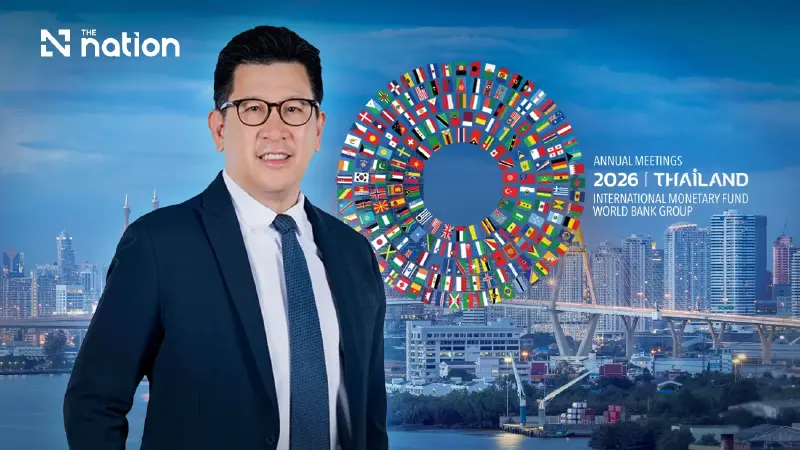


Thailand plans to propose a Bangkok Declaration at the 2026 IMF-World Bank meetings, focusing on digital finance, climate resilience and global cooperation.
Thailand plans to propose a “Bangkok Declaration” during the 2026 Annual Meetings of the International Monetary Fund (IMF) and the World Bank Group, seeking to contribute to discussions on the future direction of the global economy and financial system.
Deputy Prime Minister and Finance Minister Ekniti Nitithanprapas said Thailand would use its role as host to advance two key outcomes — the Bangkok Blueprint and the Bangkok Dialogue — which it hopes can continue to influence international economic and financial cooperation beyond the seven-day meetings.
Bangkok Blueprint focuses on digital finance
The first initiative, the Bangkok Blueprint for Fraud-Resilient Financial Services, is intended to provide a framework for modern digital finance while using technology to broaden access to funding for low-income and underserved people.
Thailand plans to draw lessons from its own digital innovations, including the Paotang and Tung Ngern applications and AI Nok Krasip, an artificial intelligence tool designed to help small traders, including street-food vendors, improve their businesses.
Ekniti said Thailand, the Bank of Thailand and the IMF had also been working on approaches to strengthen digital financial security, with the aim of producing a framework that financial policymakers in other countries could adapt for practical use.

The second initiative, the Bangkok Dialogue, will draw together the outcomes of discussions held throughout the seven-day meetings. It is expected to culminate on the final day as part of the Bangkok Declaration and provide a framework for countries to take forward economic ideas and opportunities discussed in Bangkok.
“We will turn what we showcase here into approaches that countries can use to help shape the direction of the global economy and drive their own economies forward,” Ekniti said.
He added that he expected the two initiatives to have an impact beyond the meetings themselves and remain relevant to international economic and financial discussions for years.
Climate and water management on agenda
Thailand also intends to promote greater cooperation between the World Bank and IMF in helping countries address climate change, global warming and increasingly volatile weather conditions.
The World Bank is due to hold a special session on water management during the meetings, where Thailand plans to share lessons from its experience in managing both floods and droughts, including conditions associated with a super El Niño.
Thailand will also showcase water infrastructure developed under royal initiatives from the reigns of King Rama IX to King Rama X at the Royal Pavilion, including the Kaem Ling, or “monkey cheek”, water-retention approach.
Another area Thailand plans to highlight is artificial intelligence infrastructure and data centres.
Ekniti said Thailand had completed criteria for data-centre investment aimed at ensuring investment in innovation and AI takes account of economic, social and environmental effects while delivering the greatest possible benefit to the country.
Thailand plans to share its experience in developing those criteria during the international meetings.
Thailand hosts meetings for second time
Thailand previously hosted the IMF-World Bank annual meetings in 1991 at the Queen Sirikit National Convention Center. This year marks the country’s second time as host, 35 years later.
More than 16,000 participants have registered for the 2026 meetings, which run from October 12-18.
Ekniti said Thailand intended to use the gathering to demonstrate its strengths in three main areas.
The first is Thai identity, including displays of Thai textiles, venue decorations using community products, internationally recognised Thai cuisine and the participation of Thai young people in welcoming global financial leaders.
He said involving young people was intended to inspire them to pursue opportunities on the international stage in the future.
The second area is Thailand’s ambition to position itself as a “trusted connector” capable of building links between major global powers.
The third focuses on sustainability, attracting investment and strengthening resilience to economic and environmental volatility, while using the meetings to build partnerships and encourage investment in Thai businesses.
“The most important impression should be Thainess,” Ekniti said. “I believe everyone will want to return to Thailand. The world will see the character and potential of Thai people and our ability to contribute to the direction of the global economy. The global stage will look at us again as a leader in economics and finance.”
