
World Bank urges reforms to grow Thailand’s 1.7tn-baht creative economy
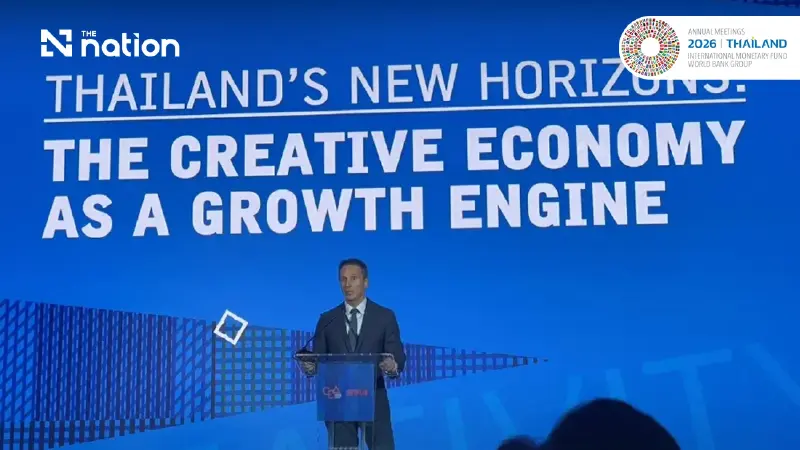


The World Bank recommends stronger intellectual property rights and financing to help Thai creative businesses expand abroad and create formal jobs.
- The World Bank recommends three key reforms: shifting focus from funding projects to growing businesses, from creating intellectual property (IP) to generating income from it, and from developing domestic creators to building globally competitive companies.
- Proposals include strengthening IP rights enforcement, improving access to finance by using IP as collateral, and building support networks to help businesses compete in the US$1.4 trillion global creative services market.
- The goal is to transform the 1.7 trillion baht creative economy into a stronger source of investment and formal jobs, with one scenario suggesting the potential to create three million additional jobs by 2040.
The World Bank is urging Thailand to turn its creative economy, estimated at 1.7 trillion baht, into a stronger source of investment and formal jobs by helping businesses expand and generate revenue from intellectual property (IP) in global markets. The recommendations were presented at a Bangkok forum on October 13, 2026.
Denis Medvedev, the World Bank Group’s global director for trade, competition and business, outlined the proposals in his presentation, “Thailand’s New Horizons: The Creative Economy as a Growth Engine”, at “CREATIVITY AS CAPITAL: Driving the Next Growth Frontier”.
Medvedev identified creative industries as one of five industries of the future with the potential to drive Thailand’s long-term growth. The World Bank Group’s Building Thailand’s Future Today report calls for a shift towards higher-value economic activities to improve productivity, competitiveness and the creation of quality jobs, with creative industries among the sectors where Thailand has strengths to build on.
World Bank proposes three shifts to grow creative businesses
The World Bank recommends changing how Thailand supports and measures the development of creative industries, placing greater emphasis on business expansion, income from intellectual property and international competitiveness.
The World Bank’s proposals for Thailand centre on three shifts:
- From funding individual projects to helping businesses grow. Support should be assessed by companies’ ability to expand, enter new markets and attract private investment, rather than simply by the number of projects funded or the amount of financial assistance provided.
-
From creating intellectual property to generating income from it. Stronger protection, licensing arrangements and commercial opportunities would help turn creative works into economic assets capable of generating further value.
-
From developing domestic creators to building globally competitive companies. Producers, distributors, platforms, professional service providers and overseas buyer networks should play a greater role in helping Thai creative businesses reach international markets.
Thai creative industries have scope for more formal jobs
The World Bank estimates Thailand’s broader creative economy at approximately 1.7 trillion baht, or 10.8% of national gross value added (GVA). Core creative industries, a narrower category, contribute about 4.6% of GVA, demonstrating their economic importance beyond culture and social life.
The World Bank’s published report puts core creative industries at roughly 2% of jobs in Thailand. That employment share is lower than in Brazil and the Philippines, countries with comparable creative-industry contributions to their economies.
Thailand’s ability to produce high-value creative works therefore leaves room for more businesses that can expand, create formal employment and offer quality careers, according to the assessment presented at the forum. Opportunities include activities capable of reaching wider markets rather than relying on specialised production for limited customer groups.
A conditional scenario presented at the Creativity as Capital forum suggested that developing Thailand’s creative economy towards South Korea’s level could create around three million additional formal jobs by 2040. Under that scenario, creative industries could account for about 5.6% of GVA and nearly 9% of employment, provided the necessary development takes place.
A further World Bank scenario, which also brings Thailand’s creative professional services closer to US levels, suggests the creative economy could account for about 6.1% of GVA and 12% of employment. These figures illustrate potential outcomes under development assumptions, rather than results expected to occur automatically.
Creative services offer a US$1.4 trillion export market
Global creative services exports are valued at approximately US$1.4 trillion, more than twice the market for creative goods, according to figures presented at the forum. The World Bank sees opportunities for Thailand to expand creative services and digital content businesses that earn income from intellectual property overseas.
Thailand’s creative goods exports increased from approximately US$3.2 billion in 2002 to US$8.2 billion in 2024, more than doubling over the period. Dependence on certain product categories nevertheless remains a constraint on developing internationally competitive businesses and expanding formal employment.
The figures presented at the forum also pointed to global media and entertainment revenues approaching US$3 trillion and a video-game market projected at approximately US$312 billion.
Medvedev’s presentation highlighted opportunities for Thai businesses to build on strengths in food, fashion, design, film, music and handicrafts to develop products and services for international markets. Music copyrights, characters and original designs could generate recurring revenue through licensing and overseas distribution.
Stronger IP rights and financing support business expansion
The World Bank’s recommendations include stronger enforcement of intellectual property rights, greater use of digital rights management technology, improved organisations for collecting royalties, and one-stop services for registering and protecting IP across borders.
Valuing intangible assets is another priority for Thailand’s creative businesses. The proposals call for systems to assess copyrights, characters, music catalogues and designs, helping companies demonstrate their value and improve access to finance.
The World Bank also proposed financing backed by intellectual property as collateral, supported by appropriate valuation methods and risk-management arrangements.
Thailand’s Creative Economy Agency (Public Organization), or CEA, aims to use the Creativity as Capital event to encourage international exchanges on creative-economy policy. The agency’s objective is to turn creativity, cultural capital and intellectual property into assets that generate value, attract investment and reach global markets.
For Thailand’s public sector, the proposals emphasise market systems and support mechanisms that help businesses grow, alongside improvements to legislation and access to finance. Performance should be measured through business growth, export value, intellectual property income and the creation of quality jobs.
Private businesses and investors are encouraged to assess the value of intellectual property, access to customers and workforce capabilities. Combining cultural capital with digital technology could help Thai creative enterprises develop commercial opportunities in Asian and global markets.
