
ECB Chief Christine Lagarde Warns of 'Harder to Read' Global Economy and Emerging Inflation Risks
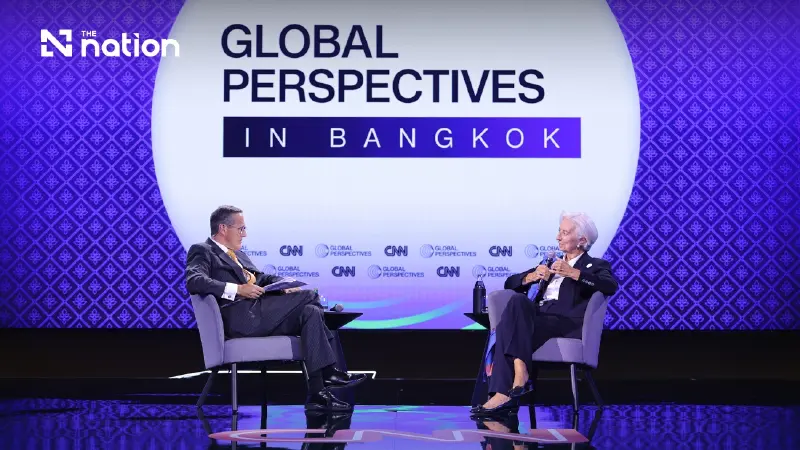


Speaking at CNN’s inaugural Asia-based Global Perspectives event in Bangkok, ECB President Christine Lagarde warns that rising energy pressures and hidden wage risks threaten global stability
- ECB President Christine Lagarde warns the global economy is becoming increasingly difficult to predict due to fluctuating energy prices, shifting trade routes, and geopolitical conflicts.
- Global headline inflation is anticipated to rise to 4.7%, largely driven by persistent pressures on energy and food prices.
- Lagarde identified a key emerging risk of "second-round" inflation, specifically from significant wage increases that could lead to a wage-price spiral.
- Despite these challenges, Lagarde stated the ECB's primary focus remains on its mandate of ensuring price stability to create a predictable environment for investment.
Speaking at CNN’s inaugural Asia-based Global Perspectives event in Bangkok, ECB President Christine Lagarde warns that rising energy pressures and hidden wage risks threaten global stability.
For families and businesses trying to plan for the future, the global economy is beginning to feel like a moving target. From fluctuating utility bills to shifting trade routes, everyday consumers are acutely aware that the economic weather can change overnight.
Addressing this uncertainty head-on, European Central Bank (ECB) president Christine Lagarde warned that the global economic landscape is becoming increasingly difficult to read.
Speaking on Wednesday, 14 October 2026, at CNN's Global Perspectives: In Bangkok, Lagarde joined CNN’s business editor at large, Richard Quest, to dissect the pressures reshaping modern markets.
This landmark event marks the first time CNN’s Global Perspectives series has been held in Asia, choosing Bangkok as its stage following its London debut in November 2025 (which focused on the African continent) and a subsequent session at the World Economic Forum in Davos in January 2026.
Navigating a "Harder to Read" Global Economy
Lagarde’s cautions arrive right on the heels of the International Monetary Fund’s (IMF) latest World Economic Outlook report, released during the IMF-World Bank Annual Meetings in Bangkok.
The IMF report projects global growth at 3.1% for 2026 and 3.4% for 2027, noting that while the global economy continues to prove resilient, that resilience is becoming increasingly uneven.
Global headline inflation is anticipated to tick up to 4.7% this year, largely driven by persistent pressures on energy and food prices.

For Europe and other advanced economies, these macro headwinds are compounded by recurring geopolitical flashpoints.
Lagarde pointed directly to the protracted war in Russia against Ukraine, alongside ongoing strains on oil and gas supply chains stemming from the Middle East conflict, which continue to place intense pressure on refinery capacities and energy security.
"How do you make decisions when the outlook can literally change overnight?" Lagarde noted, describing an environment where trade shifts, rising debt, and geopolitical tensions challenge traditional assumptions about where growth originates.
The Threat of "Second-Round" Inflationary Shocks
While headline inflation metrics have largely retreated from their pandemic-era peaks, central banks remain on high alert for hidden hazards.
When questioned about the ECB's cautious stance and use of a "measured response", Lagarde stressed that monetary authorities cannot afford to wait until secondary pressures materialise in plain view.
"The problem with secondary effects is by the time you see them it's too late," Lagarde explained. "Typically, second-round effects have to do with wages... When wages begin to rise significantly, then you have these second-round effects. In Europe in particular, you see anticipation of wage increases through collective bargaining arrangements."
She noted that while current wage negotiations—often starting higher before settling closer to a medium-term objective—remain manageable, the ECB must remain exceptionally vigilant to prevent a wage-price spiral.

Growth Resilience and the Domestic Balancing Act
Against a backdrop of rising sovereign bond yields and tight fiscal constraints—with the IMF urging countries to rebuild fiscal space given high global debt levels—critics have warned of a "perfect storm" for growth.
However, Lagarde pushed back against outright pessimism regarding Europe's trajectory.
Driven by substantial domestic momentum, infrastructure investments, and increased military and green-transition spending in key member states like Germany, European growth has been revised upward, with the region tracking toward a 1.1% growth outcome.
Addressing pressures on European sovereign debt and bond markets—including market anxieties surrounding countries like France—Lagarde emphasised that the primary solutions must begin at home through disciplined domestic fiscal policies.
Meanwhile, the ECB remains steadfastly anchored to its primary legislative mandate: price stability.
"I'm focused on my objective, what has been assigned to me by the European Treaty, which is price stability," Lagarde stated. "I think the best contribution that we can make at the moment is to procure price stability so that those who are looking at investing heavily in infrastructure, military equipment, artificial intelligence... know exactly what the price environment is."

Breaking Barriers and Inspiring the Next Generation
Closing out the high-stakes economic panel on a personal note, Lagarde reflected on her upcoming book and her trailblazing career spanning law, national finance ministries, the IMF, and the ECB.
Having navigated male-dominated financial corridors since the 1980s, she shared a message of empowerment directed at young girls and aspiring professionals across Southeast Asia and the globe.
"What it feels like is being quite isolated but at the same time being different," Lagarde reflected. "What I want to say to those young women is you can be an economist, you can do monetary policy, you can do financial programmes with countries, and you can still be a woman. That’s okay."
