
Thailand–EU trade negotiations face key decisions on market access
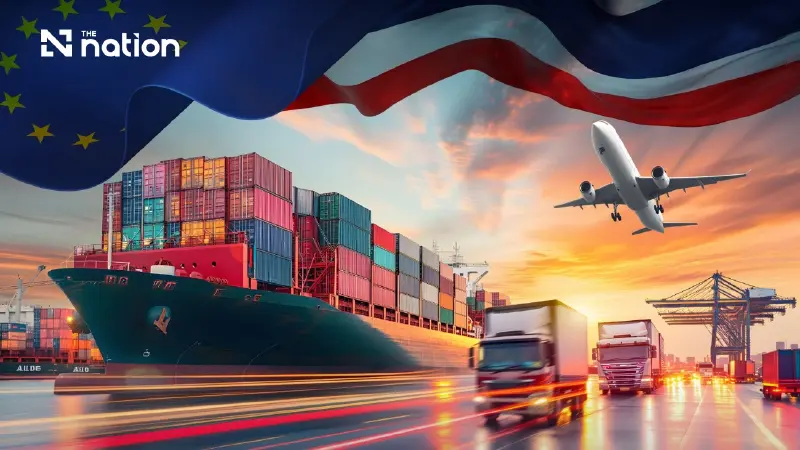


Both sides aim to conclude talks in 2026 as Thailand weighs export opportunities against competition and concerns over farmers’ rights and access to medicines.
- Key decisions in the negotiations center on market access for goods, specifically the scope and timeline for tariff reductions and the treatment of sensitive products.
- Discussions extend beyond goods to determine the level of market opening for services, investment, and government procurement, affecting both competition and policy space.
- Agricultural market access is the most sensitive issue, involving not just tariffs but also compliance with EU standards, while intellectual property rights and sustainable development are other critical policy areas.
- The core challenge is to reach a reciprocal agreement that balances opportunities for Thai exports to the EU with the need to manage competition for domestic producers.
Negotiations on a free trade agreement (FTA) between Thailand and the European Union (EU) have reached a critical juncture following the 10th round, held in Phuket from Monday (September 28, 2026) to Tuesday (October 6, 2026).
Significant progress was made on the agreement’s provisions, while market access and policy issues remain under discussion.
Both sides continue to aim to conclude negotiations in 2026.
This “final stretch” may involve more than drafting rules.
Although many provisions can be agreed in principle, the detailed schedules for goods and services require both sides to decide how far to open their markets and what benefits to obtain in return.
Those schedules require Thailand and the EU to determine which goods should receive immediate tariff cuts, which should have tariffs reduced gradually, which need longer adjustment periods and which should be designated as sensitive products.
Market opening also extends beyond goods to services, investment and government procurement, all of which affect Thailand’s competitive landscape and room to set policy over the long term.
For goods, the key decisions concern product coverage, tariff rates, tariff reduction timetables and conditions for sensitive products.
From Thailand’s perspective, greater access to the EU market would create more opportunities for Thai exports, particularly agricultural products, food, processed agricultural products and industrial goods. The EU also wants better access to the Thai market for European products.

“Market opening” therefore involves bargaining over reciprocal benefits, rather than one side opening its market alone.
However, the latest detailed market access offers for individual products and items have not yet been made fully public. The EU states that the proposal documents it has published are preliminary, with final wording to emerge from negotiations with Thailand.
Agricultural and food market access is the most sensitive issue because it directly affects producers and farmers and is linked to sanitary and phytosanitary (SPS) measures, rules of origin, technical barriers to trade and sustainable food systems.
Opening agricultural markets therefore goes beyond “how far tariffs are cut”. It also requires considering the extent to which Thai products can meet EU standards and conditions, and whether businesses would face higher compliance costs.
In the other direction, opening Thailand’s market would give European agricultural and food products greater opportunities to compete domestically. The degree of market opening and the adjustment periods must therefore be suited to domestic producers’ competitiveness.
Beyond market access, policy issues drawing attention from various sectors include plant variety protection under the 1991 Act of the International Convention for the Protection of New Varieties of Plants (UPOV 1991), intellectual property and access to medicines.

Before the 10th round, 146 civil society organisations expressed concern about commitments relating to UPOV 1991 and Trade-Related Aspects of Intellectual Property Rights-Plus (TRIPS-Plus).
Their concerns included effects on farmers’ rights, access to medicines, health and Thailand’s policy space.
Government procurement is another key issue, determining the extent to which companies from either side could bid for government contracts under agreed conditions, contract values, covered agencies and exceptions.
If procurement markets are opened under the agreement, EU companies would have opportunities to bid for Thai government contracts within the agreed scope.
Thai companies would also have opportunities to access the EU’s procurement market.
The issue to watch is therefore more than “whether to open the market”. It is who would gain access, which types of contracts would be covered, their value and the exceptions that would apply.
Opening markets for services and investment is another important area, covering market entry conditions, business establishment, shareholdings and restrictions in individual sectors.
For Thailand, greater access to the EU market could create opportunities for Thai companies to operate and provide services in Europe.
Opening Thailand’s market would also increase competition from EU businesses.
The challenge is to set a level of market opening that matches the capabilities of Thai businesses, while using the FTA to attract investment and technology and upgrade supply chains.
Trade and Sustainable Development (TSD), a priority for the EU, is another issue that should not be overlooked.
The FTA framework covers labour rights, environmental protection and climate objectives, alongside enforceable sustainability rules.
Together, these issues are central to the final stretch of negotiations.
For Thailand, the key question is not simply “Will the FTA be concluded?” but “On what terms?”
Ultimately, Thailand needs to balance opening markets to create new opportunities with maintaining its competitiveness, so the Thailand–EU FTA can expand trade and investment opportunities and strengthen links with global supply chains as international trade rules change.
Source: Bangkokbiznews
