
Moscow and Bangkok seek concrete projects ahead of 2027 milestones
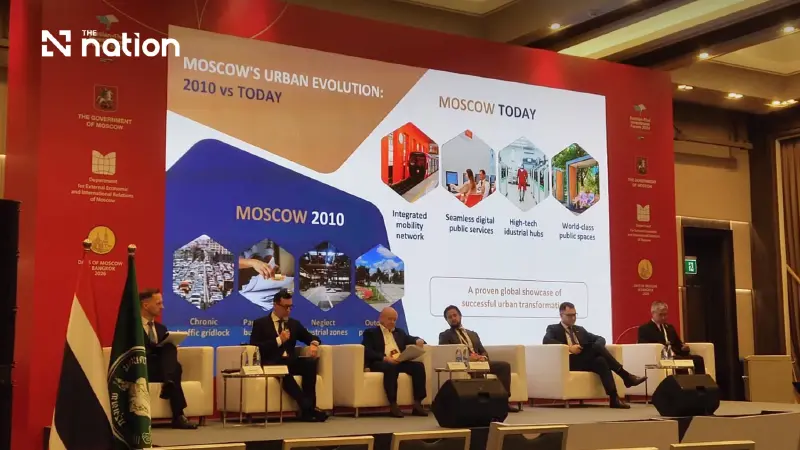


Moscow and Bangkok discussed joint projects in transport, technology and project finance at the Russian-Thai Investment Forum 2026, ahead of 2027 anniversaries.
- Moscow and Bangkok are aiming to establish tangible joint investment projects before two significant relationship anniversaries in 2027.
- Proposed areas for cooperation include transport, technology, industry, healthcare, and digitalisation, with Moscow promoting its urban technology solutions.
- The focus is on moving beyond general trade to create deeper commercial partnerships, such as joint product development and technology exchange.
- Efforts are being made to diversify investment and connect businesses with specific projects, though the lack of an active bilateral investment-protection treaty was noted as a challenge.
Moscow and Bangkok are seeking to turn their long-standing relationship into joint investment projects in transport, technology and industry, building on existing city links to develop more substantial commercial partnerships.
These priorities were discussed at the plenary session “Moscow–Bangkok: Partnership and Development” during the Russian-Thai Investment Forum 2026, held at the Royal Orchid Sheraton Riverside Hotel Bangkok on Friday (October 30).
The meeting came ahead of two milestones in 2027: 130 years since Russia and Thailand established diplomatic relations in 1897, and 30 years since friendly relations between the two capitals began in 1997.
Thai interest in Russian education, culture and technology, alongside Russian tourism and investment in Thailand, has provided a foundation for closer ties. Speakers focused on how that relationship could support viable projects and two-way investment.
Urban technology and city priorities
Viacheslav Manuylov, deputy head of Moscow’s Department for External Economic and International Relations, estimated trade between Moscow and Thai companies at nearly US$1 billion in 2025. He identified further opportunities in transport, digitalisation, education, healthcare and tourism, pointing to an existing transport working group between the two capitals.
Manuylov highlighted digital public services, integrated transport systems, artificial intelligence for medical diagnostics and data-driven urban planning as areas for cooperation. He described Moscow’s electronic public services, intelligent traffic management and electric river transport as examples of solutions that could support residents while creating openings for technology businesses.
He also invited Thai firms to explore partnerships in microelectronics, pharmaceuticals, robotics, electric transport and aerospace. The Technopolis Moscow special economic zone, which he described as home to more than 180 high-technology companies, was among the investment locations he presented.
Witoon Apisitpuvakul, director-general of the Bangkok Metropolitan Administration’s Strategy and Evaluation Department, emphasised that cooperation should reflect a broad range of urban priorities rather than focus on transport alone. Bangkok’s development vision, he explained, seeks to improve the quality of city life while creating economic opportunities.
He highlighted small and medium-sized enterprises (SMEs) alongside large investors, as well as tourism, festivals, creative activities and the night-time economy.
Witoon stressed the importance of connecting public and private stakeholders, making reliable city data accessible and using online information platforms to help businesses understand policy progress and investment opportunities.
Business partnerships beyond trade
Vladimir Platonov, president of the Moscow Chamber of Commerce and Industry, outlined the contribution of entrepreneurs to Moscow’s economy, putting the number of SMEs in the city at more than 900,000.
He advocated joint product development, technology exchange and lasting commercial relationships, particularly in healthcare, pharmaceuticals, food production, transport and digital services.
Platonov recalled the chamber’s cooperation agreements with the Thai Chamber of Commerce in 2003 and the Federation of Thai Industries in 2016.
He argued that business organisations must help companies identify suitable partners, prepare for negotiations and maintain contact afterwards, rather than treat conferences as an exchange of business cards. He also highlighted programmes that help young people turn business and research ideas into commercial projects.
Financing and project opportunities
Alexey Kretov, director and head of the Project Finance Office at the Russian Export Center, estimated Russian investment in Thailand at about US$1.5 billion, with much of it concentrated in property.
He called for broader investment in manufacturing, logistics, processing and higher-value technology, building on existing trade links.
Kretov outlined support for companies progressing from initial exports to regular distribution and eventually local production. He described promotional activities under the Made in Russia initiative, alongside export-credit insurance against non-payment and investment insurance against political risks overseas.
He also discussed possible insurance support for foreign investors in Russian projects and assistance for service and creative-sector exports.
Another issue he raised was the absence of a bilateral investment-protection treaty in force. Russia and Thailand signed an agreement in 2002, but it has yet to take effect. Kretov viewed progress on investor protection as important for encouraging further capital flows.
Alexander Shatirov, director of the Roscongress Foundation Investment Platform and the RK-Investments Foundation, focused on converting expressions of investment interest into projects capable of attracting financing.
He described 24 Moscow projects identified for presentation to Thai businesses, alongside a much wider pipeline of nearly 4,000 projects in advanced stages of development across Russia.
The platform offers project information, expected budgets, financial indicators and contact details to help investors assess opportunities and approach developers. Shatirov highlighted medical technology, robotics, software, logistics, food and wellness, while also identifying opportunities for Russian exports to Thailand and the wider Southeast Asian market.
He explained that the platform could help connect investors with project developers and financial specialists while guiding them towards available government support mechanisms.
The discussion closed with an emphasis on finding suitable partners and presenting examples of successful joint projects at future meetings, so that the anniversaries in 2027 could be accompanied by tangible business outcomes.
