
Russian and Thai chambers seek lasting trade partnerships
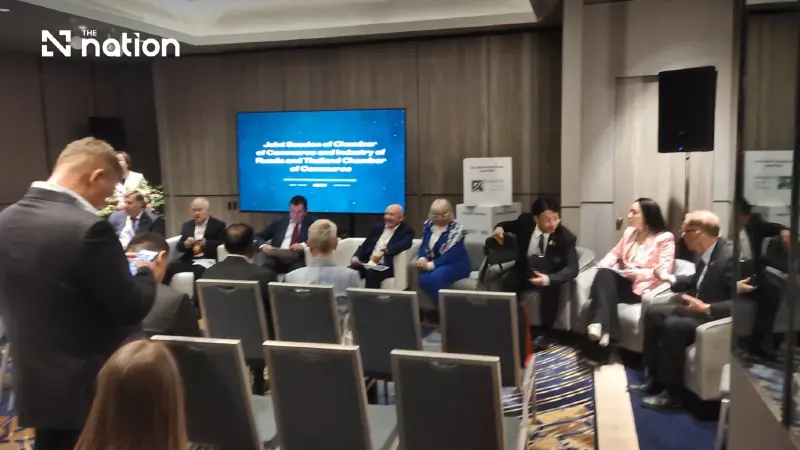


At the Russian-Thai Investment Forum 2026 in Bangkok, chamber leaders outlined ways to ease trade barriers, verify partners and develop regional investment projects.
- Russian and Thai chambers of commerce are seeking to build on a 13% rise in bilateral trade by establishing long-term investments, reliable supply chains, and practical partnerships.
- Key areas identified for cooperation include food security, by linking Russian agriculture with Thailand's food-processing industry, as well as technology and localised production.
- The chambers aim to help businesses overcome challenges such as market access, cross-border payments, and high customs duties by assisting in finding reliable partners and providing expert support.
- Discussions also highlighted the potential for Russian firms to use Thailand as a strategic base to access wider markets across the Association of Southeast Asian Nations (ASEAN).
Russian and Thai chambers of commerce are seeking to turn a reported 13% rise in bilateral trade in the second quarter of 2026 into longer-term investment, more reliable supply chains and practical business partnerships, with market access, payments and trusted local contacts among the main challenges.
The priorities emerged during the joint session of the Chamber of Commerce and Industry of the Russian Federation and the Thai Chamber of Commerce at the Russian-Thai Investment Forum 2026, held at the Royal Orchid Sheraton Riverside Hotel Bangkok on Friday (October 30).
The forum programme stressed that individual transactions would not be enough to sustain commercial momentum. Participants explored how chambers could help companies identify opportunities, overcome barriers and build partnerships across regions.
Lower barriers, broader trade
Vladimir Padalko, vice president of the Chamber of Commerce and Industry of the Russian Federation, outlined support ranging from finding reliable business partners and providing expert assessments of import and export products to arbitration when commercial disputes arise. Such services can give businesses greater confidence when entering each other's markets.
Dr Chanintr Chalisarapong, vice president of the Thai Chamber of Commerce and chairman of its International Trade Development Committee, highlighted the complementary strengths of Russian agricultural production and Thailand's food-processing and animal-feed industries.
He identified food security as a promising area of cooperation amid demand from overseas markets and pressures associated with geopolitical uncertainty, climate change and higher energy and fertiliser costs. Chanintr called for lower customs duties and fewer technical barriers to trade, arguing that both governments needed to address these obstacles.
Vitaly Kiselev, president of the Thai-Russian Chamber of Commerce, cautioned that recent growth in turnover should be viewed in the context of the higher trade figures he cited for 2012 and an imbalance favouring Russian exports. He also linked stronger competition from lower-priced Vietnamese products to Vietnam's free-trade agreement.
Kiselev proposed pursuing new opportunities in technology and agriculture, including localised production and joint exports to other markets, rather than relying solely on purchases and sales between the two countries. He identified cross-border payment arrangements as one of the practical issues where business chambers could help their members.
Regional opportunities and practical support
Vladimir Platonov, president of the Moscow Chamber of Commerce and Industry, drew on the city's experience with digital public services. He described one-stop service centres, electronic healthcare systems and platforms for gathering residents' views as examples of how technology and cooperation between businesses and public authorities can improve urban services. Chambers, he noted, can share such experience and connect organisations with relevant expertise.
Boris Stupnitsky, president of the Chamber of Commerce and Industry of Primorsky Krai, presented Russia's Far East as a potential destination for Thai investors in agriculture, fisheries, processing and related industries. He referred to investment incentives and opportunities to develop tourism in both directions, including attracting more Thai visitors to the Russian Far East. He also discussed potential regional cooperation involving Phuket.
Kongsak Khoopongsakorn, chairman of the Phuket Chamber of Commerce, described the importance of Russian tourists to the island's economy and the chamber's capacity to connect overseas businesses with provincial networks. Local knowledge of entrepreneurs, officials and regional needs could, he suggested, help transform existing tourism links into broader commercial cooperation.
Lyudmila Kozlova, president of the Ryazan Chamber of Commerce and Industry, outlined the region's 22 industrial clusters and investment opportunities in electronics, information technology, pharmaceuticals, manufacturing and agriculture. She noted that companies in the region export to more than 100 countries and cited ventilation equipment and medical products supplied to Vietnam, alongside fertiliser exports to Indonesia and Malaysia.
Her chamber supports international business missions, business-to-business meetings, partner verification and assistance with cross-border transactions. Kozlova expressed interest in establishing a cooperation agreement with Thai chamber counterparts and invited potential investors to visit Ryazan's factories and cultural attractions.
Trusted partners across Southeast Asia
Duong Thu Huong, chairwoman of the Thai-Vietnam Chamber of Commerce, identified three priorities for chambers: building trust, defining specific projects with qualified partners and strengthening regional connections linking Russia, Thailand and Vietnam. She identified medical tourism, food security, digital innovation, logistics and investment as potential fields for cooperation.
She argued that progress should be judged by partnerships formed, projects launched and value created, rather than the number of discussions or business cards exchanged.
Karel de Lange, chairman of the board of the South African-Thai Chamber of Commerce, offered a broader perspective on shifting geopolitical relationships and the potential of artificial intelligence to transform productivity. He called on business leaders to recognise changing opportunities and use commercial relationships to support prosperity and peaceful cooperation.
Aung Ko Ko Oo, executive director of the Myanmar Digital Economy Association, encouraged Russian firms to regard Thailand as a base for reaching markets across the Association of Southeast Asian Nations (ASEAN), citing Thailand's infrastructure, connectivity and industrial capacity. He singled out digital infrastructure, cybersecurity, financial technology, smart manufacturing and green technology as areas worth exploring.
More important than collecting contacts, he argued, was finding dependable partners who could assist with registration, certification, logistics and regulatory questions after an initial meeting.
