
Russia and Thailand Pledge to Turn Trade Ties into Co-Created Investment


Officials and business chiefs back co-creation in energy, food, tourism and technology and press for payments, certification and an EAEU trade deal
- Russia and Thailand are transitioning their economic relationship from simple trade to deeper partnerships involving joint ventures, shared supply chains, and long-term investment.
- Key sectors identified for this "co-created" investment include energy, food security, technology (including digital and creative industries), and specialized tourism.
- To facilitate this shift, both countries are focused on overcoming practical barriers by establishing direct payment systems, streamlining product certification, and accelerating a free trade agreement between Thailand and the Eurasian Economic Union (EAEU).
- Thailand is actively encouraging direct Russian investment, particularly in its Eastern Economic Corridor (EEC), which offers incentives for high-tech industries like healthcare, digital technology, and future mobility.
Officials and business chiefs back co-creation in energy, food, tourism and technology and press for payments, certification and an EAEU trade deal.
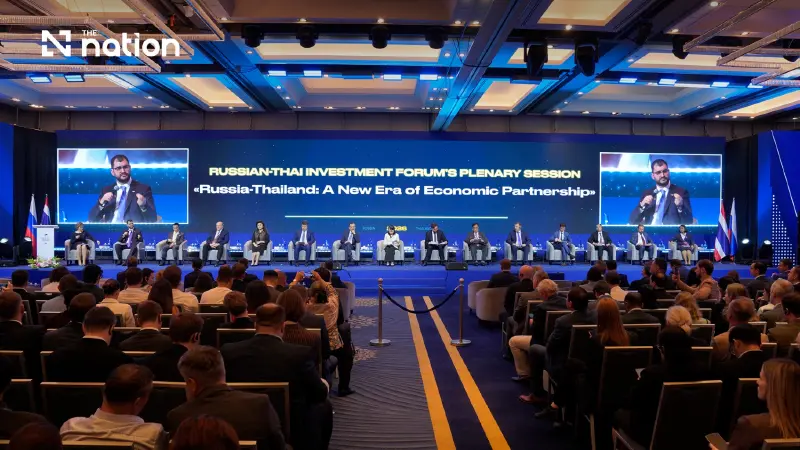
Russian and Thai officials and business leaders used the plenary session of the Russian-Thai Investment Forum to call for a move from simple buying and selling to joint ventures, shared supply chains and long-term investment.
Speakers at the session, “Russia-Thailand: A New Era of Economic Partnership", repeated three messages. Both countries need new partners as global trade fragments. Their economies complement each other, notably in energy, food and tourism.
And practical barriers, from payments to product certification, must come down, helped by an early start to talks on a Thailand–Eurasian Economic Union (EAEU) free trade agreement.
The two-day forum, on 30 and 31 October, is the second of its kind, after Phuket last year. Organisers said more than 800 companies and 1,500 participants were taking part, with projects representing an investment potential of more than $4.5 billion. They said trade turnover rose by a quarter in 2026.

Patience, payments and paperwork
Ivan Demchenko, chairman of the Russian-Thai Business Council, said success in Thailand demands patience, trust-building and steady progress, the “sabai sabai” approach, rather than aggressive short-term tactics. He set out three priorities.
First, dedicated banking mechanisms for direct payments, citing the Russian-Vietnamese bank model. Second, streamlined mutual product registration, working with the Federation of Thai Industries (FTI). Third, use of the Board of Investment’s 100 per cent foreign-ownership exemptions for high-tech sectors, plus simpler work-visa quotas to bring skilled Thai workers to Russia.

Energy security meets food security
Thai Energy Minister Akanat Promphan said Thailand has six refineries with a capacity of almost one million barrels a day, yet imports more than 90 per cent of its crude oil.
Disruption in the Middle East, including the Strait of Hormuz and the Red Sea, has made diversification urgent, he said. Demand is also surging.
He said power requests from AI data centres alone exceed 30 gigawatts, equivalent to supplying another country. Gas provides about 60 per cent of Thai power generation, and 30 per cent of that is imported liquefied natural gas.
Russia supplies oil, gas and fertilisers, he said, and Thailand can reciprocate with food.
Russian Ambassador Evgeny Tomikhin pointed to the 130th anniversary of diplomatic relations next year, saying the embassy is co-organising commemorative events and backs intergovernmental dialogue to deepen economic and cultural ties.

Dr Kirida Bhaopichitr, Thailand’s vice minister for commerce, said bilateral trade runs at about $2 billion a year. Russian investment in Thailand is about $6 billion, against about $1 billion of Thai investment in Russia.
She urged “co-creation” of shared supply chains, with Russian fertiliser helping Thai farms produce food for export back to Russia. She named three priority sectors:
• Food security, through joint production and resilient supply chains.
• Specialised tourism, including wellness and medical travel, and more Thai visitors to Moscow and St Petersburg.
• The creative economy, pairing Russian post-production strengths with Thai film production. She reaffirmed support for concluding a Thailand–EAEU free trade agreement and noted Thailand’s interest in BRICS.

Vladimir Ilichev, Russia’s deputy minister of economic development, represented the Russian government, backing intergovernmental trade mechanisms, regulatory alignment and the EAEU free trade negotiations.
Veniamin Kondratyev, governor of the Krasnodar region, led a regional delegation promoting agricultural partnerships and the export of Krasnodar wines to Thailand.
Business bodies call for practical links
Pimjai Leeissaranukul, chairwoman of the FTI and of the Thai-Russian Business Council, welcomed an agreement signed between the FTI and Business Russia to create a direct platform for entrepreneurs.
Thai industrialists see significant commercial potential in Russia despite Western sanctions, she said. She named energy supply, natural resources, infrastructure, transport and logistics, and pharmaceuticals as areas for joint investment.
Alexey Repik, chairman of Business Russia, called for a transition from import-export trade to joint ventures, technology transfer and localised production.
Business associations, he said, must help firms overcome practical hurdles including cross-border financing, certification, logistics and intellectual property protection.
Dr Poj Aramwattananont, chairman of the Thai Chamber of Commerce and Board of Trade of Thailand, said the Thailand-Russia joint intergovernmental commission can resolve obstacles such as product registration, regulatory approvals and customs clearance.
Thailand exports canned tuna, pet food and natural rubber to Russia, he noted, while Russia supplies fertilisers and wheat. A Thailand–EAEU free trade agreement would provide a structured framework for market access and investment security, he said.
Vladimir Padalko, vice president of the Russian Chamber of Commerce and Industry, said the chamber network would support business matchmaking, trade delegation exchanges and chamber-to-chamber links.
Nikita Gusakov, senior vice president of the Russian Export Center and CEO of EXIAR, outlined the export support available to Russian companies. It includes pre-export financing at 7.5 per cent ruble interest rates for small and medium-sized enterprises, long-term corporate loans, export insurance and “Made in Russia” brand promotion.

An invitation to invest in the EEC
Dr Chula Sukmanop, secretary general of Thailand’s Eastern Economic Corridor (EEC) Office, issued the most direct invitation of the session, urging Russian firms to invest in Thailand rather than only trade with it.
The EEC spans three eastern provinces near Suvarnabhumi Airport and Pattaya. He described it as a “special development zone” combining economic, social and environmental goals. Its five target sectors are:
• Medical and healthcare. Foreign doctors may practise in EEC facilities without local Thai licences, and pharmaceutical manufacturing is eligible for incentives.
• Digital technology. This covers semiconductors, microchips and data centres.
• Future mobility. The focus is next-generation vehicles, aircraft, industrial drones and eVTOL aircraft.
• Bio-circular-green economy. This includes biopharmaceuticals, recycling and green technology.
• Services and creative industries. These include film studios, logistics, education and high-end tourism. He said the EEC Office offers one-on-one, tailored incentive packages.
Platforms of trust and digital cooperation
Alexander Stuglev, chairman of the Board and director of the Roscongress Foundation, said Roscongress acts as a bridge between business, government, financial bodies and experts, building long-term trust.
He pointed to its Investment Foundation and a network spanning more than 90 countries and invited Thai participants to the 30th St Petersburg International Economic Forum.
Nongkran Chompoonut, president of the Digital Council of Thailand, highlighted the memorandum of understanding between her council and the Russian-Thai Business Council on digital transformation and technological exchange.
Working with the FTI’s Digital Club, the council aims to help 17,000 Thai manufacturers move from automation to robotics and “dark factories”. She said Thailand urgently needs industrial cybersecurity, data centres, compliance with personal data protection law, AI adoption and technology transfer to ease skilled-labour shortages.

Senate president: look for opportunity amid uncertainty
Mongkol Surasajja, president of the Senate of Thailand, thanked organisers for bringing together government, business and investors from both countries. The first forum in Phuket last year produced the digital-council memorandum, he said, and this year’s has attracted more than 2,000.
He said resilient supply chains, technological innovation, food security and sustainable development are shared priorities amid global uncertainty.
The Thai government is promoting economic diplomacy and high-quality investment and wants Thailand seen as a trusted partner and gateway to Southeast Asia.
It is courting investment in artificial intelligence, semiconductors, robotics, biotechnology, clean energy, healthcare and advanced manufacturing and encourages joint ventures that bring technology transfer.
He noted that the 130th anniversary of relations falls next year, with a design contest whose press conference and awards ceremony are planned for December 2026. He also cited the ninth session of the Thailand-Russia joint commission on bilateral cooperation, held in Moscow in August.
Trade is growing, but considerable potential remains untapped, he said. Thailand regards an early start to negotiations on a Thailand–EAEU free trade agreement as an important goal and appreciates Russia’s continued support.
“Countries and businesses that prepare for change will be best positioned to seize opportunities in the future,” he said, urging participants to build networks and practical partnerships.
