
EU Envoy: Thailand Can be Europe’s Platform in Southeast Asia as FTA Talks Advance
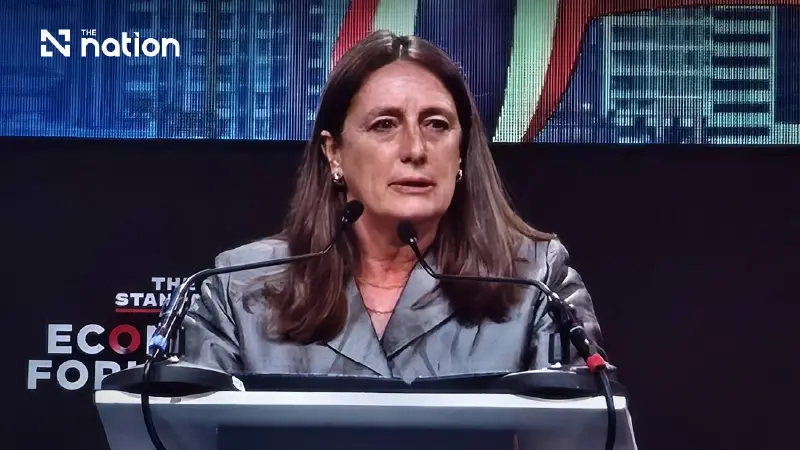


Luisa Ragher tells The Standard forum a trade deal, green investment and skills could help Thailand climb the value chain and attract European capital
- EU Ambassador Luisa Ragher stated that as Free Trade Agreement (FTA) negotiations advance, Thailand can serve as a strategic platform for European investment and production in Southeast Asia.
- The proposed FTA is designed to be comprehensive, going beyond tariffs to anchor deeper investment, facilitate technology transfer, and support Thailand's shift to a greener, higher-value economy.
- A study cited by the EU suggests the trade deal could increase Thailand's GDP by 1.25% and its exports by 2.8%, helping the country move up the economic value chain.
- The envoy emphasized that for Thailand to attract European capital and technology, it must improve its investment climate, ensure predictable regulations, and invest in its workforce to boost productivity.
Luisa Ragher tells The Standard forum a trade deal, green investment and skills could help Thailand climb the value chain and attract European capital.
The European Union has pitched itself as a “trusted and long-term partner” for Thailand’s economic transformation, with its ambassador saying a free trade agreement (FTA) now under negotiation could anchor deeper investment, technology transfer and a shift towards a greener, higher-value economy.
Luisa Ragher, the EU’s ambassador to Thailand, delivered a keynote on “Thailand–EU FTA: Trade, Green Transition & Growth” at the opening of “Economic Forum 2026: Reinvent Thailand”, hosted by The Standard.
“Thailand is not just a market for European companies. It can be a platform for European investment in Southeast Asia,” she said, describing the country as a potential regional production base.
A partnership built on open trade
Ragher said the world was becoming more fragmented and more strategically contested, with geopolitics reshaping trade and supply chains, while artificial intelligence and the energy transition transform production.
At a time of rising protectionism, she said, the EU remains committed to open, rules-based markets and has the world’s largest portfolio of trade agreements, including deals with Singapore, Vietnam and Indonesia. Negotiations continue with Thailand and Malaysia.
She stressed that the relationship is already substantial. EU–Thailand trade in goods reached about 44 billion euro in 2025, with services trade of about 14 billion euro. European investment stock in Thailand stands at about 40 billion euro, making Europeans the third-largest source of foreign investment.
EU-invested companies support about 22,000 direct jobs, plus many more indirect ones, and European visitors contribute almost 6 billion to the economy.
The EU, she added, invested more than 400 billion euro in research and development in 2024.
More than tariffs
Ragher said the FTA should not be viewed narrowly. “FTAs are often reduced to tariffs and market access. They are important, but the agreement we are negotiating is much more,” she said.
The deal covers access to markets for goods, services, investment and public procurement, along with fairer and more transparent rules and commitments on sustainability, including labour rights, environmental protection and climate resilience.
A study commissioned by the EU found it could raise Thailand’s GDP by 1.25% and exports by 2.8%. The greater prize, she said, lies beyond immediate trade gains.
It is the chance to move up the value chain through more advanced technology, higher skills, more productive businesses and more resilient supply chains.
The agreement could also support Thailand’s twin ambitions of joining the OECD and becoming a high-income, innovation-driven economy by 2037.
From capital to productivity
The ambassador said Thailand must shift from growth driven by capital and labour to growth driven by productivity, innovation and competition. Labour productivity grew 2.3% a year between 2015 and 2025, down from 4.8% in the previous period.
She outlined three conditions for success: Let businesses grow, invest and compete, while allowing new entrants to challenge established players.

Provide clear, predictable regulation, implemented consistently. Ensure investment, domestic or foreign, benefits the wider economy through stronger links between investors, companies, universities and workers, so that knowledge, technology and skills spread.
“Investors have choices,” Ragher warned, noting that they weigh institutional quality, workforce skills, regulatory transparency and ease of operating across borders.
Accumulated FDI inflows into Thailand between 2015 and 2023 equalled about 11% of annual GDP, a figure she said compared unfavourably with some regional peers.
That was no reason for pessimism, she added, pointing to the strong interest shown in applications to the Board of Investment. But applications are not investment, she said, and the task now is to turn interest into productive projects, skills, jobs and technology transfer.
Ageing and the green opportunity
Demographics add urgency. People aged 65 and over made up 15.4% of Thailand’s population in 2024, so future growth will depend increasingly on raising output per worker.
“Investing in people is therefore as important as investing in infrastructure,” she said.
On the green transition, Ragher said competitiveness in manufacturing increasingly depends not only on what is produced but on energy efficiency, renewable energy, low-carbon logistics and sustainable agriculture, as investors and regulators raise expectations on emissions.
European firms can contribute technology and investment expertise, she said, while Thailand offers a strong industrial base, renewable energy potential and a strategic position in regional supply chains.
The EU is working with Thailand on projects, including support for an immigration system improvement scheme, and is exploring cooperation on energy connectivity, renewable energy uptake and sustainable aviation.
“Our green transition should not be seen as a constraint on competitiveness. It is an opportunity to attract investment, develop new industries and be a first mover,” she said.
Three priorities
Ragher closed with three priorities, which she said echoed those set out earlier by the World Bank:
Move up the value chain and invest in people, across agriculture, tourism, advanced manufacturing, digital services and clean energy, with closer links between education and the economy.
Strengthen the investment climate by opening services and investment, making public procurement more transparent and accessible, and ensuring predictable rules, effective digital government and fair competition.
Use openness, including the FTA, to accelerate transformation and build competitive advantage.
“It is about building an economy that creates better opportunities, higher-value jobs and more sustainable prosperity for the next generation,” she concluded.
