
Brunei and Thailand discuss education priorities in Bangkok
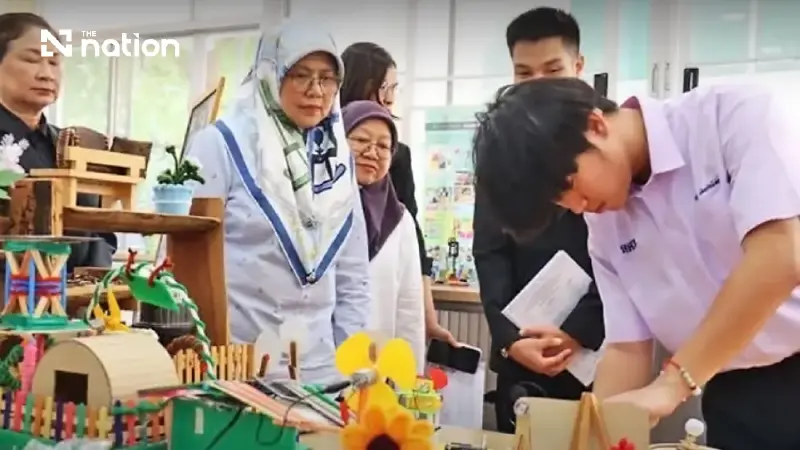


Early intervention for children with special needs, the need for qualified teachers and students’ reliance on artificial intelligence featured in the ministerial talks.
- Brunei's and Thailand's education ministers met in Bangkok to discuss closer cooperation in education.
- Key discussion topics included the need for qualified teachers, students' reliance on artificial intelligence, and special needs education.
- The focus on special needs was highlighted by the Brunei minister's visit to a school for the deaf to observe its teaching methods.
- The meeting was part of a working visit by Brunei's Education Minister in her capacity as the 2025-2027 President of the Southeast Asian Ministers of Education Organisation (SEAMEO) Council.
Brunei Darussalam and Thailand explored closer education cooperation in Bangkok, with discussions spanning the need for qualified teachers, students’ reliance on artificial intelligence and special needs education, particularly early intervention in early childhood education.
Brunei’s Education Minister Datin Seri Setia Dr Romaizah Mohd Salleh concluded her October 29–30, 2026 working visit after a programme that began with a courtesy call on Thai Education Minister Prasert Jantararuangtong.
The two ministers also considered Thailand’s education priorities.
Romaizah holds the 2025–2027 presidency of the Southeast Asian Ministers of Education Organisation (SEAMEO) Council.
Her Bangkok trip was part of a series aimed at reinforcing cooperation among member countries, combining courtesy calls on council members with visits to the organisation’s Secretariat, regional centres and networks.
Regional work was discussed at the SEAMEO Secretariat headquarters in Bangkok, where Romaizah met Datuk Dr Habibah Abdul Rahim, the Secretariat’s director, alongside representatives of the Secretariat and Bangkok-based regional centres.
Their exchange examined the centres’ mandates, programmes and initiatives, and their contribution to cooperation across education, science and culture.
Tropical medicine is SEAMEO TROPMED Thailand’s specialism; the
SEAMEO TROPMED Network covers that field as well as public health.
SEAMEO SPAFA promotes collaboration in archaeology and fine arts.
Higher education development falls within SEAMEO RIHED’s remit.
SEAMEO STEM-ED advances education in science, technology, engineering and mathematics, while SEAMEO SEPS promotes the Sufficiency Economy Philosophy to support sustainability.
The contributions highlighted in the discussion ranged from building capacity and sharing knowledge to advancing sustainable development across South-East Asia, reflecting the varied roles of SEAMEO’s specialised centres and networks.
Romaizah also learnt about education for deaf and hard-of-hearing students through a visit to Thungmahamek School for the Deaf, including its programmes and teaching and learning methods.
Inclusion and accessibility linked the school visit to her earlier talks with Prasert on special needs education.
Dr Shamsiah Zuraini Kanchanawati Tajuddin, permanent secretary (core education) at Brunei’s Ministry of Education, travelled with Romaizah.
She accompanied the minister as the 2024–2026 chair of the SEAMEO High Officials Meeting (SEAMEO HOM).
Source: The Star
