
Chinese Scholar Urges Thailand to Move Up Value Chain with China as Partner
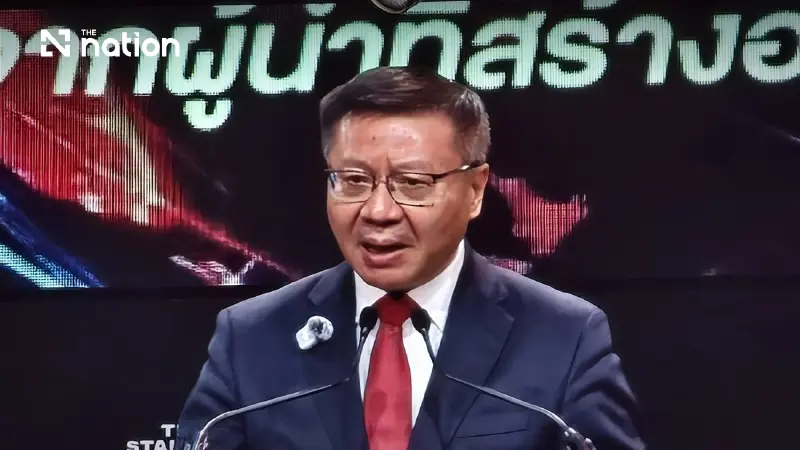


Zhang Weiwei tells The Standard forum Thailand should shift from low-cost assembly to green and digital industry, with Chinese investment to share know-how
- Chinese scholar Zhang Weiwei urges Thailand to transition its economy from low-cost assembly to an innovation-driven, green, and digital industry.
- He proposes China as a key partner, providing investment that goes beyond capital to include technology sharing, local R&D, and skills development to help Thailand move up the value chain.
- Promising areas for cooperation include green industries (like EVs), the digital economy (AI), upgraded infrastructure (such as the high-speed railway), and integrated supply chains.
- The goal is for Thailand to leverage its geography to become a connected regional platform, capturing more value from its industrial strategy.
Zhang Weiwei tells The Standard forum Thailand should shift from low-cost assembly to a green and digital industry, with Chinese investment to share know-how.
Thailand can turn its geography into a “connected, resilient” regional platform and climb the value chain with China as a long-term partner, a leading Chinese academic told business leaders on Wednesday (Noveber 4), while warning that Chinese investment must deliver more than capital and factories.
Zhang Weiwei, dean of the China Institute at Fudan University, delivered a keynote titled “The China Wave: Rethinking the Global Order” at the opening of “Economic Forum 2026: Reinvent Thailand”, hosted by The Standard.
“Let’s work together for a closer China-Thailand friendship and turn this into durable and shared prosperity,” Professor Zhang said.
Where Thailand and China can work together
Professor Zhang described Thailand as a natural hub at the heart of mainland Southeast Asia, with geographical connectivity, a stable industrial base, agricultural competitiveness and long-standing diplomatic credibility.
He identified the most promising areas for deeper cooperation:
Upgraded infrastructure, notably the China–Thailand high-speed railway.
Green industries, including electric vehicles (EVs) and renewable energy.
The digital economy, AI cooperation and smart agriculture.
Integrated regional supply chains linking China, the Mekong subregion and wider ASEAN.
Thailand also has potential, he said, to export premium farm products, medical services and cultural tourism, and to serve as a manufacturing and logistics gateway for investors.

He pointed to the scale of existing ties. China has been ASEAN’s largest trading partner for 17 consecutive years, and ASEAN has been China’s largest for six.
The China–ASEAN free trade agreement has been upgraded to version 3.0, with more emphasis on green energy, high technology, AI and supply chains.
China, he said, contributes roughly 30% of annual global economic growth and ASEAN 7–8%. China will act as a “firm supporter” of Thailand’s transformation, he said, by sharing technology, developing talent and opening its large consumer market.
What Thailand needs to reinvent
Echoing the forum’s theme, Professor Zhang said Thailand must reinvent its economic model, moving from low-cost assembly to innovation-driven, green and digital production. It must also reinvent its positioning, turning its location into a connected Asian platform.
He set out what Chinese investment should look like. It should not only bring capital and factory capacity but also help Thailand move up the global value chain, he said, through local research and development, joint technical laboratories, vocational training and skills development.
It should nurture local suppliers, small and medium-sized enterprises and domestic industrial clusters. Both sides, he said, must prioritise “responsible, sustainable and long-term cooperation”.
Such a partnership would give China a trusted regional production base, he argued, while Thailand captures more value from its own industrial strategy.

A contested global backdrop
Much of the speech framed this cooperation within China’s vision of global order, which he said rests on a “community with a shared future for mankind” and four initiatives advanced by President Xi Jinping on development, security, civilisation and governance.
He said these ideas have been put into practice in China–ASEAN relations, which he credited with almost five decades of peace and development despite occasional difficulties.
He contrasted that record with Europe, which he said has lost both peace and development since the Ukraine crisis, and criticised what he called a “rules-based order” imposed by some Western countries.
China, he said, wants a return to the principles of the United Nations Charter. He argued that Chinese security thinking is inclusive, not exclusive, and said Chinese strategic culture seeks to unite rather than divide.
China, he added, has the highest threshold among major powers for the use of force but “very clear red lines” and strong defence capabilities. For Thailand, the speech touched on the geopolitical tension that investors and policymakers are watching.
Professor Zhang acknowledged that US–China competition dominates discussion of the current big-power relationship. He argued that ASEAN’s principles of neutrality and centrality, which China supports, help the region avoid being forced to pick sides.
He also urged the European Union to “hurry up” in concluding its free trade agreement with Thailand, saying China and ASEAN are moving well ahead in building what he called the world’s largest single market.
Challenges and concerns
Professor Zhang’s remarks point to several tests for Thailand. The first is ensuring that Chinese investment brings skills and technology transfer and links to local firms, rather than simply adding assembly capacity.
The second is moving the economy up the value chain, which his closing message framed as a task for Thai policymakers as much as for Chinese partners.
The third is navigating great-power rivalry while keeping ties open with China, the EU and others.
He acknowledged that the world is “chaotic and uncertain" and argued that the China–ASEAN partnership offers “order and certainty”.
He closed by borrowing the forum’s refrain, saying the aim must be to move “from ambition to action, and from action to realising better ambition”.
