
Seven Thai industries target THB5.37 trillion in added revenue by 2030
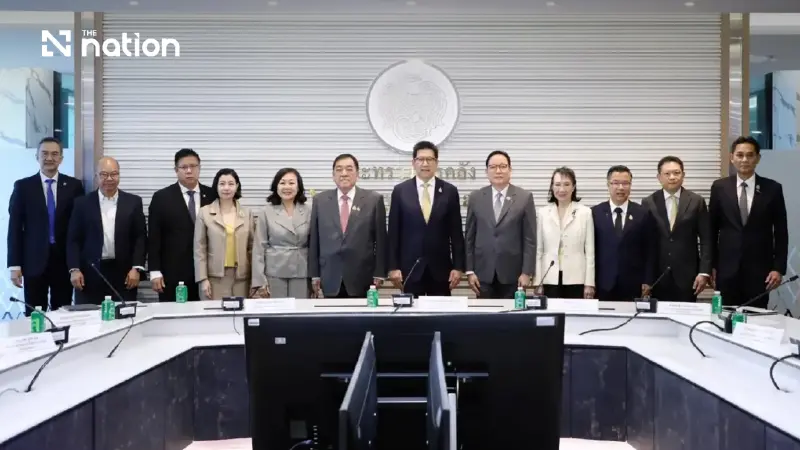


Seven private-sector groups propose a national action plan to generate THB5.37 trillion in additional revenue by 2030, with a government review set for December 2.
Thailand's private sector has proposed a restructuring plan covering seven major industries, with the aim of generating an additional THB5.37 trillion in revenue by 2030, attracting investment and improving the country's competitiveness in global markets.
The proposals form part of the Reinvent Thailand initiative, which aims to stimulate a new phase of economic growth as the country's traditional growth drivers lose momentum.

Deputy Prime Minister and Finance Minister Ekniti Nitithanprapas chaired discussions with the Joint Standing Committee on Commerce, Industry and Banking (JSCCIB) and representatives of the seven industries to assess progress and prepare the proposals for consideration at the national level.
The government plans to consolidate the recommendations into a national action plan ahead of a meeting of the Joint Public and Private Sector Committee for Economic Problem Solving (JPPCC), chaired by the prime minister, on December 2.

Ekniti outlined three objectives under what he described as Thailand's "Second Take-off": achieving annual economic growth of more than 3%, increasing investment from approximately 23% to 30% of gross domestic product (GDP), and placing Thailand among the world's 20 most competitive economies by 2030.
The National Economic and Social Development Council (NESDC) will review the relevant proposals and help align private-sector priorities with the country's economic development plans before they are advanced through the JPPCC.
"We will consolidate proposals from all seven industry groups into a national action plan before presenting them to the prime minister at the full JPPCC meeting scheduled for December 2," Ekniti said.
"The aim is to translate Reinvent Thailand into concrete results."
Seven industries outline revenue targets
Agriculture and processed food: THB860 billion
Poj Aramwattananont, chairman of the Thai Chamber of Commerce and the Board of Trade of Thailand, presented three approaches to strengthening the agriculture and processed food industries.
These include improving productivity while reducing production costs, upgrading agricultural and food products for premium markets to increase export value, and developing new industries based on high-value agricultural products.
The proposals aim to generate an additional THB860 billion in revenue.
Automotive: THB640 billion
Pimjai Leeissaranukul, chairwoman of the Federation of Thai Industries (FTI), proposed strengthening Thailand's automotive industry by supporting a range of vehicle technologies, including internal combustion engine vehicles and electric vehicles (EVs).
Her proposals also include attracting production of new EV models to Thailand, increasing the use of locally manufactured components and developing recycling industries for batteries and automotive parts.
The sector aims to generate an additional THB640 billion in revenue and reach vehicle production of 1.95 million units in 2030.
Smart electronics: THB500 billion
Panitarn Pavarolavidya, representing the electronics industry, proposed capitalising on demand associated with artificial intelligence (AI) and data centres to attract more manufacturing orders to Thailand.
The industry aims to ensure that no less than 50% of targeted components and equipment are produced domestically.
Other proposals include using investment in electricity infrastructure upgrades to create opportunities for Thai manufacturers and developing Thailand into a base for product testing and joint development.
The group also proposed encouraging consumers to replace old electrical appliances with energy-efficient models through a trade-in scheme, creating a market worth no less than THB30 billion annually.
Together, the measures are expected to generate an additional THB500 billion in revenue.

Tourism: THB500 billion
Chadatip Chutrakul, representing the tourism industry, proposed shifting Thailand's tourism strategy away from concentrating primarily on visitor numbers towards attracting travellers with greater potential to spend, invest and stay for extended periods.
The plan also calls for stronger links between major tourist destinations and secondary cities to distribute economic opportunities more widely.
Five pilot areas have been identified: Bangkok, the Eastern Economic Corridor (EEC), Phuket, Chiang Mai and Nakhon Ratchasima.
These areas would be developed as attractive destinations for tourism, residential living and investment, with the sector targeting an additional THB500 billion in revenue.
Medical services and wellness: THB1.1 trillion
Sarunyu Chanet, representing the medical and wellness industry, proposed expanding Thailand's medical services and wellness businesses into international markets.
The group aims to generate no less than THB100 billion annually from foreign patients while increasing the proportion of Thai medicines and herbal products used in government procurement from 30% to 50%.
It also aims to raise pharmaceutical exports to THB11.3 billion per year, supported by continued research and development and improvements in workforce capabilities.
The combined proposals carry an additional revenue target of THB1.1 trillion, the largest among the seven industries.
Retail and trade: THB800 billion
Wallaya Chirathivat, representing the retail industry, called for measures to establish fairer competition between domestic and imported products.
Her proposals include applying the same Thai Industrial Standards Institute (TISI) and Food and Drug Administration (FDA) requirements to goods produced in Thailand and those imported from overseas.
The group also proposed developing Thai brands, identifying promising products for international expansion and improving distribution networks and cold-storage facilities to connect Thai producers with global markets.
The retail and trade sector aims to generate an additional THB800 billion in revenue.
Creative economy: THB970 billion
Kamthorn Sila-On, representing the creative economy, proposed increasing the value of Thailand's gems and jewellery industry through improved design capabilities and the development of Thai brands.
The plan also focuses on strengthening the country's ownership of intellectual property in television series, games, content production and other creative industries.
Technology and AI would be used to expand access to overseas markets, while the overall value of the creative economy would be targeted to grow by an average of 9% annually.
The sector aims to generate an additional THB970 billion in revenue.
National action plan to support broader economic growth
The Thailand Board of Investment (BOI) will coordinate with four JPPCC subcommittees and private-sector representatives to combine the seven industries' proposals into a national action plan.
Beyond generating additional revenue, the initiative is intended to ensure that small and medium-sized enterprises (SMEs), start-ups, farmers and Thai workers benefit from the restructuring.
The objective is to create opportunities for these groups to develop alongside emerging industries, ensuring that the proposed transformation strengthens Thailand's economy and competitiveness while delivering broader economic benefits.
