
Thai Chamber Pitches Five-Point Plan to Deepen Sino-Thai Trade and SME Investment
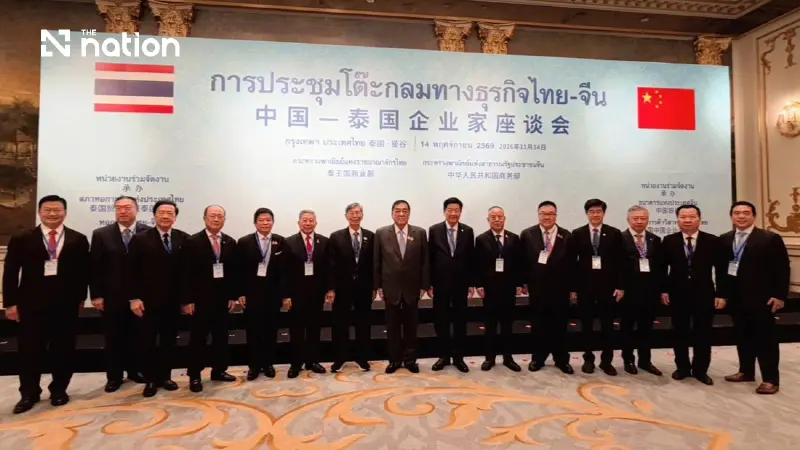


The Thai Chamber of Commerce calls for a joint investment centre, single-inspection customs, and expanded agri-food and tourism ties at Bangkok forum
- The plan proposes establishing a joint Thailand-China Investment Coordination Centre to facilitate business matching and help Thai SMEs invest in China.
- It calls for streamlining market access for Thai SMEs by creating a centralized channel to clarify Chinese import regulations and standards.
- A key point is to accelerate logistics by fast-tracking rail connectivity and implementing a "Single Inspection" customs system to reduce costs.
- The chamber advocates for expanding agri-food ties through Chinese co-investment and technology transfer in Thailand's agricultural sector.
- The proposal also aims to boost two-way tourism and support local SMEs through joint travel facilitation and upgraded safety standards.
The Thai Chamber of Commerce calls for a joint investment centre, single-inspection customs, and expanded agri-food and tourism ties at Bangkok forum.
The Thai Chamber of Commerce has submitted a five-point economic blueprint to the government leaders of Thailand and China, aiming to transition bilateral ties from traditional trade toward deeper joint investment, integrated supply chains, and expanded market access for small and medium-sized enterprises (SMEs).
Speaking following the Thailand–China Business Roundtable at the Mandarin Oriental, Bangkok on Saturday (14 November), Chamber Chairman Dr Poj Aramwattananont said the private sector is pushing for concrete mechanisms to unlock new commercial opportunities amid global economic uncertainty.
The high-level forum brought together government leaders and senior business executives from both nations—including Thai-Chinese Chamber of Commerce President Narongsak Putthapornmongkol and representatives from major Chinese financial institutions such as the Bank of China.
The discussions built directly upon Friday’s Thailand–China Business Leaders Exchange and two years of sustained coordination backed by the Thai government and the Chinese Embassy in Bangkok.


Five Pillars for Bilateral Growth
To elevate economic partnership between the two countries, Dr Poj outlined five core proposals:
Establishing a Thailand–China Investment Coordination Centre: Creating a dedicated hub—backed by the Chamber, the Thai–Chinese Chamber of Commerce, and the Thailand Board of Investment (BOI)—to facilitate business matching, identify strategic investment zones, and help Thai SMEs replicate the success of major Thai conglomerates like CP Group, TCP Group, Banpu, and Cho Heng in China.
Streamlining Market Access: Setting up a centralised coordination channel with Chinese regulators to provide clear guidance on import rules, product standards, and entry requirements, lowering regulatory hurdles for Thai SMEs. This builds on the commercial momentum of the Thailand–China Cooperation Expos held in 2025 and 2026.
Accelerating Logistics and Rail Connectivity: Fast-tracking land and maritime infrastructure—specifically linking the Thailand–Laos–China railway—alongside adopting a "Single Inspection" cross-border customs framework to eliminate redundant checks and slash regional logistics costs.
Expanding Agri-Food and Food Security Ties: Encouraging Chinese co-investment and technology transfer across Thailand’s agricultural and food-processing sectors to boost productivity, add value to Thai produce, and strengthen long-term regional food security. Boosting Tourism and
Travel Confidence: Implementing joint travel facilitation and upgraded safety standards to stimulate two-way tourism, driving revenue directly to local hotels, restaurants, service providers, and community-based SMEs.

Moving Beyond Traditional Trade
Dr Poj emphasised that lowering operational costs and opening new channels for smaller enterprises will be critical to maintaining the competitiveness of both economies.
"China is one of Thailand's most vital economic partners," Dr Poj said. "The Thai Chamber of Commerce wants to see bilateral cooperation move beyond the simple buying and selling of goods toward joint investment, supply chain integration, technology transfer, and shared growth for SMEs in both countries. The five proposals we presented today are initiatives the private sector stands ready to turn into tangible results."
The Chamber confirmed it will continue working closely with the Thai–Chinese Chamber of Commerce, the Thai–Chinese Enterprises Association, and relevant state agencies to drive the implementation of the proposals toward sustainable mutual growth.


