
China and Thailand expand cooperation through eight documents
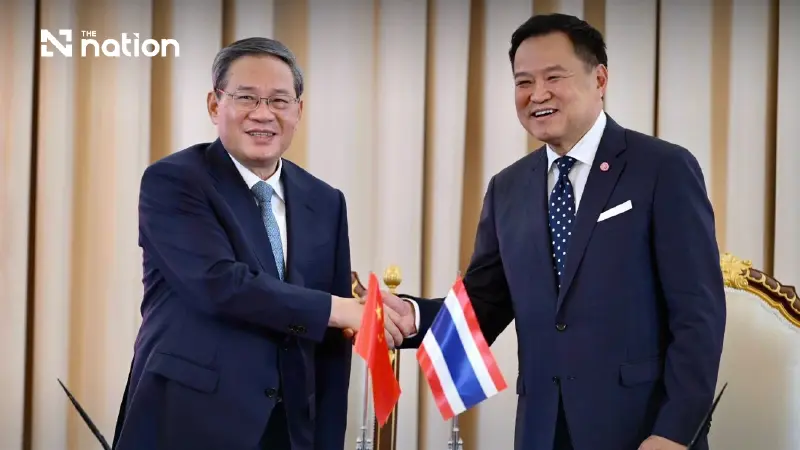


Anutin Charnvirakul and Li Qiang witnessed the signing and exchange of eight cooperation documents in Bangkok on security, fruit exports, automotive technology and training.
- Thailand and China have signed eight documents to expand their strategic cooperative partnership, covering areas such as security, trade, and education.
- The agreements include new protocols to facilitate the export of Thai agricultural products, specifically fresh durian and salacca (snake fruit), to China.
- Cooperation in the automotive industry will be enhanced, with a focus on electric vehicles, battery production, and technology transfer to strengthen supply chains.
- Security ties have been bolstered through a memorandum on cyber security and a commitment to tackle transnational crime, particularly online scams.
- Other agreements cover vocational education, measurement standards for trade, food safety, and the improvement of consular services between the two countries.
Thai Prime Minister and Interior Minister Anutin Charnvirakul and Chinese Premier Li Qiang witnessed the signing and exchange of eight cooperation documents at Government House in Bangkok on Friday (November 13), covering security, agricultural exports, automotive technology, vocational education and other areas.
The ceremony took place at the Santi Maitri Building at 6.30pm, following bilateral talks between the two leaders. Li’s three-day official visit is the first such visit to Thailand by a Chinese premier in seven years. It also follows Anutin’s visit to China in July, with both governments aiming to advance their comprehensive strategic cooperative partnership.

Security and action against online scams
During their bilateral discussions, Anutin welcomed progress on security cooperation, including the renewal of a memorandum of understanding (MoU) on cyber security.
Thailand also expressed readiness to host the first meeting between the two countries' foreign and defence ministers in the “2+2” format in early 2027 and to accelerate preparations for a new five-year joint action plan.
The Thai prime minister called for stronger cooperation against transnational crime, particularly online scams, through the exchange of investigative information and intelligence on illicit financial flows.
He also emphasised assistance for victims, the safety of residents and tourists, and the provision of accurate information to strengthen confidence in travel between the two countries.

Investment, trade and regional connectivity
Anutin encouraged Chinese investment that would create jobs, use Thai materials and components, transfer technology and strengthen local workforce skills.
Priority industries include electric vehicles, clean energy, semiconductors, cloud computing and space technology.
He also stressed the importance of transparent business practices and action against illegal operators and companies using Thai nominees to conceal foreign ownership.
On trade, Thailand sought faster registration of Thai geographical indication products in China and better access for micro, small and medium-sized enterprises to Chinese e-commerce platforms.
Anutin also followed up on the sale of 500,000 tonnes of Thai rice, of which an initial 40,000 tonnes have already been sold.
Transport connectivity featured prominently in the discussions, particularly railway links between China, Laos and Thailand, with potential extensions towards Malaysia and Singapore.
Both countries also explored closer financial cooperation, including links between their payment systems and cross-border QR code payments to facilitate business transactions and tourism.

Water pollution and environmental cooperation
The two leaders discussed strengthening cooperation to address transboundary water pollution, particularly in the Mekong–Lancang region.
China expressed willingness to provide technical experts and monitoring equipment to help Thailand investigate, monitor and address water quality problems.
Thai and Chinese agencies and academic institutions also plan to establish a joint laboratory to test water quality in northern Thailand.
The proposed cooperation includes information sharing, technology transfer, technical training and environmentally responsible mining in upstream areas to reduce risks to natural resources, public health and local communities.

Cultural ties and regional cooperation
Anutin sought Chinese support for Thailand's bid to inscribe Chud Thai, traditional Thai dress, on UNESCO's Representative List of the Intangible Cultural Heritage of Humanity.
The leaders also discussed expanding educational, youth, academic and museum exchanges to strengthen understanding between people in both countries.
Other topics included food and energy security, cooperation within the Association of Southeast Asian Nations, regional peace and stability, the safe and accessible development of artificial intelligence, and efforts to bring the upgraded ASEAN–China Free Trade Area 3.0 agreement into force.

Eight cooperation documents signed or exchanged
The eight documents cover the following areas:
- Security cooperation: An MoU between the Thai and Chinese foreign ministries promotes cooperation under China's Global Security Initiative. It aims to strengthen strategic security ties, mutual trust and cooperation in maintaining regional and international peace and stability.
- Measurement standards: An MoU between Thailand's Ministry of Commerce and China's State Administration for Market Regulation seeks to improve cooperation on weights and measures. The agreement aims to increase accuracy in commercial transactions, reduce trade discrepancies and strengthen confidence among businesses and consumers.
- Durian exports: A phytosanitary protocol between Thailand's Ministry of Agriculture and Cooperatives and China's General Administration of Customs establishes requirements for fresh Thai durian exports. It is intended to strengthen quality and safety standards, improve import inspections and reduce the risk of shipment suspensions.
- Salacca exports: A separate phytosanitary protocol establishes requirements for exporting fresh Thai salacca, also known as snake fruit, to China. The agreement is expected to open new market opportunities, with projected export earnings of THB76 million or more annually, while encouraging improvements in farming and packing standards.

- Food safety: A cooperation framework for import and export food safety among countries participating in China's Belt and Road Initiative promotes the exchange of information, technical knowledge and food safety practices. It aims to improve food safety standards, reduce trade barriers and create further opportunities for Thai agricultural and food exports.
- Automotive industry: An MoU between Thailand's Ministry of Industry and China's Ministry of Industry and Information Technology covers electric and smart vehicles, battery production and recycling, technology transfer, industrial standards and supply chains. It is intended to attract investment and strengthen the participation of Thai manufacturers and component suppliers in global automotive supply chains.
- Vocational education: An MoU between the two countries' education ministries focuses on vocational training, curriculum development, teaching methods and the establishment of training centres. It also provides for exchanges involving students, teachers and specialists to improve workforce skills and support future industries.
- Consular services: An exchange of letters between Thailand's Ministry of Foreign Affairs and the Chinese Embassy in Thailand concerns staffing arrangements at Chinese consulates-general in Thailand and Thai consulates-general in China. It is intended to improve consular administration and services for citizens as bilateral trade, investment and travel expand.

The Thai government described the eight cooperation documents and wider discussions as steps towards stronger economic ties, improved security cooperation and practical benefits for businesses and communities in both countries.
