
Japanese researchers report world’s first plant–animal hybrid cells
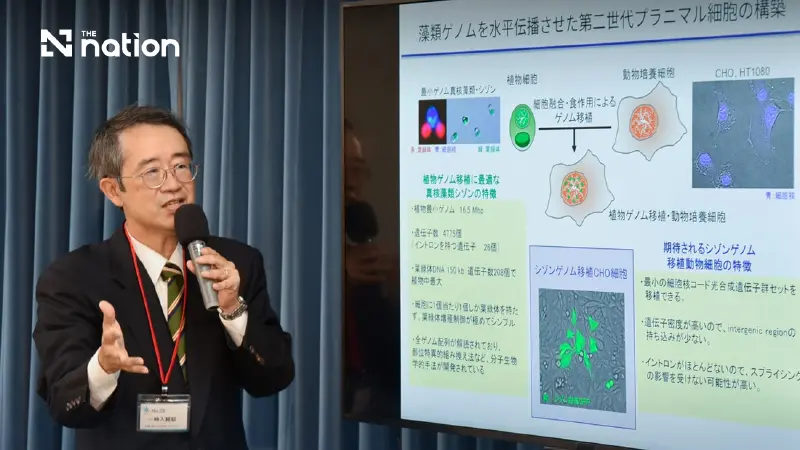


The new cells cannot yet photosynthesise, but researchers hope future developments could help produce medicines and cultured meat.
- A Japanese research team created the world's first hybrid cells by integrating the entire DNA of a single-celled alga into the chromosomes of cultured animal cells.
- The resulting "planimal" cells were stable and able to divide and multiply for over 150 generations, behaving much like ordinary animal cells.
- Despite the DNA integration, the hybrid cells did not gain photosynthetic abilities because the algal DNA was suppressed and its chloroplasts broke down during the fusion process.
The entire DNA of the single-celled alga Cyanidioschyzon merolae has been integrated into the chromosomes of cultured animal cells in a Japanese experiment. The team describes the resulting “planimal” cells as the world’s first plant-animal hybrids.
The hybrids showed no new photosynthetic capability. They continued to function as animal cells because the algal DNA was suppressed and the chloroplasts, the structures that carry out photosynthesis, broke down in the fusion process.
In culture, the hybrids underwent more than 150 generations of division and multiplication, behaving much like ordinary cultured animal cells.
“We hope to introduce chloroplasts and activate C. merolae genes to generate oxygen through photosynthesis,” said Sachihiro Matsunaga, a professor at the University of Tokyo’s Graduate School of Frontier Sciences.
Medicines and cultured meat are possible future applications, provided photosynthesis can be used to grow large quantities of cells producing useful animal and plant proteins.
The work extends an effort Matsunaga began in 2018, when he proposed developing such hybrids. For the experiment, he and his colleagues used cells originating from Chinese hamster ovaries, a type of animal cell used to manufacture medicines and other products.
C. merolae has a very small genome and, as a primitive alga, no cell wall. This sets it apart from plant cells, which have a wall outside the cell membrane.
Matsunaga and his colleagues used polyethylene glycol in a conventional cell-fusion procedure designed to deliver the algal DNA into the animal cell nucleus. The procedure had a low success rate, but produced hybrids in which the alga’s entire DNA became part of the animal chromosomes.
Once incorporated, the algal DNA was kept inactive through methylation, a mechanism that served as an “off” switch for gene expression.
The research brought together the University of Tokyo, the Institute of Science Tokyo, Kindai University and other institutions. Their findings appeared in the international journal Nature Communications.

[Copyright The Jiji Press, Ltd.]
