
Anutin and Li lead Thai–China investment talks on trade upgrade and 2030 high-speed rail target
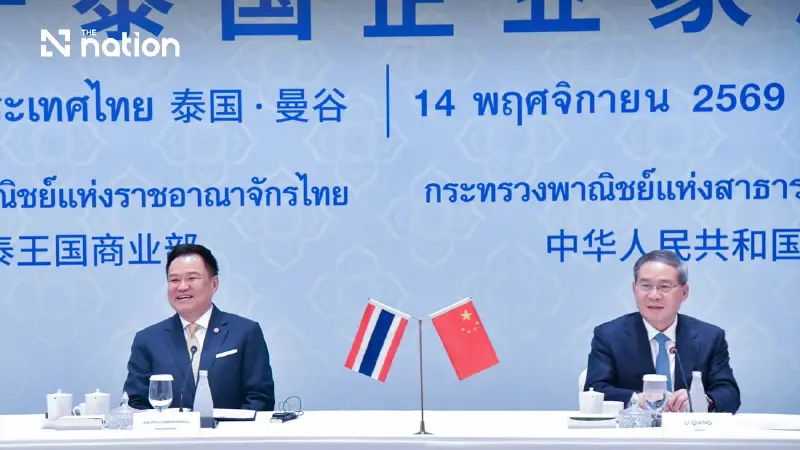


At a Bangkok roundtable with Li Qiang, Anutin invites Chinese investment in electric vehicles, food and technology and pledges faster approvals.
- Thai Prime Minister Anutin Charnvirakul and Chinese Premier Li Qiang led talks to accelerate the ASEAN–China Free Trade Area (ACFTA) 3.0 Upgrade Protocol.
- Thailand reaffirmed its commitment to completing and opening the first phase of the Thai–Chinese high-speed railway by a 2030 target, with plans for a second phase to connect with Laos and China.
- The discussions focused on boosting Chinese investment in Thailand, with Anutin noting a significant increase in investment applications from Chinese companies, particularly in electric vehicles, agriculture, and technology.
- Anutin pledged government support to facilitate investment through faster approvals and developing a skilled workforce to strengthen Thailand's position as an investment hub.
Prime Minister and Interior Minister Anutin Charnvirakul called for an upgraded regional trade agreement with China to take effect swiftly and reaffirmed a 2030 opening target for the first phase of the Thai–Chinese high-speed railway at a business roundtable on November 14, 2026.
Anutin delivered opening remarks alongside Chinese Premier Li Qiang at the Mandarin Oriental hotel in Bangkok. More than 200 participants attended, including deputy prime ministers, government agency heads and business leaders from both countries, during Li’s official visit as a guest of the Thai government.

Anutin urged the two countries to develop their trading relationship into a partnership built on joint planning and investment, combining their strengths to create business opportunities and improve people’s incomes.
“This meeting is not merely about reaffirming the good relations between Thailand and China,” he said. “It is about discussing how both countries can use those relations to deliver tangible benefits for their economies and people.”
“Thailand and China face the same challenges, including the environment, technology, ageing societies and opportunities for younger generations.”
“No country or business can achieve strong growth without cooperating with other countries and building partnerships across a broad range of areas.”

Trade upgrade and regional rail connections
Anutin pledged to work with China to accelerate the entry into force of the ASEAN–China Free Trade Area (ACFTA) 3.0 Upgrade Protocol, supporting an open trading system between China and the Association of Southeast Asian Nations.
Thailand also aims to complete and open the first phase of the Thai–Chinese high-speed railway by 2030. Preparations would continue for the second phase to connect Thailand, Laos and China, making cross-border travel and freight movements easier.
Anutin argued that improved connections would strengthen Thailand’s position as a base for Chinese investors serving an ASEAN market of around 700 million people.
Thailand’s location at the centre of the region could help connect China with ASEAN and link regional economies with global markets, he added. The country remained open to trade, tourism, investment, technology and cooperation with partners from all directions.

Chinese investment and Thai supply chains
Anutin described China as a longstanding partner and pointed to investment promotion applications as evidence of continued business confidence.
“Since this government began work, investment from China in Thailand has continued to increase,” he said.
“In the first nine months of this year, Chinese companies submitted applications for investment promotion for nearly 500 projects, the highest number of any country and more than one-third of all foreign investment projects.”
“These figures reflect mutual trust. The government’s task is to turn that trust into successful investments.”
Electric vehicles and agriculture and food offered two clear opportunities to deepen cooperation, Anutin told participants.
Chinese vehicle manufacturers had already established production bases in Thailand. The next step was to connect those investments more closely with Thai component makers and other local businesses, strengthening domestic supply chains and developing Thailand as a manufacturing base for exports.
In agriculture and food, Thailand could contribute quality raw materials and products popular with Chinese consumers, while China offered processing technology, logistics systems and market access. Combining those strengths would help both sides generate more value from investment.
Thailand was also ready to develop its role as a medical and healthcare centre serving the needs of ageing societies worldwide.

Faster approvals and workforce development
Anutin identified speed, skilled people and national strength as the three foundations of Thailand’s growth strategy.
Recognising that delays impose costs on businesses, the government would use the Board of Investment’s (BOI) Thailand FastPass mechanism to coordinate major projects. It would also advance proposed “Super License” legislation to help suitable investments begin operating sooner.
Modern factories, data centres and technology businesses all required skilled workers, he noted. Thailand would therefore strengthen engineering, digital and artificial intelligence (AI) skills, while inviting Chinese companies to develop curricula with Thai universities and colleges.
Anutin maintained that Thailand already had an industrial base, capable businesses and skilled workers on which to build a new period of growth. The government’s responsibility was to turn technology transfer, new skills and partnerships into commercial opportunities and public incomes.
Businesses would lead that expansion, with the government facilitating investment, removing obstacles and helping projects move forward more quickly.
Energy security and long-term partnerships
The government would strengthen energy security, expand alternative and clean energy, and modernise regulations to support data centres, semiconductors and AI, Anutin said.
Those industries would develop alongside established Thai strengths in automotive manufacturing, electronics, finance and banking, agriculture and food, and medical and healthcare services. Investment in infrastructure and workforce development would proceed together.
Security cooperation was another priority. Anutin pledged closer Thai–Chinese action against transnational crime and scam networks to protect residents, tourists and legitimate businesses, stressing that investors needed freedom, safety and long-term confidence.
Further opportunities included clean energy, green industries, digital technology, AI and space exploration.
Anutin encouraged younger Chinese people to view Thailand as a place to invest and innovate, alongside its appeal as a tourism destination. Thailand would also prepare its younger generation to pursue learning, business and new partnerships in China.
Thai companies were encouraged to become joint investors and technology development partners with Chinese businesses in both markets. The government would support those partnerships with clearer, more modern rules and practical measures to remove barriers.
“Premier Li Qiang and I will jointly set the direction of cooperation at the policy level,” Anutin said.
He described the meeting as a further starting point for public and private cooperation to build opportunities for future generations and create lasting prosperity for both countries.
