
Thailand confident Toyota will keep production base despite regional competition
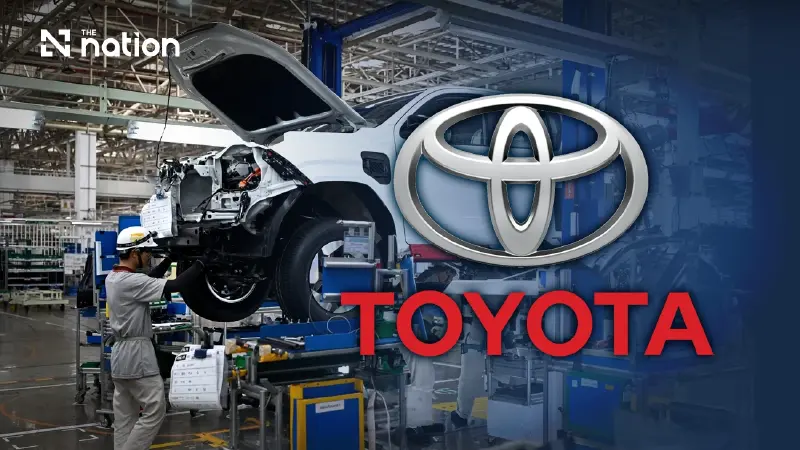


Thailand’s 30-year automotive supply chain and planned tax changes are expected to help retain Toyota and other Japanese manufacturers.
- Thailand's confidence is rooted in its deeply established automotive supply chain, developed over more than 30 years, which would be difficult for a manufacturer to replicate elsewhere.
- The Thai government is actively working to retain manufacturers by restructuring taxes and proposing lower import duties on components to make local production more cost-effective.
- Despite a downturn in passenger car exports, the country remains a strong global production hub for one-tonne pick-up trucks, a segment that saw 50% growth.
- Thailand is also implementing forward-looking EV promotion policies that require companies receiving incentives to eventually establish manufacturing facilities in the country.
Thailand’s economic planning agency is confident that Toyota will not relocate its production base from the country, citing a well-established automotive supply chain developed over more than three decades.
Danucha Pichayanan, secretary-general of the National Economic and Social Development Council (NESDC), was responding to Indonesia’s efforts to attract greater investment from major carmakers, including Toyota, as it seeks to strengthen its automotive industry and compete with Thailand as a regional production hub.
Although Toyota already invests in and manufactures certain vehicle models in Indonesia, Danucha said Thailand continued to benefit from longstanding economic ties with Japan.
Japanese carmakers have invested continuously in Thailand, creating an automotive supply chain with considerable breadth and depth over more than 30 years.
Relocating production to another country would therefore not be straightforward unless the destination could offer a manufacturing ecosystem as comprehensive and efficient as Thailand’s.
“We remain confident that Japanese carmakers continue to regard Thailand as a highly efficient production base with strong capabilities in every area,” Danucha said.

Finance Ministry plans tax changes to support local production
Amid intensifying regional competition for automotive investment, the Finance Ministry is preparing measures to restructure taxation and improve the competitiveness of companies that invest in manufacturing operations in Thailand.
One proposed measure is a reduction in import duties on components brought in from overseas, helping manufacturers with Thai production bases manage their costs more effectively.
The approach would strengthen the position of companies that invest in factories and manufacture products domestically, compared with businesses that import fully assembled goods for sale without establishing production operations in Thailand.
The proposed changes reflect the government’s intention to use the tax system as a tool to encourage investment and create fairer competition between domestic manufacturers and importers.
Import-duty revenue not the main consideration
Addressing concerns that lower import duties on components could reduce government revenue, the NESDC assessed that the impact would be limited.
Thailand has free trade agreements with several countries, while changes in the structure of global trade have already brought import duties on many goods down to relatively low levels.
The government is therefore giving greater weight to other economic benefits, particularly retaining and creating domestic jobs, increasing export capacity and generating more value within Thailand.
Maintaining automotive production in the country would support economic activity throughout the supply chain, from component manufacturers and smaller businesses to logistics providers and industrial workers.
Danucha said these broader benefits would have a greater effect on the overall economy than concentrating solely on preserving revenue from import duties.
Passenger car exports fall 42.4% in second quarter
Thailand’s automotive industry nevertheless remains under pressure from the global transition towards new vehicle technologies.
Passenger car exports contracted by 42.4% in the second quarter of 2026.
A key factor was declining demand for vehicles powered by internal-combustion engines, or ICE vehicles, as several trading partners introduced stricter environmental requirements.
These included tighter carbon standards and measures intended to reduce greenhouse-gas emissions.
The global vehicle market is also facing stronger competition from electric vehicles, which are reshaping the industry and taking market share from conventional passenger cars.
The pressures caused overall automotive production in Thailand to fall by 7.2% in the second quarter, while capacity utilisation declined to 57.47%.
The figures underline the challenge facing Thailand as it seeks to preserve the competitiveness of its conventional automotive industry while adapting to the global shift towards EVs and more demanding environmental standards.
One-tonne pick-ups grow by 50%
Not every segment of the automotive market has weakened, however.
Thailand’s one-tonne pick-up segment, one of the country’s leading automotive products, remained strong and expanded by 50%.
The growth reflects Thailand’s position as a major global production base for pick-up trucks, supported by a component-manufacturing network and industrial ecosystem developed over several decades.
The segment presents both an opportunity and a challenge for Thailand: the country must retain the strengths of its established production base while accelerating its transition towards new automotive technologies.
EV incentives require production in Thailand
Thailand’s EV promotion measures include requirements for companies receiving incentives to establish manufacturing facilities in the country to compensate for vehicles initially imported under the schemes.
The mechanism is intended to ensure that support for EV imports during the early stages of market development eventually leads to the creation of genuine domestic production capacity.
Thailand’s competition to retain its automotive manufacturing base therefore goes beyond preserving existing ICE vehicle factories.
The country must also rapidly develop an ecosystem covering EVs, batteries, electronics, emerging technologies and next-generation automotive components.
The central challenge is to ensure that the supply chain Thailand has built over more than 30 years can adapt and continue growing as the global automotive industry changes.
